
When your child is unraveling before your eyes—missing school, melting down over simple tasks, isolating from friends—you know it’s not just a rough patch. You know it’s not “typical teen stress.” You know, deep down, something’s wrong.
But you also might feel frozen. Where do you even start? Who do you trust? How do you know what kind of help is right? If you’re the parent of a young adult in crisis, you’re likely carrying fear, confusion, guilt—and an urgent need for real answers.
You’re not alone in that. And the first step doesn’t have to be perfect. It just needs to be real. A structured anxiety treatment program in Massachusetts might be what your child—and your family—needs to stabilize, heal, and rebuild.
Why Anxiety Can Spiral Into Crisis for Young Adults
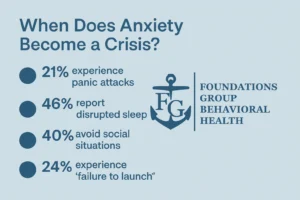
Anxiety is more than nerves before a test or occasional worry. It becomes a crisis when:
- Panic attacks begin disrupting daily life
- Anxiety leads to academic failure or dropping out
- A young person becomes too scared to leave the house
- Sleep disappears, eating habits fall apart, or self-harm surfaces
Anxiety disorders are among the most common mental health diagnoses in adolescents and young adults—but they’re also one of the most frequently downplayed. Families wait, hoping their child will outgrow it. They tell themselves, “Maybe it’s just a phase.”
But when anxiety goes untreated, it can rapidly escalate. That’s not a parenting failure. It’s a signal. And it’s okay to respond with urgency.
What Is an Anxiety Treatment Program?
An anxiety treatment program is a clinical, structured service designed for people whose anxiety has become too severe for traditional outpatient therapy.
This isn’t just about getting someone to talk about their feelings. It’s about interrupting the spiral, stabilizing the crisis, and giving your child tools, support, and safety they can’t currently access on their own.
At Foundations Group, that includes:
- Individual therapy focused on understanding anxiety triggers and building emotional regulation
- Group therapy for skill-building using evidence-based modalities like CBT and DBT
- Family therapy that helps parents support their child without over-functioning or walking on eggshells
- Medication management when appropriate, with careful psychiatric oversight
- Crisis support and stabilization, including structured daily routines and clinical oversight
This level of care is often called a partial hospitalization program (PHP) or intensive outpatient program (IOP), depending on intensity.
How Do I Know It’s Time for a Higher Level of Care?
Ask yourself:
- Has my child stopped functioning in daily life—school, work, hygiene, social engagement?
- Are they showing signs of intense avoidance, panic, or self-harm?
- Have they withdrawn from everyone—including me?
- Do I feel scared for their safety or future if we don’t do something soon?
If the answer to even one of those questions is yes, it’s time to look into a professional anxiety treatment program.
What Makes Foundations Group Different?
We specialize in supporting young adults who are experiencing acute anxiety, panic disorders, and related mood issues. We’re not just treating a diagnosis—we’re holding space for a human being who is scared, stuck, and often ashamed of how “out of control” things feel.
Here’s what families tell us they appreciate most:
- We don’t minimize the crisis. If your child needs more than talk therapy, we say so. We don’t send families in circles.
- We partner with parents without blaming them. Your love isn’t the problem. Our role is to help you support your child without burning out or carrying it all.
- We know the Cape Cod system. Our Barnstable County-based anxiety program is connected to local schools, providers, and outpatient supports for continuity of care.
- We welcome clients from Falmouth, MA, and surrounding areas who need structured, trauma-informed care without the disruption of long-distance treatment.
Common Myths About Anxiety Treatment Programs (And the Real Truth)
Myth: My child isn’t “sick enough” for a program like this.
Truth: You don’t need a hospitalization or suicide attempt to qualify for structured anxiety treatment. Programs are designed for early intervention, too.
Myth: If I suggest treatment, they’ll think I’m giving up on them.
Truth: Framing treatment as an act of love, not punishment, can transform the conversation. You’re not giving up—you’re showing up with stronger tools.
Myth: Once you start medication or intensive therapy, it’s forever.
Truth: Treatment programs are designed to be time-limited. The goal is stabilization, skill-building, and then a return to regular life with better support in place.
What Does Recovery Look Like?
Recovery from severe anxiety doesn’t mean never feeling anxious again. It means:
- Being able to attend school or work without panic shutting them down
- Learning how to navigate stress without spiraling
- Rebuilding self-esteem, confidence, and relationships
- Trusting themselves again—and giving you space to exhale
Recovery looks like a young person who starts to believe they’re not broken. And a parent who doesn’t feel like they have to fix everything alone.
Local Care Can Make a Big Difference
If you’re based on the Cape, proximity matters. Having access to a quality anxiety treatment program in the community means your child can:
- Maintain school involvement or outpatient support
- Build local peer support
- Transition into lower levels of care more smoothly
We’ve worked with schools, guidance counselors, pediatricians, and family doctors throughout Barnstable County. Families from Falmouth, MA often tell us the local connection helps reduce the disruption and increases trust.
Your Child Deserves Real Help—And So Do You
Anxiety is treatable. Even when it feels like your child has fallen off the edge, there’s still a path forward.
But you don’t have to map it alone. Whether you’re just starting to worry—or you’ve been losing sleep for months—it’s okay to take the next step. You’re not overreacting. You’re responding.
And that response could change everything.
Frequently Asked Questions: Anxiety Treatment Programs
How long does an anxiety treatment program last?
It varies, but most structured programs last 4–8 weeks. The exact length depends on your child’s needs and progress.
Will my child be able to go to school while in the program?
Yes, especially in intensive outpatient (IOP) programs. Some services run after school, while partial hospitalization (PHP) programs may require a temporary academic pause with school coordination.
Is medication required?
No. Medication is never forced. Our psychiatric team will discuss options, but you and your child are part of that decision-making process.
What if my child refuses to go?
Resistance is common—and it’s often rooted in fear, not defiance. We can help you with language and support to approach the conversation with compassion and clarity.
Does insurance cover anxiety treatment programs?
Most commercial plans cover PHP and IOP services. We’ll verify your insurance and explain your benefits before starting.
Ready to Talk?
Call 888-685-9730 or visit our Anxiety Treatment Program services in Cape Cod, MA to learn how we can help your child stabilize, heal, and move forward with hope.