
It didn’t fall apart dramatically. There was no rock bottom. Just a slow fade—like someone kept dimming the lights in my life, one notch at a time. Until I was sitting in a room full of people, smiling politely, and thinking, Why do I feel like I’m not here?
I’d been through treatment before. Years ago. And it worked. Or at least I thought it had—until everything started slipping again.
So if you’re someone who’s been stable for a while but lately feel like you’re running on fumes, I want to tell you something: You’re not broken. And going back to treatment doesn’t mean you failed. It means you’re paying attention.
That’s what I did. And Foundations Group Behavioral Health helped me feel like me again.
Learn more about their depression treatment program here.
I Didn’t Realize I Was Slipping—Until I Couldn’t Feel Joy
There’s a version of depression that doesn’t scream. It just silences things.
At first, I thought I was just tired. Work stress, pandemic hangover, a few bad weeks—nothing serious. But it didn’t stop. I was getting through the day, but not connected to it. Meals tasted bland. Music didn’t move me. I wasn’t in pain—I was in pause.
And because I wasn’t “a mess,” I convinced myself it would pass.
Spoiler: it didn’t.
I Had Tools—But They Stopped Working
I’d done the work before. Therapy, medication, even group sessions. I knew how to journal, how to regulate, how to reframe. But this time, the tools felt… dull. Like trying to saw through concrete with a butter knife.
And the more I failed to “fix” it on my own, the more ashamed I felt.
What’s wrong with me? I should know how to do this by now.
That’s the lie depression whispers when you’re in the alumni phase. That you should be beyond needing help. That if you’re not thriving, it must be your fault.
It’s not.
Returning to Treatment Felt Like Admitting I Failed—Until It Didn’t
I almost didn’t call. I kept hovering over the Foundations Group website, wondering if I’d look foolish for asking to come back.
But when I did reach out, the response was simple and kind:
“We’re glad you called. Let’s figure this out together.”
That first intake appointment wasn’t about judgment—it was about reconnection. Not to a program, but to myself. And that changed everything.
The Second Time Around Wasn’t About “Starting Over”—It Was About Deepening
I didn’t need to go back to square one. I needed to plug back into something structured, steady, and emotionally real.
This time, I came in knowing my story. I didn’t have to explain from scratch. The clinicians saw my past experience as a strength, not a liability. They helped me tune into patterns I’d missed, gently challenge some of the coping I’d outgrown, and build deeper emotional resilience—not just crisis prevention.
It felt like getting a tune-up—not a rescue.
Depression Treatment Isn’t Just for Emergencies
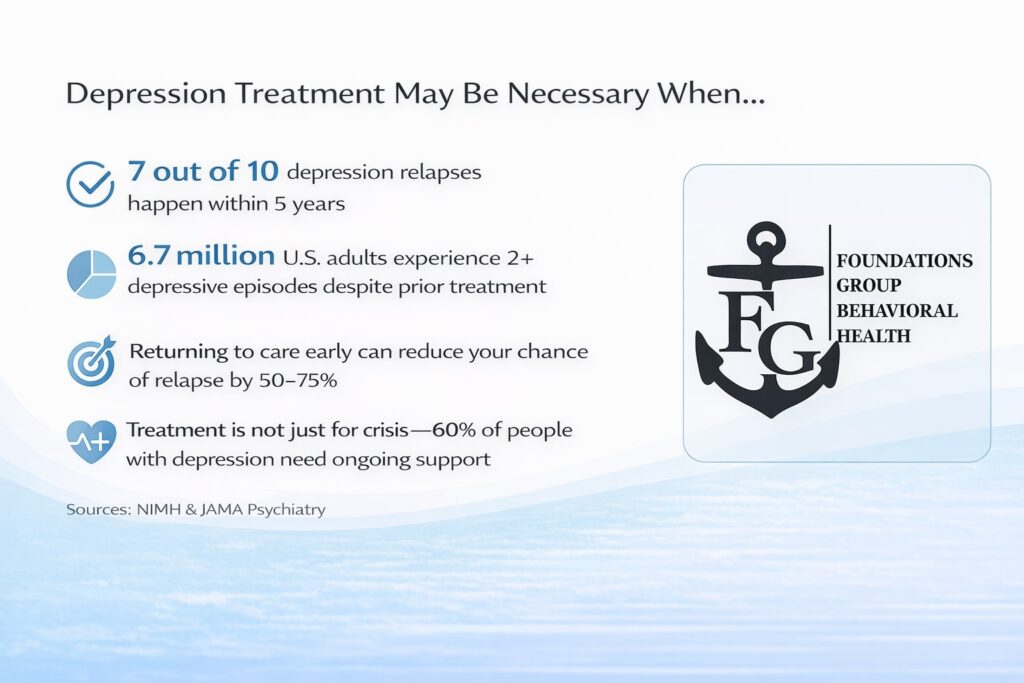
This is the part no one tells you: You don’t have to be in crisis to deserve help. You can be stable and still need support. You can be functioning and still be lost.
A good depression treatment program isn’t just a parachute when you’re falling—it can be an anchor when you’re drifting. Foundations gave me space to be honest about the numbness, the disconnection, the flatness I couldn’t name.
Sometimes, just saying “I don’t feel like myself” out loud is the beginning of healing.
There’s No Medal for Suffering in Silence
I kept telling myself I was “fine.” But fine wasn’t living. Fine was hiding. Fine was surviving.
It took more courage to raise my hand and say, “I need help again,” than it did the first time. Because this time, my pain wasn’t loud. It was quiet, well-behaved, easy to dismiss.
But your pain doesn’t need to scream to be valid.
Alumni Deserve Support Too
There’s this unspoken myth that once we “graduate” from treatment, we’re supposed to have it figured out. But emotional health isn’t linear. Life changes. People change. Depression evolves.
Being an alum doesn’t make you immune. It makes you aware. And that awareness is your superpower—if you act on it.
So if you’re feeling stuck, flat, tired of pretending you’re okay, let me say it clearly:
You are allowed to ask for more. You are allowed to come back.
What People Say
“I thought I was too far out from treatment to ask for help. But Foundations didn’t make me start over. They just helped me pick up where I left off—stronger.”
– Alumni, 2023
“I wasn’t in crisis, but I was disconnected. That was enough reason to get help. I’m glad I did.”
– Client, 2022
“It felt like I got to come home, not report for duty.”
– Long-term alumni, 2024
FAQ: Returning to Depression Treatment as an Alumni
Is it normal to feel disconnected after being stable for a while?
Yes. Depression can return in subtle ways—emotional flatness, loss of joy, fatigue. Stability doesn’t mean immunity. Emotional disconnection is a valid reason to seek help, especially if it lingers.
Do I have to start over in the program?
Not at all. Many programs, like the one at Foundations Group Behavioral Health, personalize care for returning clients. You build from where you are now, not from scratch.
What if I’m not in a crisis?
That’s okay. You don’t need to be in crisis to benefit from treatment. In fact, catching disconnection early can prevent deeper depressive episodes. Think of it as mental health maintenance.
Will anyone judge me for coming back?
No. The staff at Foundations welcomes returning clients with respect. They understand that mental health is ongoing and non-linear.
How do I know if it’s time to reach out?
Ask yourself: Have I felt emotionally flat for weeks? Am I pulling away from people or things I used to enjoy? Do I feel like I’m going through the motions? If the answer is yes, support is worth exploring.
📞 Call 888-685-9730 or visit this page to learn more about our Depression treatment program services in Cape Cod, MA. Whether it’s your first time reaching out—or your second, third, or fifth—this program is here to meet you where you are, not where you “should” be. Personalized Mental Health & Addiction Care in Barnstable County, Falmouth, MA.
You don’t have to pretend everything’s fine. You just have to show up. We’ll help you feel like yourself again.