

You can feel it before anyone says it out loud.
They’re withdrawing. Snapping. Sleeping at odd hours. Avoiding responsibilities. Maybe using old coping habits again. Maybe insisting they’re “fine.”
And you’re back in that familiar place—watching, worrying, wondering if you’re about to lose them to something invisible.
If you’re the parent of a 20-year-old who seems to be spiraling with anxiety again, I want to speak to you carefully here.
Your fear makes sense.
Your exhaustion makes sense.
Your love is not the problem.
And there are structured ways to interrupt this pattern before it becomes a full collapse.
Many families begin by exploring what intentional, higher-frequency care looks like through resources like Foundations’ anxiety care options. Not because they’re giving up—but because they want to stabilize things early.
Let’s talk about what actually makes that kind of support effective.
Anxiety in Young Adults Doesn’t Always Look Like Panic Attacks
Parents often expect anxiety to look dramatic—hyperventilating, visible distress, obvious fear.
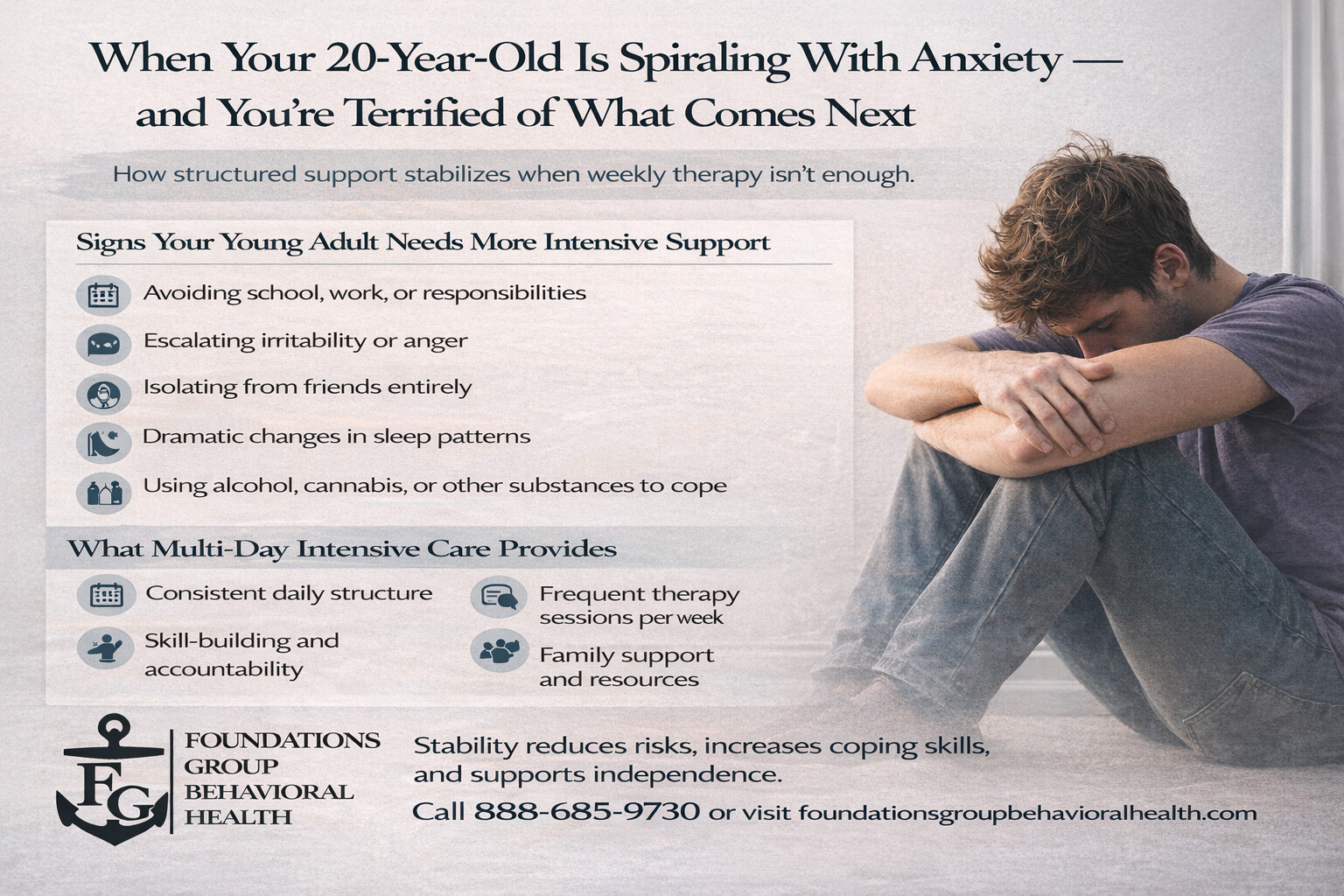
But in 20-year-olds, it often shows up as:
- Chronic avoidance
- Irritability or anger
- Procrastination that feels extreme
- Dropping classes or calling out of work
- Sleep reversal
- Increased reliance on substances to “take the edge off”
It can look like laziness.
It can look like defiance.
It can look like “they just don’t care.”
But underneath? Their nervous system is stuck in overdrive.
Effective treatment focuses less on surface behavior and more on regulating that overwhelmed system. When the body settles, the behavior begins to shift.
Structure Is Medicine for a Chaotic Mind
Anxiety thrives in unpredictability.
When sleep is inconsistent, responsibilities are avoided, and days blur together, symptoms intensify. The brain starts to anticipate threat everywhere.
One of the most powerful elements of an effective Anxiety treatment program is consistent structure.
Not military-style control.
Not punishment.
Predictable, steady rhythm.
Multi-day weekly care gives young adults:
- A reason to get up
- A place to show up
- A schedule that supports nervous system regulation
- Repeated exposure to coping tools
Over time, that rhythm becomes stabilizing. And stability lowers anxiety.
Repetition Builds Emotional Muscle
Once-a-week therapy can be helpful.
But when anxiety is severe—or returning—frequency matters.
Think of it like physical rehab. If someone tore a ligament, we wouldn’t expect them to strengthen it with one session a week and no follow-through.
Young adults benefit from:
- Multiple therapy sessions per week
- Skills groups where they practice tools live
- Gentle accountability
- Immediate feedback
- Clinicians who notice patterns quickly
Effective programs create space for “guided reps.” Not just talking about anxiety—but practicing how to tolerate discomfort, how to face avoided tasks, how to regulate in real time.
That repetition builds emotional muscle.
Addressing Avoidance Directly (Without Shaming It)
Avoidance is anxiety’s favorite strategy.
If something feels scary, the brain says: “Don’t do it.”
Short term? Relief.
Long term? The fear grows.
A strong program helps young adults gradually face what they’ve been avoiding—school, work, conversations, decisions—at a pace that stretches but doesn’t overwhelm.
The goal isn’t forcing independence.
It’s rebuilding confidence through supported exposure.
When they succeed at small avoided tasks repeatedly, their brain updates its threat response. That’s real neurological change.
When Substances Become Part of the Equation
This is often where parental fear spikes.
If your child has started using alcohol, cannabis, or other substances to cope with anxiety, it doesn’t automatically mean they’ve “failed.”
But it does mean the cycle is tightening.
Anxiety increases → substance provides temporary relief → anxiety rebounds stronger → substance use increases.
Effective care doesn’t shame this pattern. It addresses it directly.
When mental health and substance use collide, treatment must look at both together. Ignoring one fuels the other.
The right level of care helps interrupt that loop before it becomes more entrenched.
Family Involvement That Supports—Not Blames
Parents often carry quiet shame.
“I should have seen this coming.”
“Maybe I pushed too hard.”
“Maybe I didn’t push enough.”
Anxiety disorders are not parenting failures.
Strong programs include family work not to assign blame, but to strengthen the system around your young adult.
Family sessions may help you:
- Learn how to respond without escalating
- Set boundaries that protect both of you
- Reduce rescuing behaviors that unintentionally reinforce avoidance
- Communicate in ways that lower defensiveness
Your steadiness matters more than your perfection.
And support for you matters too.
Real Progress Is Quiet
Parents sometimes hope for dramatic breakthroughs.
What actually signals effectiveness is quieter:
- They wake up at consistent times.
- They attend regularly—even when they don’t feel like it.
- They start finishing small tasks.
- They tolerate uncomfortable conversations.
- They ask for help earlier instead of imploding.
Progress looks like scaffolding, not fireworks.
And scaffolding holds.
The Level of Care Matters
Not every situation requires round-the-clock support.
But when weekly therapy isn’t enough and home alone all day isn’t working, structured daytime care several days a week can bridge the gap.
It allows young adults to:
- Maintain some independence
- Stay connected to school or work when possible
- Receive consistent therapeutic intensity
- Build skills before crisis escalates
Choosing that level of care isn’t overreacting.
It’s intervening wisely.
Frequently Asked Questions
How do I know if my 20-year-old needs more than weekly therapy?
If you’re seeing worsening avoidance, repeated setbacks, emotional volatility, or substance use creeping back in, weekly sessions may not provide enough containment.
When anxiety interferes with school, work, relationships, or basic functioning, higher-frequency care can offer the structure needed to stabilize. You don’t have to wait for a hospitalization-level crisis to seek more support.
Will they lose their independence in a structured program?
Not necessarily. Many structured programs are designed specifically for young adults who need intensity without being removed entirely from their lives.
They can often continue living at home and, in some cases, maintain part-time work or academic commitments while receiving care.
The goal isn’t to take independence away—it’s to rebuild the skills that support it.
What if they refuse to go?
Resistance is common. Anxiety often tells them treatment means “I’m broken” or “I’ve failed.”
Instead of pushing with urgency, try framing it as additional support—like tutoring for their nervous system.
You might say: “I see how hard this feels for you. I don’t think you’re failing. I think you deserve more help.”
Sometimes hearing that it’s about support—not punishment—lowers defensiveness.
Can anxiety really get better at this age?
Yes. Young adulthood is actually a powerful time for change. The brain is still highly adaptable.
With repetition, structure, and guided exposure, the nervous system can recalibrate. Patterns that feel cemented at 20 are often more flexible than they appear.
Early intervention increases the likelihood of long-term stability.
What if substances are involved?
If substances are being used to cope, they need to be addressed alongside anxiety.
Ignoring them doesn’t make them disappear. But approaching them with shame often drives them underground.
Integrated care—where both patterns are treated together—offers the best chance at breaking the cycle.
How long does structured care usually last?
It varies. Some young adults benefit from several weeks of multi-day weekly treatment before stepping down to weekly therapy. Others may need longer.
The goal isn’t indefinite intensity. It’s stabilization, skill-building, and gradual independence.
What if I feel completely exhausted?
That’s understandable. Loving someone who is struggling with anxiety is emotionally draining. Many parents operate in quiet hypervigilance for months or years.
You deserve support too. Family sessions and parent guidance can reduce that constant state of alarm and give you tools that protect your own mental health while helping your child.
If You’re Scared of What’s Coming
If you’re reading this because something feels off again—trust that instinct.
You don’t have to wait for a dramatic collapse to intervene.
Early, structured, consistent support can interrupt the spiral before it tightens.
And asking about options doesn’t commit you to anything. It simply gives you clarity.
Call 888-685-9730 or visit our Anxiety treatment program services to learn more about our Anxiety treatment program services in Falmouth, MA.