

Something shifts when you realize your child isn’t just struggling with one thing.
Maybe it started with anxiety, depression, or sudden mood swings. Then alcohol, pills, or other substances entered the picture. For many parents, the moment of panic is realizing these two problems seem tangled together.
Families exploring co-occurring disorder support often discover something surprising: mental health and substance use are usually treated at the same time—because they often grow together.
And addressing only one rarely brings real relief.
When Mental Health Pain Tries to Solve Itself
Young adults don’t usually wake up one day planning to misuse substances.
More often, something inside already hurts.
Anxiety that won’t quiet down.
Depression that makes everyday life feel heavy.
Thoughts racing so fast sleep becomes impossible.
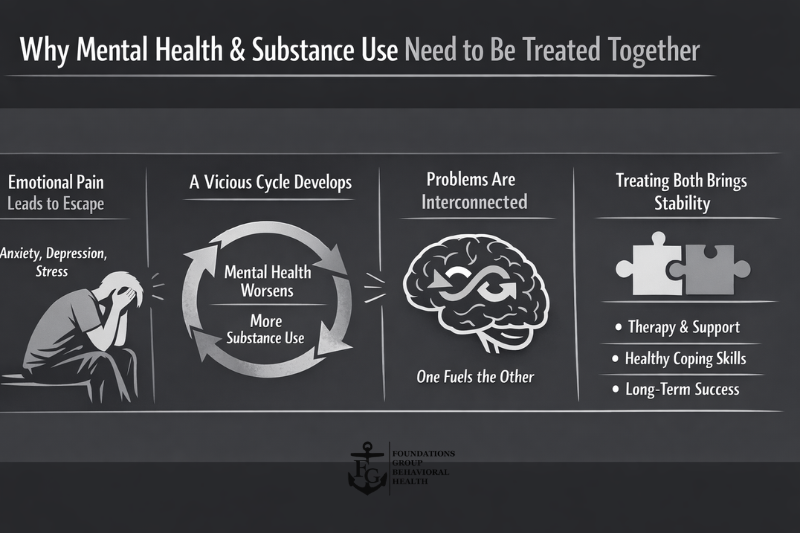
Substances can start as a form of self-medication. A way to numb, slow down, or escape.
For a while, it may even seem like it helps.
But over time, what began as a coping attempt starts making the underlying mental health struggle worse.
Why Treating Only One Problem Rarely Works
Parents often ask a reasonable question:
“Shouldn’t we just focus on the substance use first?”
The challenge is that the mental health symptoms usually don’t disappear when the substance stops.
In fact, they often surge back stronger.
Imagine trying to repair a leaking roof while ignoring the cracked foundation beneath it. The water keeps coming back because the real structural issue was never addressed.
When mental health and substance use collide, both pieces need attention at the same time for real stability to begin.
The Brain Doesn’t Separate These Problems
To families, it can look like two separate issues:
- Depression
- Alcohol or drug use
But inside the brain, they interact constantly.
Substances can intensify anxiety, deepen depression, trigger paranoia, and destabilize mood. At the same time, untreated mental health symptoms increase the urge to escape through substances.
It becomes a loop.
Break one side without addressing the other, and the cycle often restarts.
Why Simultaneous Care Brings Better Stability
Programs that support people facing both challenges focus on stabilization from multiple angles at once.
That might include:
- Therapy that addresses emotional pain beneath the substance use
- Psychiatric support for mood, anxiety, or thought disorders
- Skill-building for coping without substances
- Structured daily care that rebuilds routine and safety
The goal isn’t simply removing substances. It’s helping the person feel steady enough that they no longer need them to survive the day.
For many families, this approach finally starts making sense of what felt confusing for years.
A Moment Many Parents Recognize
There’s often a moment parents describe with quiet heartbreak.
They realize their child isn’t “choosing chaos.”
They’re overwhelmed.
What looks like defiance is often panic, numbness, or desperation playing out in ways young adults don’t yet know how to manage.
When treatment addresses both mental health and substance use together, something powerful can happen:
The chaos starts making sense.
And when things make sense, healing becomes possible.
Hope Exists Even When Things Feel Out of Control
If you’re reading this, chances are something in your child’s life has changed in ways that feel frightening or confusing.
You may be asking questions like:
- How did we get here?
- Did I miss the signs?
- Is it too late to help them?
It isn’t too late.
Families across the state have found stability through behavioral health treatment programs in Massachusetts designed for situations exactly like this—where mental health and substance use appear together.
Call 888-685-9730 or explore our behavioral health treatment programs Massachusetts, co occurring disorder treatment program Massachusetts services to learn how support can begin.
And if you’re the parent quietly holding all this fear inside—please know this:
You are not alone at this moment. And help does exist for both of you.