

You might not be trying to quit anything. Not officially.
You’re just noticing things. The way you feel before going out. The way you rely on something to take the edge off. The way your mind doesn’t quite settle—even on your best days.
If that’s where you are, you’re not overthinking it. You’re paying attention. And you can explore deeper support through our anxiety treatment program in Massachusetts if those patterns are starting to connect.
Start by Getting Curious About the “Why” Behind the Curiosity
Sober curiosity doesn’t usually come out of nowhere.
It shows up as a quiet question:
Why do I feel like I need this?
Not in a dramatic way. More like a subtle discomfort you can’t ignore anymore.
Instead of focusing on what you’re doing—drinking, coping, unwinding—try shifting your attention to why it feels necessary.
Is it about relaxing?
Or is it about escaping something underneath the surface?
That distinction matters more than most people realize.
Look at the Anxiety That Comes Before the Habit
Most people evaluate their relationship with alcohol based on what happens after.
But the more important moment is usually before.
That pre-event tension.
That low-level unease.
That feeling like you need something to “smooth things out” just to show up.
That’s anxiety.
And it doesn’t always look dramatic. Sometimes it’s just:
- Overthinking what to say
- Feeling slightly out of place
- Worrying you won’t feel comfortable in your own skin
In places like Falmouth, Massachusetts, where life can look calm and put-together from the outside, this kind of internal pressure often goes unnoticed—even by the people experiencing it.
Notice If You’re Using Something to Feel “Normal”
This is where things get honest.
Not harsh. Just honest.
Ask yourself:
- Do I feel more like myself after a drink—or just less anxious?
- Do I rely on something external to feel relaxed, social, or at ease?
- Do I feel off-balance without it, even if I don’t want to depend on it?
If the answer is yes, the goal might not actually be sobriety.
It might be relief.
And anxiety is often the thing asking for it.
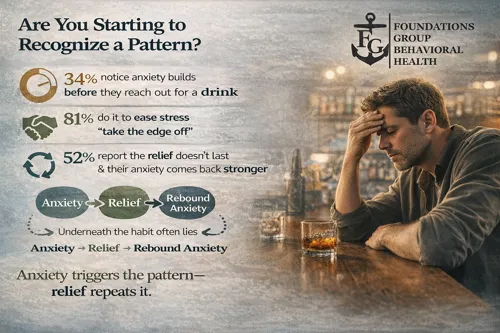
Recognize the Cycle Most People Miss
Here’s the part that doesn’t get talked about enough:
Anxiety → Relief → Rebound Anxiety → Repeat
You feel anxious.
You do something to quiet it.
It works—for a moment.
Then the anxiety comes back, sometimes stronger.
So you repeat the cycle.
Over time, it can start to feel like:
- You’re chasing calm but never quite reaching it
- You’re managing symptoms instead of resolving them
- You’re stuck in a loop that looks functional—but feels exhausting
That’s not a lack of willpower.
That’s a pattern your system has learned.
Try Interrupting the Pattern—Not Just the Behavior
A lot of people try to “fix” this by cutting something out.
Drink less. Go out less. Avoid certain situations.
And sometimes that helps—for a while.
But if the anxiety underneath stays the same, the pressure doesn’t disappear. It just shifts.
Instead of focusing only on what you’re doing, try asking:
- What feeling is driving this choice?
- What happens if I sit with that feeling, even briefly?
- What kind of support would make that feeling more manageable?
You’re not just changing a habit.
You’re learning how to respond to yourself differently.
Let Yourself Consider Support That Goes Beyond Self-Fixing
There’s a quiet belief many people carry:
I should be able to figure this out on my own.
And for a while, that belief can keep you going.
But eventually, it can also keep you stuck.
Because anxiety isn’t always something you can outthink or out-discipline.
It often needs:
- Repetition
- Structure
- Guidance
- A space where you don’t have to hold it all together
Some people find that multi-day weekly treatment or structured daytime care gives them the consistency they’ve been missing—not because they’re “worse,” but because they’re ready for something that actually works.
Understand That You’re Not Losing Control—You’re Regaining It
One of the biggest fears is this:
If I look at this more closely, what will it mean about me?
But this isn’t about labeling yourself.
It’s about understanding yourself.
You’re not giving something up.
You’re getting closer to the version of you that doesn’t need to rely on constant coping just to feel okay.
In communities like Barnstable County, Massachusetts, more people are starting to recognize that mental health support isn’t about crisis—it’s about quality of life.
And that shift matters.
Give Yourself Permission to Take This Seriously
It’s easy to minimize this stage.
You’re functioning. You’re showing up. You’re not “falling apart.”
But something still feels off.
That’s worth paying attention to.
Because the earlier you listen to that signal, the easier it is to respond to it in a way that actually helps.
You don’t need to wait for things to get worse.
You’re allowed to want things to feel better.
You Might Be Closer Than You Think
That moment where you start connecting the dots?
Where you realize it might not be about drinking at all—but about how you feel in your own mind and body?
That’s not confusion.
That’s clarity starting to form.
And clarity, even when it’s uncomfortable, is a powerful place to begin.
FAQ: The Questions That Usually Stay Quiet
What if I’m not sure anxiety is the real issue?
You don’t have to be certain to explore it. Noticing patterns is enough to start asking better questions—and getting better support.
Can I still be sober curious without having a “problem”?
Yes. Sober curiosity often comes from wanting to feel better, not from hitting a breaking point.
Why does anxiety feel worse when I try to cut back?
Because your system may have been relying on certain habits to regulate it. When those are removed, the underlying anxiety becomes more visible—not stronger, just more noticeable.
What if I don’t want something extreme or overwhelming?
Support doesn’t have to feel intense to be effective. The right approach meets you where you are and builds gradually.
How do I know if I need more structured help?
If you’ve tried making changes on your own and keep returning to the same patterns, it might be time for more consistent support.
Is it possible to feel like myself without relying on anything external?
Yes—but it usually takes practice, support, and time. That version of you isn’t missing. It’s just been layered over.
This Isn’t About Giving Something Up—It’s About Getting Something Back
It might look like you’re questioning a habit.
But what you’re really doing is questioning a pattern that hasn’t been working as well as it once did.
That’s not failure.
That’s growth trying to happen.
Ready to Talk?
You don’t have to figure this out alone.
Call 888-685-9730 to learn more about our anxiety treatment program in Massachusetts.
And if part of you is still unsure, that’s okay too.
You don’t need to have it all figured out.
You just need to stay honest about what you’re feeling—and open to the idea that you don’t have to keep handling it the same way.