

What Is Relationship Anxiety?
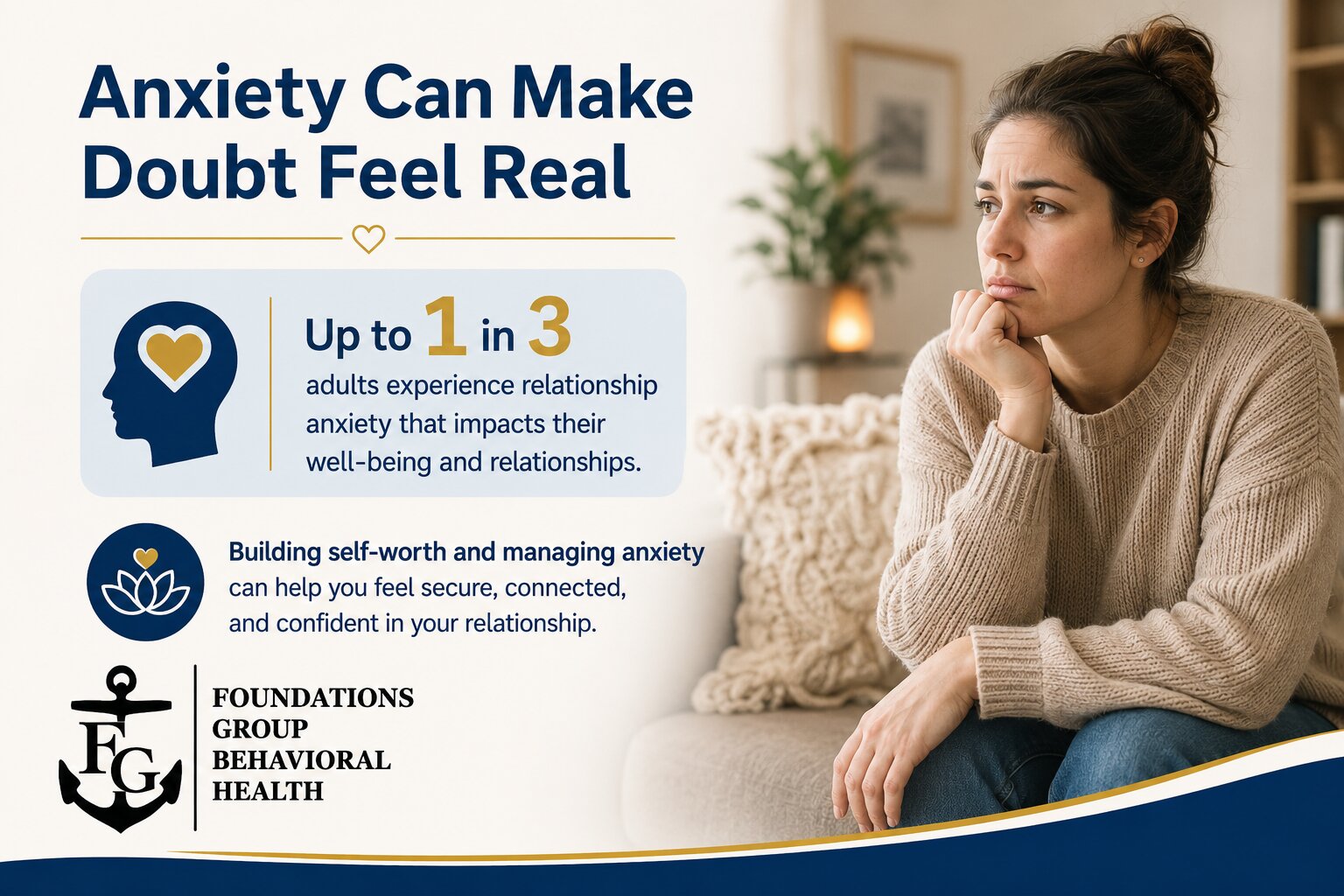
Relationship anxiety is a pattern of persistent worry, doubt, or fear about a romantic relationship that doesn’t correspond to what’s actually happening in the relationship. It’s different from situational nervousness — the normal apprehension of starting a new relationship or navigating a difficult patch. Relationship anxiety is ongoing, often present even when things are going well, and driven by internal fears rather than external evidence.
It’s not a formal clinical diagnosis, but it’s a well-recognized pattern that can occur in people with or without a diagnosed anxiety disorder. It often reflects an anxious attachment style — a way of relating to closeness that was shaped by early experiences and tends to repeat across relationships unless addressed directly.
Signs of Relationship Anxiety
Emotional Signs
- Constant reassurance-seeking — needing repeated confirmation that your partner loves you, that the relationship is okay, that they’re not about to leave
- Fear of abandonment — an outsized dread of the relationship ending that doesn’t match its actual stability
- Feeling like something is about to go wrong — even during good periods, a background sense of impending loss or disappointment
- Difficulty being present — spending time with your partner while mentally elsewhere, anticipating problems or replaying past interactions
Behavioral Signs
- Overanalyzing communication — reading tone into texts, tracking response times, interpreting neutrality as coldness
- Testing the relationship — picking fights, withdrawing, or behaving in ways designed to provoke a reaction that confirms or denies your fears
- Self-silencing — suppressing your own needs or opinions to avoid conflict, then building resentment when those needs go unmet
- Excessive checking — monitoring your partner’s location, activity, or social media for signs of threat
Physical Signs
- Stomach knots, nausea, or tension connected to relationship worry
- Difficulty sleeping when you haven’t heard from your partner or after conflict
- Racing heart or a sense of dread that arrives without a clear trigger
If these signs are affecting your daily life or your relationship, anxiety treatment at Foundations Group Behavioral Health can help you understand what’s driving them and build more sustainable ways of relating.
What Causes Relationship Anxiety?
Relationship anxiety rarely comes from nowhere. Common roots include:
Anxious attachment style. Attachment styles are formed in early childhood based on the consistency and responsiveness of our caregivers. People with anxious attachment learned — often very early — that love and closeness were unpredictable or conditional. They grew up hypervigilant to signs of withdrawal or rejection, and that hypervigilance doesn’t automatically turn off in adult relationships.
Past relationship trauma. Betrayal, sudden endings, emotional neglect, or chronic unpredictability in previous relationships can leave lasting marks. The nervous system learns to anticipate what it’s already experienced — so even in a healthy relationship, it stays on alert.
Low self-worth. A deep belief that you’re not enough — not lovable, not interesting, not worth staying for — drives constant vigilance for evidence that confirms the fear. Reassurance helps momentarily, but it can’t fix a belief.
Co-occurring anxiety disorders. If you have generalized anxiety disorder, panic disorder, or other anxiety conditions, the anxiety often extends into relationship territory. The worry mechanism is the same; the content shifts to whatever matters most.
Relationship Anxiety vs. ROCD vs. Gut Feeling
Three different experiences can look similar from the inside but require different responses:
Relationship anxiety is rooted in fear about whether you are loved and safe. The worry is about your partner leaving, not loving you, or finding someone better. It’s driven by insecurity and past experience, not present evidence.
Relationship OCD (ROCD) involves intrusive, ego-dystonic doubts about whether you love your partner or whether the relationship is right. The doubt feels unwanted and is maintained by compulsive mental behaviors like reassurance-seeking and mental reviewing. For more on ROCD, see our post on Relationship OCD: What It Is and How to Recognize It.
A genuine gut feeling is grounded in observed behavior over time — specific patterns, repeated experiences, a consistent mismatch between what someone says and what they do. It tends to be relatively stable and doesn’t require compulsive mental effort to maintain. Anxiety, by contrast, is volatile and responsive to reassurance (temporarily).
If you’re unsure which applies to you, a therapist experienced with both attachment and OCD-spectrum concerns can help you distinguish them.
How Relationship Anxiety Affects Your Partner
Relationship anxiety doesn’t stay contained to the anxious person — it shapes the entire relationship dynamic.
The reassurance trap is one of the most common patterns: you ask for reassurance, your partner provides it, you feel better briefly, the anxiety returns, you ask again. Over time, partners often feel exhausted by the cycle, unable to provide enough reassurance to make a lasting difference — because no amount of external reassurance can fix an internal belief.
Testing behaviors — picking fights, withdrawing, manufacturing situations to see how your partner responds — can erode trust and create genuine distance, which then confirms the anxiety’s fears in a self-fulfilling cycle.
This doesn’t mean relationship anxiety is your partner’s problem to solve. But understanding its impact on the dynamic is part of taking responsibility for addressing it.
How to Manage Relationship Anxiety
There are practical strategies that help — though for significant relationship anxiety, self-help strategies work best as a complement to professional support rather than a substitute for it.
- Name the anxiety for what it is. “I’m feeling anxious right now” is different from “something is wrong with my relationship.” The first is about your internal state; the second is a conclusion that may not be accurate.
- Check the evidence. What is your partner actually doing? Is there observable behavior that supports the fear, or is the fear running ahead of the evidence?
- Build a life outside the relationship. Relationship anxiety intensifies when a partner becomes your primary source of security, identity, and comfort. Friendships, interests, and a sense of self that exists independently reduce the stakes that drive the anxiety.
- Resist the reassurance loop. This is counterintuitive — but seeking reassurance repeatedly actually maintains anxiety rather than resolving it. Sitting with uncertainty, rather than seeking to eliminate it, is what gradually teaches the nervous system that uncertainty is tolerable.
- Communicate your needs without demanding reassurance. There’s a difference between “I’ve been feeling insecure lately and I’d love some quality time together” and “Do you still love me? Are we okay? You seem distant.” The first is a bid for connection; the second keeps the anxiety loop running.
When Relationship Anxiety Needs Professional Support
Relationship anxiety that is significantly affecting your daily life, your relationship’s health, or your ability to function is worth addressing with professional support. Signs that self-help strategies aren’t enough:
- The anxiety is present most days and doesn’t improve with reassurance
- It’s affecting your ability to work, sleep, or maintain other relationships
- It’s creating recurring conflict or significant distance in the relationship
- You’ve tried to manage it on your own and keep hitting the same walls
Effective therapeutic approaches include cognitive behavioral therapy (CBT) for the thought patterns that maintain anxiety, emotionally focused therapy (EFT) for attachment-based patterns, and individual therapy focused on building self-worth independent of relationship validation.
Foundations Group offers individualized outpatient care that addresses the underlying drivers of anxiety — not just the symptoms. Explore our outpatient mental health programs to learn more.
Frequently Asked Questions
Is relationship anxiety the same as having an anxious attachment style?
They’re closely related but not identical. An anxious attachment style is a broader relational pattern — a way of orienting toward closeness that was shaped in childhood. Relationship anxiety is the specific manifestation of that style within a romantic relationship. Not everyone with an anxious attachment style experiences severe relationship anxiety, and relationship anxiety can also arise from situational factors like past trauma without a longstanding attachment pattern.
What is the 3-3-3 rule for anxiety?
The 3-3-3 rule is a grounding technique for anxiety: name 3 things you can see, 3 sounds you can hear, and move 3 parts of your body. It’s designed to interrupt anxious rumination by redirecting attention to the present moment through sensory awareness. It can be useful in moments of acute anxiety but doesn’t address the underlying patterns that create relationship anxiety.
Can relationship anxiety go away on its own?
For mild cases, increased self-awareness and a consistently secure relationship can reduce anxiety over time. For significant relationship anxiety rooted in attachment patterns or past trauma, it rarely resolves without some form of intentional work — whether that’s therapy, structured self-help, or both. Untreated, it tends to repeat across relationships.
Should I tell my partner I have relationship anxiety?
In most cases, yes — with some thought about how and when. Sharing your experience can create understanding and reduce the likelihood of your partner misinterpreting your behaviors as rejection or dissatisfaction. The goal isn’t to make them responsible for managing your anxiety, but to create a shared context. A therapist can help you prepare for that conversation if it feels difficult.
You Can Learn to Feel Safe in Love
Relationship anxiety is treatable — and working through it doesn’t just improve your relationship. It changes your relationship with yourself. The security you’re looking for externally can be built internally, with the right support. Personalized mental health & addiction care in Barnstable County, Falmouth, MA.
Foundations Group Behavioral Health provides individualized treatment that helps you build healthier relationships from the inside out. Learn about our anxiety treatment program or talk to our team to get started. You can reach us at (888) 685-9730.