

When I got sober, I expected the hard part to be the actual quitting. Turns out, that was just the beginning. The real challenge was figuring out how to live—how to be in a room without feeling like a ghost, how to hang out with friends without faking it, how to sit still without spiraling.
For a while, I felt like the only one who didn’t “bounce back.” Everyone else seemed to get their lives together while I was stuck in this limbo, feeling too raw, too awkward, too weird. Therapy wasn’t a magic cure. But it gave me small lifelines—tiny shifts that helped me feel a little more grounded, a little more okay. It helped me feel normal again. Or at least normal enough to stop pretending I was.
If you’re in that weird, wobbly middle space—still figuring out how to be a person without substances—maybe these moments will feel familiar.
👉 Check out the mental health therapy services that helped me feel human again.
1. Naming What I Was Actually Feeling
Before therapy, everything was either “fine” or “I want to disappear.” I didn’t know how to name the in-betweens: like anxious-excited, emotionally sore, or lonely in a room full of people. My therapist gave me language. And naming those feelings didn’t just make me feel smarter—it made the emotional fog way less overwhelming.
2. Learning That My Reactions Made Sense
I used to beat myself up for overreacting or zoning out. But therapy helped me understand that my brain was doing exactly what it thought it needed to do to stay safe. Trauma, neglect, chronic stress—those experiences left imprints. Therapy didn’t excuse my behavior, but it helped explain it. That alone eased so much shame.
3. Having One Hour That Was Fully About Me
There’s something weirdly sacred about having a full hour where you’re not expected to be okay. No “I’m good, thanks.” No social script. Just… your stuff, center stage. I didn’t realize how rare that was until I had it. For once, I didn’t have to apologize for taking up space.
4. Figuring Out My Inner Critic’s Voice
At some point, I absorbed the idea that I was too much. Too loud, too needy, too complicated. Therapy helped me trace that voice back to its roots—a mix of family dynamics, bad relationships, and internalized anxiety. Once I could separate me from that inner critic, I had space to start forming a gentler voice.
5. Getting Practical Tools That Actually Helped
I thought therapy would just be “talking about my feelings.” But it was also super practical. I learned grounding techniques to deal with panic attacks, how to notice spiraling thoughts before they snowballed, and how to set boundaries without ghosting everyone. Those tools felt like emotional life jackets on rough days.
6. Feeling Seen Without Being “Diagnosed”
I was terrified I’d be labeled or pathologized. But the best therapists don’t just hand you a diagnosis and send you on your way. They get curious with you. They help you feel seen as a full, complicated human. That was huge—especially after years of feeling like a walking red flag.
7. Learning to Be Bored Without Freaking Out
Early sobriety was so. freaking. boring. Without the chaos, the distractions, the drama—I had to sit with myself. At first, that felt like torture. But therapy helped me explore that discomfort instead of running from it. I started to notice the difference between stillness and emptiness—and over time, I found peace in the quiet.
8. Hearing That I Wasn’t the Only One
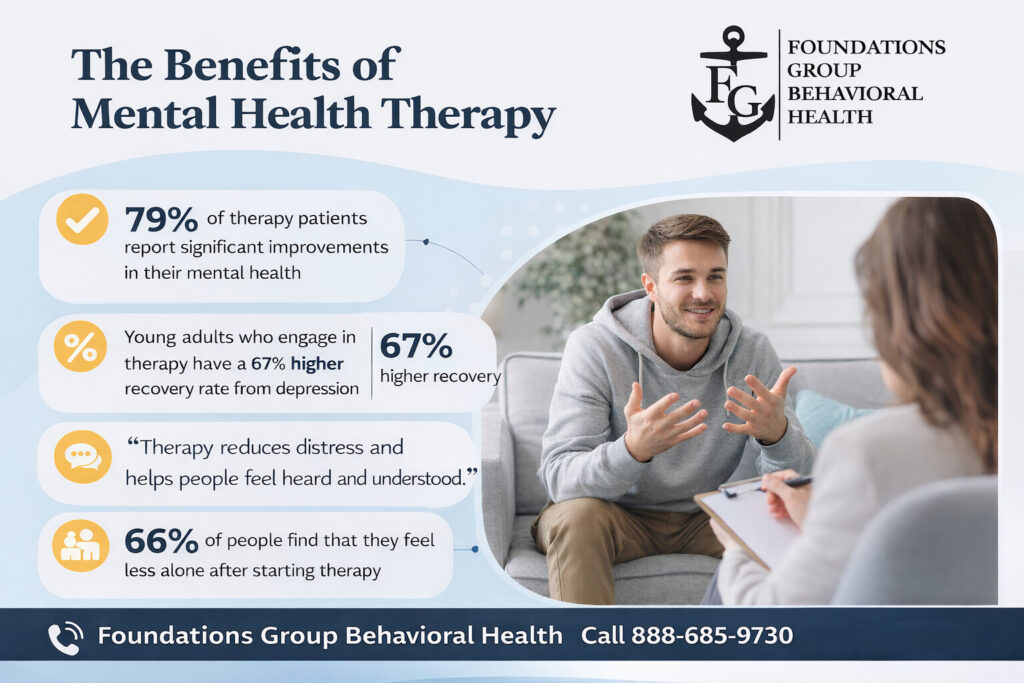
Therapy (especially group therapy) showed me that my “weird” wasn’t unique—it was human. Hearing other people share similar struggles cracked something open in me. I wasn’t broken. I wasn’t alone. I was just a person learning how to be a person again.
“It was the first time I said out loud, ‘I don’t know how to hang out with people anymore,’ and someone nodded instead of laughing.”
– Outpatient Client, 2023
9. Rebuilding Trust With My Own Brain
I used to treat my thoughts like enemies. I didn’t trust myself—my judgment, my memory, even my feelings. Therapy helped me rebuild that trust in small ways: noticing when my anxiety lied to me, learning when to check in with someone I trust. It wasn’t about “fixing” my brain. It was about getting back on speaking terms with it.
10. Starting to Like the Person I Was Becoming
This was the most unexpected one. Slowly—without realizing it—I started liking who I was. Not in a “look at me now” kind of way. Just… I didn’t flinch at my reflection anymore. I didn’t dread being alone with my thoughts. I started laughing more. Making playlists. Texting people back. Little signs that I wasn’t just surviving—I was starting to live.
FAQ: Mental Health Therapy for Young People in Recovery
Is therapy just for people with serious mental illness?
Nope. Therapy can help with everything from anxiety and social struggles to trauma, grief, or just feeling stuck. You don’t need a diagnosis to deserve support.
What kind of therapy works best after getting sober?
That depends on your needs. Some people find individual therapy most helpful, while others benefit from group therapy, trauma-informed approaches, or cognitive-behavioral therapy (CBT). A mental health provider can help guide you toward the right fit.
How long do I have to be in therapy before I feel better?
There’s no one-size-fits-all timeline. Some people feel relief in a few sessions. For others, it takes longer to build trust and unpack things. Feeling awkward at first is normal.
What if I don’t like my therapist?
That’s okay—it happens. Therapy is a relationship, and not every therapist will be the right fit. If it doesn’t feel safe or helpful, it’s absolutely okay to look for someone else.
Can I do therapy if I’m not 100% sure I want to stay sober?
Yes. Therapy can actually help you explore that uncertainty without judgment. You don’t have to commit to a forever plan—just be honest about where you’re at.
Therapy didn’t “fix” me. It helped me stop trying to be fixed. It gave me tools, language, and permission to just be—awkward, unsure, growing, human.
If you’re tired of pretending everything’s fine, or if you’re sober but still feel a little broken, I see you. You’re not the only one. And you don’t have to figure it out alone.
📞 Call 888-685-9730 or visit Foundations Group Behavioral Health to learn more about our mental health therapy services in Cape Cod, MA. Help doesn’t have to be dramatic. Sometimes it starts with one honest conversation.