

If you’ve ever stared at an email you needed to send, a pile of laundry, or an important work project—fully aware it needed to be done but seemingly unable to begin—you may have experienced ADHD paralysis.
For many adults, this isn’t about being lazy, unmotivated, or careless. It’s a frustrating neurological experience that can leave you feeling trapped between intention and action. If you’ve spent years hearing that you “just need more discipline” or “aren’t trying hard enough,” it’s understandable if you’ve started believing those messages. But for people with ADHD, there is often a much different explanation.
Learning more about ADHD treatment can help you understand whether these challenges are connected to untreated ADHD and what effective support may look like.
The important thing to know is this: ADHD paralysis is rooted in executive function—not character. Understanding why your brain freezes is often the first step toward finding strategies that actually work.
What Is ADHD Paralysis?
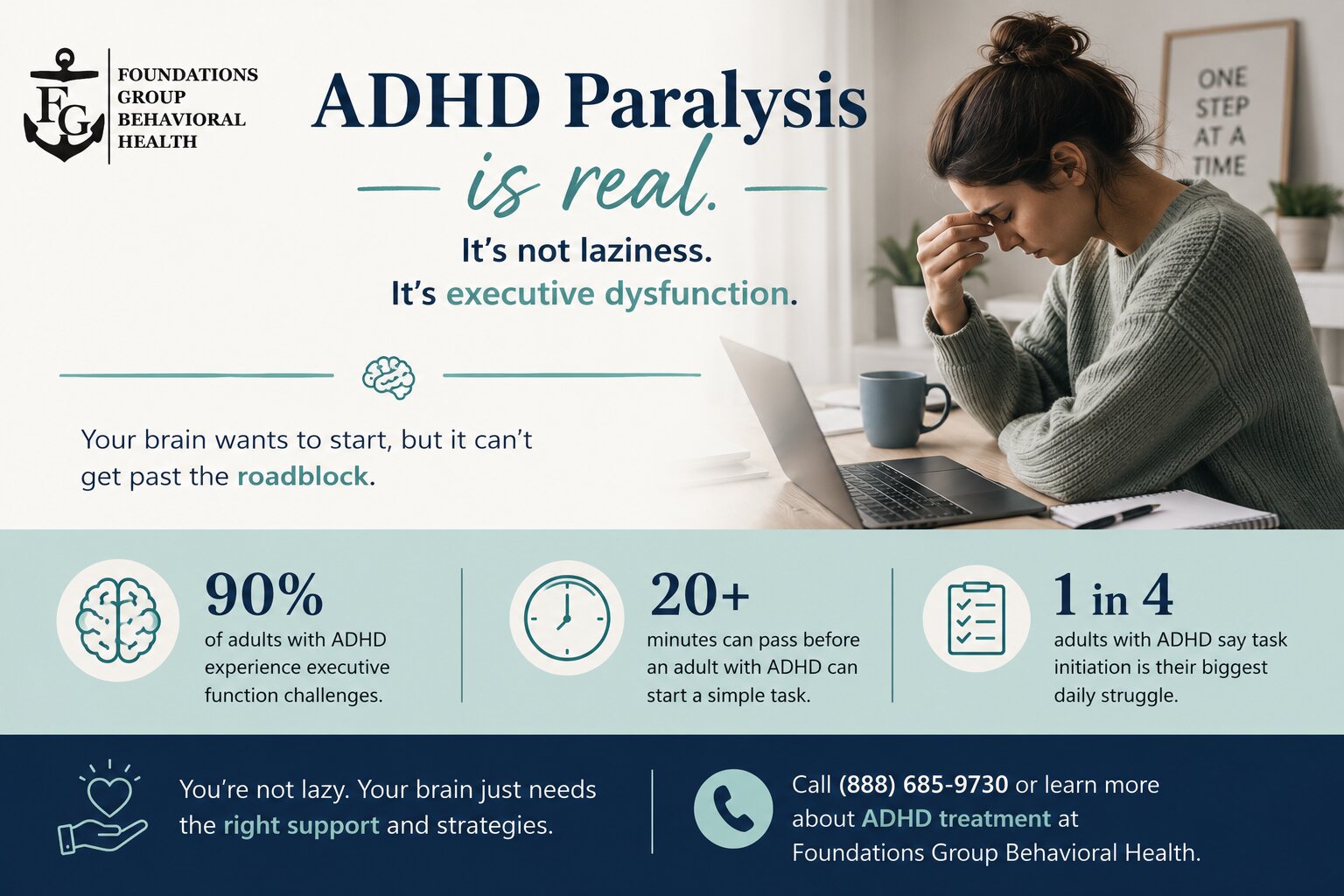
ADHD paralysis is the inability to start, switch between, or finish tasks despite genuinely wanting to complete them. It is one of the many ways ADHD executive dysfunction can affect daily life.
People often describe it as feeling “stuck.” They know exactly what needs to happen next, but their brain refuses to cooperate.
This isn’t a lack of intelligence or ambition. In fact, many adults with ADHD are highly capable professionals, students, parents, and entrepreneurs who appear successful from the outside while privately struggling with everyday responsibilities.
Executive functions are the brain’s management system. They help you:
- Initiate tasks
- Organize priorities
- Shift attention
- Plan ahead
- Regulate emotions
- Maintain focus
- Complete goals
When executive functioning is impaired—as it often is in ADHD—getting started can feel surprisingly difficult, even when the task is important.
This is one reason why comprehensive ADHD treatment often focuses on more than attention alone. It also addresses executive functioning skills, coping strategies, and the factors contributing to daily impairment.
The 3 Types of ADHD Paralysis
Although people often use the term broadly, ADHD paralysis typically appears in three distinct ways.
1. ADHD Task Paralysis
ADHD task paralysis happens when you know exactly what needs to be done but cannot seem to begin.
The task isn’t confusing.
You aren’t forgetting it.
You genuinely want to complete it.
Yet hours—or even days—pass without taking action.
Daily examples include:
- Staring at a work assignment without opening the document
- Avoiding making an important phone call
- Leaving dishes untouched despite noticing them repeatedly
- Waiting until the last possible minute to start a project
- Sitting on the couch thinking about exercising instead of beginning
People experiencing task paralysis often become trapped in cycles of guilt.
“I should be doing this.”
“Why can’t I just start?”
“The longer I wait, the worse it gets.”
Ironically, the growing pressure often makes starting even harder.
2. ADHD Choice Paralysis
Sometimes the problem isn’t starting.
It’s deciding.
ADHD choice paralysis occurs when too many options overwhelm the brain’s ability to prioritize.
Instead of making a decision, everything stops.
Examples include:
- Opening Netflix and spending 45 minutes choosing something to watch
- Looking at dozens of emails without knowing which one to answer first
- Spending hours researching instead of making a purchase
- Feeling overwhelmed by multiple work priorities
- Standing in the grocery store unable to decide what to cook
To someone else, these choices may appear simple.
For someone with ADHD, every option can feel equally urgent, equally important, or equally impossible.
Without a clear starting point, the brain may default to avoiding the decision altogether.
3. Mental Paralysis
Sometimes the freeze happens internally rather than behaviorally.
Mental paralysis feels like your thoughts suddenly scatter or shut down.
People commonly describe it as:
- Brain fog
- Feeling mentally blank
- Losing the ability to organize thoughts
- Forgetting what they were doing mid-task
- Being unable to solve problems they normally could
This form of ADHD freeze can be especially frustrating because people often know they are capable of thinking clearly.
On some days, ideas flow effortlessly.
On others, even writing a short email feels impossible.
That inconsistency is one reason ADHD can be misunderstood by others—and even by the person experiencing it.
Why the ADHD Brain Freezes: The Executive Function Explanation
One of the biggest misconceptions about ADHD paralysis is that it’s simply procrastination.
While procrastination involves intentionally delaying something despite expecting negative consequences, ADHD paralysis is often an inability to activate the brain systems needed to begin.
The difference matters.
Executive Function Is the Brain’s Management System
Executive functions help coordinate dozens of mental processes, including:
- Planning
- Prioritizing
- Starting tasks
- Managing time
- Sustaining attention
- Switching between activities
- Monitoring progress
In ADHD, these systems don’t work consistently.
A person may successfully complete a complex work presentation while struggling to fold laundry or respond to a simple text message.
That inconsistency isn’t evidence that they’re choosing when to try.
It’s part of how ADHD affects executive functioning.
Stress, fatigue, anxiety, lack of sleep, and overwhelming environments can make executive dysfunction even more noticeable.
The Dopamine Connection
Researchers believe dopamine also plays an important role.
Dopamine helps regulate motivation, reward, attention, and learning.
Many people with ADHD appear to require greater levels of:
- Interest
- Novelty
- Challenge
- Urgency
to activate the brain’s attention systems.
That’s why many adults notice patterns like these:
- They can hyperfocus on something fascinating for hours.
- They struggle to begin something important but repetitive.
- Deadlines suddenly unlock productivity.
- Routine paperwork feels physically painful to start.
It’s not that the task lacks importance.
It’s that the brain’s activation system doesn’t respond to importance alone.
When a task feels boring, overwhelming, or too open-ended, initiating it may require far more mental effort than people without ADHD realize.
Understanding this neurological explanation doesn’t remove responsibility—but it does replace blame with a more accurate understanding of what’s happening.
Practical Strategies for Getting Unstuck
No single strategy works every time.
The goal isn’t perfection.
It’s making activation easier.
Try Body Doubling
Many adults find it easier to work when another person is present.
That person doesn’t need to help.
They simply work nearby or remain on a video call while both people complete separate tasks.
This external accountability often helps reduce ADHD task paralysis.
Focus Only on the First Step
Large projects overwhelm executive function.
Instead of writing:
- Finish taxes
Try writing:
- Open tax folder.
Or instead of:
- Clean the kitchen
Start with:
- Put one plate in the dishwasher.
The brain often resists large, undefined tasks but responds better to small, concrete actions.
Use External Timers
Timers create structure when internal time awareness feels unreliable.
The Pomodoro Technique is one example:
- Work for 25 minutes.
- Take a 5-minute break.
- Repeat.
The goal isn’t working perfectly.
It’s creating enough urgency to overcome activation barriers.
Remove Choices
Choice paralysis improves when decisions are reduced.
Examples include:
- Planning tomorrow’s outfit the night before
- Using recurring meal plans
- Creating morning routines
- Limiting task lists to three priorities
- Scheduling repetitive activities at the same time each day
Fewer decisions leave more mental energy for important work.
Change the Environment
Sometimes changing your surroundings changes your ability to begin.
Consider:
- Clearing visual clutter
- Working somewhere quieter
- Using noise-canceling headphones
- Playing instrumental music
- Keeping distracting devices out of reach
- Leaving reminders where you’ll actually see them
External cues often compensate for internal executive function challenges.
Practice Self-Compassion
This strategy isn’t always mentioned, but it matters.
Many adults with ADHD have spent years believing they are lazy because they struggle with things others seem to do effortlessly.
That internal criticism rarely improves executive functioning.
Instead, it often increases stress—which can make paralysis worse.
Replacing self-judgment with curiosity can create space for more effective problem-solving.
For example:
Instead of:
“I never get anything done.”
Try:
“What made starting difficult today?”
That small shift encourages learning rather than shame.
Remember That Strategies Have Limits
Productivity tools can make daily life easier, but they don’t treat the underlying neurological differences associated with ADHD.
If paralysis continues interfering with work, school, relationships, or self-care despite trying different strategies, professional assessment may be appropriate.
When ADHD Paralysis Signals It’s Time to Get Assessed
Everyone gets stuck sometimes.
Everyone procrastinates occasionally.
The difference is frequency, intensity, and impact.
It may be time to consider an ADHD evaluation if you:
- Regularly freeze on important tasks
- Miss deadlines despite working hard
- Feel overwhelmed by everyday responsibilities
- Have struggled with these patterns since childhood or adolescence
- Constantly feel like you’re working harder than everyone else just to stay organized
- Experience significant stress because of chronic procrastination or task avoidance
Many adults aren’t diagnosed until later in life because they learned to compensate.
They earned degrees.
Built careers.
Raised families.
Met expectations.
But behind the scenes, everyday tasks often required enormous effort.
If that description feels familiar, an assessment may provide answers—not labels.
A comprehensive evaluation can determine whether ADHD, anxiety, depression, or another condition is contributing to executive functioning challenges and help guide the most appropriate next steps.
You Don’t Have to Stay Stuck
Living with ADHD paralysis can be exhausting. It often looks like wanting to move forward while feeling mentally pinned in place. Over time, that disconnect can affect confidence, relationships, work, and overall well-being.
The good news is that understanding why your brain freezes changes the conversation. Instead of asking, “Why am I so lazy?” you can begin asking, “What support does my brain need to get started?”
If ADHD paralysis is consistently disrupting your life, professional evaluation can help identify what’s happening and whether ADHD is part of the picture. Personalized mental health & addiction care in Barnstable County, Falmouth, MA.
Call (888) 685-9730 or learn more about ADHD treatment at Foundations Group Behavioral Health.
Frequently Asked Questions
What is ADHD paralysis?
ADHD paralysis is the inability to start, transition between, or complete tasks despite wanting to do them. It is commonly linked to executive dysfunction, making activation and organization much more difficult than they appear from the outside.
Is ADHD paralysis the same as laziness?
No. Laziness implies a lack of desire or effort, while ADHD paralysis is rooted in neurological differences that affect executive functioning. People experiencing ADHD paralysis usually want to complete the task but struggle to initiate action.
How do you break ADHD paralysis?
Helpful strategies include breaking tasks into one small first step, using timers, reducing choices, body doubling, creating structured routines, and modifying your environment to reduce distractions. If paralysis frequently affects work, relationships, or daily life, seeking a professional assessment can help identify whether ADHD or another condition is contributing.