

When your young adult child is struggling again—after months or even years of progress—it can feel like a quiet heartbreak you weren’t ready for.
Maybe they had finished a therapy program, gone back to school, or started rebuilding routines. You started to exhale. Maybe even let yourself hope. And now, something’s shifted. The panic is back. They’re not sleeping again. They’re isolating. You’re walking on eggshells in your own home, wondering if you should say something—or if it will only push them further away.
If this is where you are, we want you to hear something clearly:
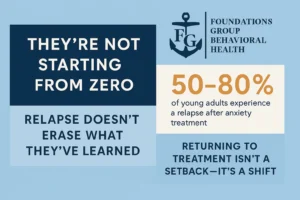
They’re not starting from zero.
And neither are you.
At Foundations Group Behavioral Health, we support families through moments like this all the time. A return to treatment is not a failure. It’s a brave and necessary recalibration—and it’s often when the deepest growth begins.
Relapse Doesn’t Erase What They’ve Learned
Anxiety, especially in young adults, rarely moves in a straight line. Even after successful treatment, life happens—new responsibilities, loss, social shifts, or transitions into independence can trigger old patterns.
So when anxiety returns, or worsens, your child may feel like they’ve “failed.” They may hide it. Or push away help. They may feel ashamed to tell you what’s really going on.
What we know clinically—and what’s often true emotionally—is this: relapse often signals that they’ve outgrown their old coping tools, not that they’ve regressed completely.
That’s why our anxiety treatment program doesn’t just restart therapy—it expands the toolkit. We help young adults build on what they’ve already learned with new, developmentally appropriate support.
Returning to Treatment Isn’t a Setback—It’s a Shift
When a young adult comes back into care, we don’t treat them like a beginner. We start by honoring the work they’ve already done.
That includes:
- Asking what helped last time—and what didn’t
- Validating any resistance, fear, or frustration
- Creating space for autonomy and choice
- Revisiting core skills through a new lens
This is especially important for 18- to 25-year-olds, whose needs are different from teens or older adults. They may have more freedom, more pressure, or more internal conflict. That’s why we tailor our anxiety treatment program in Falmouth, MA to meet them at this stage of life—not the last one.
What Daily Support Looks Like in Our Program
When anxiety flares, routine often collapses. Sleep becomes erratic. Meals become irregular. The day is ruled by avoidance, dread, or spirals of overthinking.
Our program gently rebuilds rhythm.
Here’s what a typical outpatient day might include:
- Morning grounding session to set intention and check in emotionally
- Individual therapy with a licensed clinician who specializes in anxiety and young adult development
- Skills-based group sessions on cognitive distortions, emotional regulation, and practical coping strategies
- Psychoeducational workshops covering how anxiety affects the nervous system, how to set boundaries, or how to manage perfectionism
- Creative or mindfulness-based support, such as movement, journaling, or breathwork
- Space to rest and process—our days are structured but never overwhelming
If you’re looking for an anxiety treatment program in Barnstable County, MA, our Cape Cod center offers flexible programming that can adjust to your child’s needs—without pulling them away from real life completely.
Why This Time Might Work Better Than Before
One of the most painful parts of relapse is the fear that this time will be just like last time. That they’ll quit again. Or ghost their therapist. Or smile through sessions while crumbling inside.
We understand that fear. And we work differently because of it.
Here’s how we approach returning clients:
- We don’t assume readiness. We meet them with respect, not pressure.
- We go deeper into motivation—not just what hurts, but what they still care about.
- We integrate family dynamics when appropriate, including gentle coaching for parents on communication, boundaries, and support.
- We treat them as experts on their own experience. They help co-create their treatment plan.
Healing after relapse often goes deeper than the first round of care. There’s more insight. More humility. More willingness—once trust is built again.
Your Love Isn’t a Fix. But It’s Still a Force.
As a parent, you’re likely feeling a swirl of emotions right now. Maybe guilt. Maybe grief. Maybe exhaustion. Maybe all of it.
You’ve probably Googled late at night, rewritten texts a dozen times, or cried in silence while telling others “we’re doing okay.”
This isn’t your fault. And it isn’t yours to fix alone.
What you can do:
- Stay calm, even if they’re unraveling
- Offer options, not ultimatums
- Speak from love, not fear
- Get support for yourself, too
In our program, we offer optional family engagement that isn’t about blame—it’s about connection. We want you to feel informed, involved, and supported, without taking on more than is healthy.
Small Signs of Progress Are Still Progress
In the early stages of treatment, you may be hoping for major shifts. But often, the first signs that treatment is working are subtle. Don’t miss them.
Progress might look like:
- Saying, “I’m anxious,” instead of shutting down
- Taking a walk instead of isolating all day
- Attending a group session even when they’re afraid to speak
- Texting back, even if it’s short
Each of these is a sign that their nervous system is regulating, that their internal world is stabilizing, and that trust—both in others and in themselves—is rebuilding.
These moments matter. Celebrate them.
FAQs for Parents Supporting a Young Adult After Relapse
My child says treatment didn’t work last time. Why would this be different?
That’s a valid fear—and one we hear often. The difference is often in timing, fit, and support. Our program re-evaluates what wasn’t working, explores new strategies, and works closely with each client to rebuild trust. We don’t recycle old plans—we design a new one together.
What if they refuse to go?
Start by staying calm and curious. Avoid pressure or ultimatums. Instead, say something like, “I don’t want to make you do anything—but I can tell you’re struggling, and I want us to have more support.” You can also reach out to us directly—we often coach parents on how to open the door.
Can I be involved in their care?
Yes—when your child consents. We offer optional family sessions, education, and updates. Our goal is to strengthen—not strain—family dynamics, and that often starts with shared understanding and communication.
Do you work with co-occurring depression or trauma?
Absolutely. Anxiety rarely exists in isolation. Our clinicians are trained to address overlapping diagnoses and create integrated care plans that don’t treat symptoms in silos.
Will they be in group therapy with people much older than them?
No. We group clients based on developmental and clinical fit. Most of our young adult clients are in groups with others close to their age and experience, which helps foster connection and relatability.
Can they keep working or going to school?
Yes. Our outpatient program is designed to support real life. We offer flexible scheduling to accommodate work, classes, and responsibilities outside of treatment. We’ll collaborate with you and your child to find the right rhythm.
You’re Not Starting From Scratch—You’re Starting With Wisdom
You’ve learned things from the last time around. So has your child.
You’ve learned what conversations open the door—and which ones close it. You’ve learned how to spot the signs earlier. You’ve learned that asking for help isn’t weak—it’s wise.
This chapter can be different. Not because it’s easy—but because it’s informed, supported, and rooted in experience, not panic.
Let us walk with you from here.
Want to talk about what this next step could look like?
Call 888-685-9730 or visit our anxiety treatment program page to learn more about our services in Cape Cod, MA.