
There’s a story that lives deep in the bones of many creative people: that the pain is part of the process. That the best work comes from the darkest places. That if you stop hurting, you’ll stop being real.
If you’re someone who feels deeply, thinks in color, makes music from heartbreak or writes from a place no one else seems to understand—you might’ve wondered: If I start to feel better… will I still be me?
It’s not a small fear.
As a clinician, I’ve had this conversation more times than I can count. Not just with artists and musicians, but with anyone who sees their sensitivity as core to their identity. And especially with young adults who are sober and struggling, quietly terrified that healing will flatten them.
Here’s what I tell them.
You don’t have to suffer to make something beautiful. And a depression treatment program isn’t about turning down your volume—it’s about helping you turn down the noise that drowns you out.
Pain Might Spark Art—But It Also Burns You Out
Let’s name it: pain can feel powerful. Especially when it feels like the only source of truth. You’ve felt raw, real, maybe even brilliant when the world falls apart. That heartbreak helped you write. That insomnia gave you time to paint. That disconnection gave you insight.
But over time, pain doesn’t just power the work. It takes over your life.
And then it’s not just a part of your art—it becomes your entire personality. The fuel turns toxic. The ideas dry up. Or worse, the ideas stay, but your energy to act on them disappears.
Depression doesn’t just make you sad—it convinces you that you need sadness to be interesting, deep, or worthy. That’s a lie. And treatment helps you hear yourself outside of it.
Depression Isn’t Your Edge—It’s a Thief in Disguise
It steals your sleep. Your memory. Your sense of direction. It tells you that you’re not worth much unless you’re producing. That you’re only lovable when you’re falling apart in poetic ways.
You know what it doesn’t do? Tell the truth.
In Cape Cod and across communities like Falmouth, MA, we meet people every day who believed that losing their depression meant losing their identity. But when they got the support they needed, something unexpected happened: they found themselves again. Sometimes for the first time in years.
Authenticity Isn’t About Suffering—It’s About Access
What makes you powerful isn’t your pain. It’s your ability to feel—to notice the world, to reflect it back in ways others can’t. That doesn’t go away when you heal. In fact, when depression isn’t hijacking your thoughts, you gain access to your emotional truth.
You can still feel deeply—but now you’re not stuck in emotional quicksand. You can write about grief without being consumed by it. You can create from joy, not just trauma. You can feel safe enough to explore the edges of your creativity, without fearing they’ll swallow you whole.
This is what a depression treatment program makes possible. Not numbness. Not perfection. Just space to feel fully, without breaking.
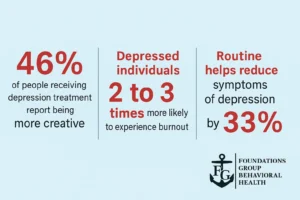
Routine Isn’t the Enemy of Creativity—It’s the Container
If you’ve lived in chaos for a while, the idea of “structure” might sound like a trap. But the right kind of structure isn’t confinement—it’s freedom.
Think about it like scaffolding on a building. It doesn’t limit what you can build. It just holds things in place while you do it.
In our depression treatment program in Barnstable County, MA, we don’t prescribe strict routines that kill spontaneity. We co-create rhythms that give your nervous system something to hold onto—so your creativity can breathe, instead of constantly fighting for survival.
You’d be amazed what shows up on the canvas when you’re not running on fumes.
You Can Still Be Deep Without Being Destroyed
There’s a particular kind of fear that comes up when your darkness has become your comfort zone. The thought of feeling better can feel like betrayal—like you’re abandoning the parts of you that have always spoken the loudest.
But you don’t lose your depth in healing. You gain control over it. You get to decide when and how to go there, instead of being dragged.
Some of the most powerful work I’ve seen come out of our program wasn’t created in crisis. It came from people who finally had space—mental, emotional, physical—to create without being at the mercy of their symptoms.
What Happens Inside a Depression Treatment Program?
First, it’s not what most people imagine. It’s not endless group shares or being told to “stay positive.” A real depression treatment program is more like a toolkit—with multiple ways to reconnect with yourself.
At Foundations Group Behavioral Health, this might include:
- Individual therapy that honors your identity—not tries to rewrite it
- Creative expression sessions (music, journaling, visual art—depending on your location and program level)
- Group therapy with people who understand emotional depth, not shame it
- Mindfulness practices that reduce overwhelm and increase clarity
- Clinicians trained in young adult and identity-focused support
Whether you’re deeply introverted, wildly expressive, or somewhere in between, treatment meets you where you are. Not where someone else thinks you should be.
You’re Allowed to Heal Without Explaining Yourself
One of the most underrated parts of being in treatment? You don’t have to perform. You don’t have to make your pain poetic. You don’t have to justify your sadness with some tragic backstory.
You get to just be—even if that version of you is quiet, confused, or awkward. That’s not a problem. That’s a beginning.
And in that beginning, your real voice—your artistic voice, your inner voice—gets a chance to speak clearly, without the filter of pain twisting every word.
FAQs: Depression Treatment & Creative Identity
Will I still be myself if I start treatment?
Yes. In fact, many people feel more like themselves once depression symptoms ease. Treatment doesn’t change who you are—it helps you access who you’ve always been, without the weight.
What if I lose my creativity when I feel better?
It’s a common fear, but in practice, most people gain creative access when they’re not exhausted, anxious, or emotionally overwhelmed. You may even explore new forms of expression you couldn’t before.
Do depression treatment programs include creative therapies?
Some do, especially those serving young adults. At Foundations Group Behavioral Health, expressive therapies are often integrated into care, and we welcome creative approaches in all forms.
Can I keep working or creating while in treatment?
Yes. Outpatient depression programs are designed to fit into your life. Whether you work a job, freelance, or are building a creative practice, we’ll help you find a rhythm that supports both healing and making.
Is medication required?
No. Medication is just one tool. You’ll work with your treatment team to decide what’s right for you. Therapy, routine, and emotional support alone can be powerful.
You don’t have to suffer to stay real.
Call 888-685-9730 or visit Foundations Group Behavioral Health’s depression treatment program page to learn more about our services in Cape Cod, MA.