

You’ve probably already tried something. Maybe therapy once a week. Maybe a few coping strategies that seemed promising at first. Maybe even apps, routines, or advice from people who meant well.
And yet… here you are. Still carrying it. Still waking up with that quiet tension in your chest.
If that’s true for you, it doesn’t mean you’re doing something wrong. It might mean you’ve only been given part of what you actually need.
You can explore more comprehensive care through our anxiety treatment program in Massachusetts, especially if what you’ve tried so far hasn’t reached deep enough.
The Comfort of “Just Enough” Support
There’s a kind of help that feels safe because it doesn’t ask too much of you.
You talk for an hour. You learn a few techniques. You leave feeling slightly lighter.
And for a while, that’s enough to get through the week.
But anxiety doesn’t always live on the surface. It waits. It adapts. It finds new ways to show up—through overthinking, avoidance, physical tension, or a constant sense of unease you can’t fully explain.
Surface-level support can feel like putting a bandage on something that actually needs time, attention, and deeper care.
Why “Understanding It” Doesn’t Always Change It
A lot of people reach a frustrating point where they get their anxiety.
They can name it.
They can explain where it comes from.
They can even predict when it’s going to show up.
And still—it shows up anyway.
That’s because anxiety isn’t just something you think. It’s something your entire system experiences.
It lives in your nervous system.
It shapes your habits.
It affects how your body reacts before your mind can catch up.
So while insight is powerful, it’s often not enough on its own.
Real progress usually requires repetition, support, and a space where you can actually practice responding differently—not just talk about it.
The Subtle Difference Between Coping and Changing
Coping skills are important. They help you survive difficult moments.
But there’s a difference between surviving anxiety… and slowly loosening its grip on your life.
Coping says:
- “Get through this moment.”
Deeper support says:
- “Let’s understand why this keeps happening—and change your relationship with it.”
That difference might not sound big on paper. But in real life, it changes everything.
Because one keeps you managing symptoms.
The other helps you build something steadier underneath them.
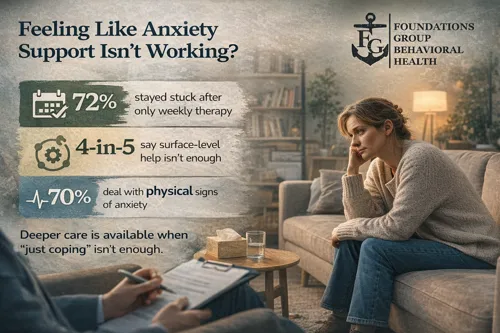
What Real Support Starts to Feel Like
People don’t always have the words for it at first. But they feel the shift.
It’s not sudden or dramatic. It’s quieter than that.
It might feel like:
- A little more space between your thoughts and your reactions
- A moment where you notice anxiety without immediately believing it
- The ability to stay present instead of escaping or shutting down
And over time, those small shifts start to add up.
Real support often includes:
- Consistent, structured time to focus on your mental health—not just squeeze it in
- Guidance that connects emotional patterns, physical responses, and behavior
- A sense that you’re not the only one experiencing this, even if it feels that way
In places like Falmouth, Massachusetts, many people quietly carry anxiety while still showing up for work, family, and responsibilities. From the outside, everything looks fine. Inside, it’s a different story.
And that’s often where deeper care begins—not at the point of collapse, but at the point of quiet exhaustion.
You Don’t Have to Be “Falling Apart” to Need More Help
There’s a common belief that you only need more support if things are visibly falling apart.
But a lot of people who benefit from deeper care are actually holding things together… just barely.
They’re:
- Functioning at work but constantly overwhelmed
- Showing up for others but feeling disconnected from themselves
- Getting through the day but dreading the quiet moments
If that sounds familiar, it doesn’t mean you’re not strong.
It means you’ve been carrying a lot—without enough support to match it.
Signs You Might Be Ready for Something More
You might not call it “treatment” yet. And that’s okay.
But you might recognize yourself in some of these:
- You feel stuck in patterns you understand but can’t change
- You’ve outgrown quick fixes and surface-level advice
- Your anxiety shows up physically, not just mentally
- You’re tired of managing symptoms and want real relief
- You keep wondering if there’s something more effective out there
That last thought matters.
Because it usually means there is.
Why Deeper Care Can Feel Scary (Even If You Need It)
It’s not just about logistics. It’s emotional.
Starting something more structured can bring up questions like:
- What if I can’t handle it?
- What if it changes me too much?
- What if I start and can’t follow through?
Those fears are real. And they deserve to be taken seriously.
But they’re also often part of anxiety itself—the part that tries to keep everything predictable, even if “predictable” means staying stuck.
The goal isn’t to push past fear.
It’s to move with support while that fear is still there.
What Happens When Support Matches What You’re Carrying
Something shifts when the level of support actually matches the weight of what you’ve been dealing with.
You don’t have to:
- Hold everything together by yourself
- Pretend you’re okay when you’re not
- Figure it all out in one hour a week
Instead, you get space to:
- Slow down
- Understand your patterns without judgment
- Practice new ways of responding—with guidance
In areas like Barnstable County, Massachusetts, access to more structured mental health support has become increasingly important—not because people are “worse,” but because more people are finally recognizing they don’t have to stay in survival mode.
You’re Not Behind—You’re Becoming More Aware
There’s a quiet thought many people have before seeking deeper help:
“Why didn’t I do this sooner?”
But that question usually comes from a place of hindsight, not truth.
You didn’t miss your chance.
You didn’t fail to figure it out.
You reached the point where what you had… wasn’t enough anymore.
And instead of ignoring that, you’re paying attention.
That’s not falling behind.
That’s moving forward.
FAQ: What People Often Wonder Before Taking the Next Step
Is it normal that what I’ve tried hasn’t worked long-term?
Yes. Many forms of support are designed for short-term relief. If your anxiety runs deeper, it often needs a more consistent and layered approach.
Do I have to be in crisis to get more structured help?
Not at all. In fact, many people benefit most when they seek support before things reach a breaking point.
What if I’m afraid I won’t be able to handle it?
That fear is common. The right support meets you where you are and adjusts with you—it doesn’t expect perfection.
Will I lose control over my routine or independence?
Good care is collaborative, not controlling. It’s about giving you tools and support, not taking away your autonomy.
How do I know if I’m “ready”?
Most people don’t feel fully ready. They just feel tired of staying the same—and willing to try something different.
You Don’t Have to Stay in This Loop
There’s a difference between enduring anxiety and actually working through it.
If you’ve been circling the same patterns, trying the same tools, and hoping something eventually clicks… it might not be about trying harder.
It might be about trying something that finally meets you at the right depth.
Ready to Talk?
You don’t have to figure this out alone.
Call 888-685-9730 to learn more about our anxiety treatment program in Massachusetts.
And just to say this clearly—because it matters:
If you’ve been holding this much anxiety for this long, it makes sense you’re tired.
It also means you’re still here, still looking, still open to something better.
That’s not something small.
That’s where change usually begins.