

You don’t have to “hit a wall” or carry a clinical label to benefit from anxiety treatment.
If you’re feeling off—tired of the loop in your head, a little more on edge than usual, or just deeply over your own overthinking—there’s a way forward that doesn’t involve turning your life into a diagnosis. For many people in Cape Cod and beyond, exploring an anxiety treatment program isn’t about identifying with a disorder. It’s about claiming some peace.
You can begin without a label. You can ask for help without explaining your entire life story. You can explore care without changing your identity.
Here’s how.
1. Stop Waiting for Things to Get “Bad Enough”
One of the most common ways anxiety hides is in high-functioning people.
You’re managing. You’re showing up. On the outside, things look okay. But inside, you’re exhausted from the spinning, the second-guessing, the quiet tension that never really lifts.
If you’ve ever said something like:
- “I’m just stressed—it’s fine.”
- “Other people have it worse.”
- “I can handle it…”
…you’re not alone. But you also don’t have to earn your way into care by falling apart.
Treatment isn’t just for people in crisis. It’s for anyone who wants to feel more at ease in their own head—and that’s a perfectly valid reason to reach out.
2. Choose a Program That Meets You Where You Are
At Foundations Group Behavioral Health, we understand that not everyone wants (or needs) a diagnostic label to begin care. Our approach to anxiety treatment is flexible, person-centered, and stigma-free.
When you join our anxiety treatment program in Massachusetts, you’re not signing a contract to be seen as broken. You’re simply saying, “I want support.”
We’ll help you identify what’s going on—whether that’s generalized anxiety, social anxiety, panic symptoms, or something you don’t even have words for yet—and offer treatment options that respect your pace, privacy, and preferences.
3. Ask Questions Without Apologizing
It’s okay to be unsure. It’s okay to want clarity before committing. And it’s definitely okay to ask how this works without explaining every detail of what you’re feeling.
Some great starter questions:
- “Can I just come talk to someone first?”
- “Do I need a formal diagnosis to begin?”
- “What if I’m not sure this is anxiety?”
Any program worth your trust will welcome these questions. Our team in Cape Cod answers them every day. We believe curiosity is a sign of health—not avoidance.
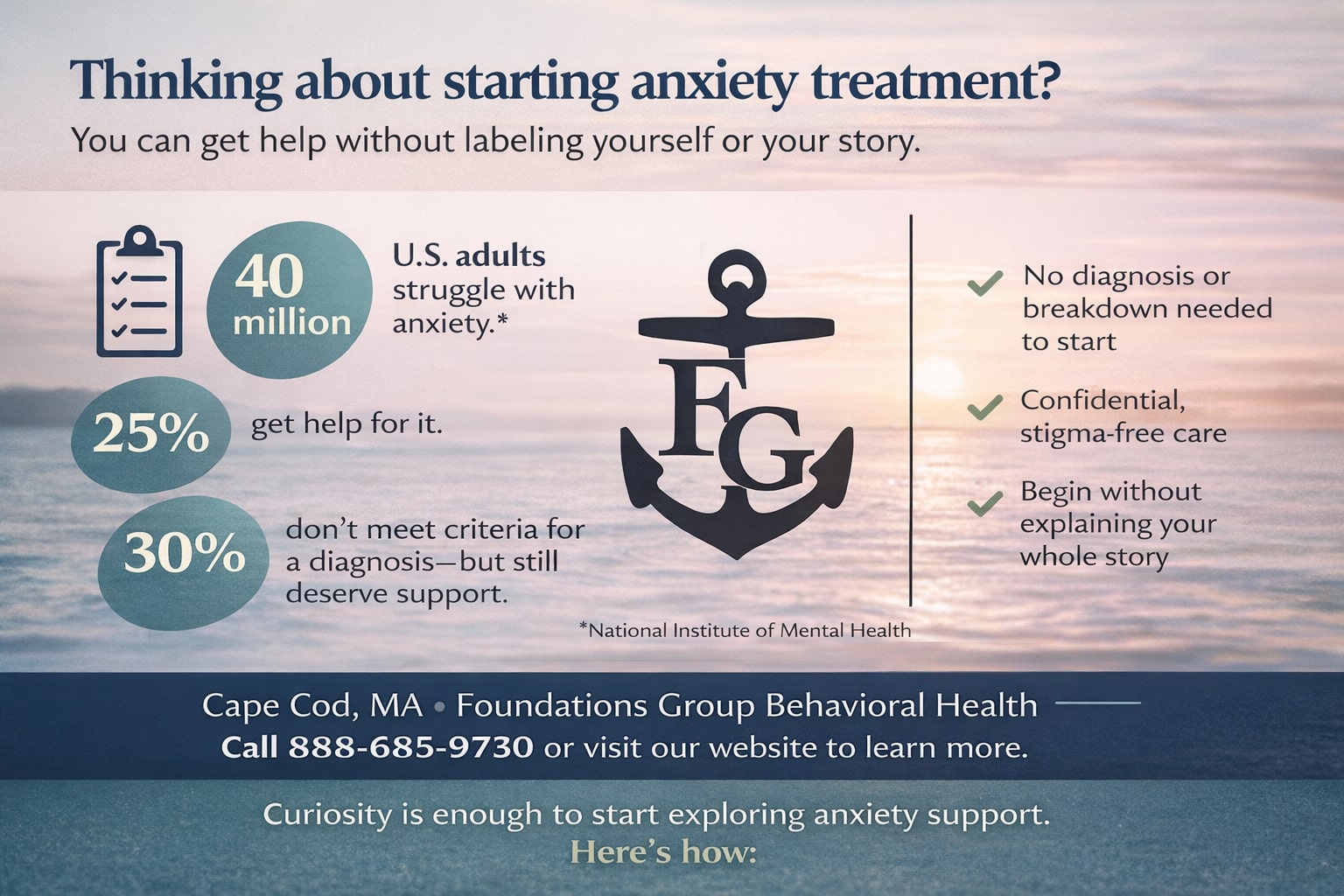
4. You Don’t Have to Call It a Diagnosis for It to Deserve Attention
Language matters. For many people who are sober curious, therapy curious, or just questioning their mental load, clinical terms can feel like boxes that don’t quite fit.
Here’s the truth: you don’t have to call it anxiety to get help for anxious feelings.
You can come in and say:
- “I feel unsettled most of the time.”
- “My thoughts won’t stop racing at night.”
- “I’m constantly bracing for something to go wrong.”
You can name the experience, not the diagnosis—and still get support that works.
5. Start with What Feels Safe and Low-Pressure
Not ready to jump into weekly therapy? That’s okay.
At Foundations Group, we offer a range of options—from short-term outpatient therapy to more structured anxiety programs. You can start small. You can start quiet. You can even start by just reading this blog and letting the idea of support become a little more real.
The point is: You get to define your pace. Treatment isn’t about pushing you—it’s about meeting you gently and consistently.
6. Explore Care in a Community That Normalizes It
In Barnstable County and Falmouth, more people are asking the question: “Could I feel better than this?”
It’s not a crisis moment. It’s a reflective one.
And it’s becoming more normal—especially among those who are quietly carrying big emotional loads while still holding down work, family roles, and relationships. You’re not weak for asking for support. You’re wise.
We’re seeing more people reframe therapy as personal maintenance—not a signal something’s wrong.
7. Give Yourself Permission to Want More Ease
One of the most loving things you can do for yourself is to stop pushing through anxiety like it’s your personality.
The pressure to stay “fine” keeps a lot of people from ever experiencing what calm really feels like. You deserve better than a constant undercurrent of tension. You deserve a nervous system that gets to exhale.
Let care be the doorway to that—not because you’re broken, but because you’re ready to feel different.
Frequently Asked Questions About Starting Anxiety Treatment
Do I need a diagnosis to begin anxiety treatment?
No. While some insurance-based programs require documentation, we offer exploratory services and evaluations that don’t demand a formal label right away. You can start with a consultation to talk about what you’re experiencing and explore next steps at your pace.
What if I’m not sure it’s anxiety?
That’s okay. You don’t need to be certain. Common symptoms like restlessness, overthinking, irritability, or difficulty sleeping might point toward anxiety—but they can also relate to other life stressors. We’ll help you understand what’s going on without pressure or assumptions.
Is this going on my “permanent record”?
Your privacy is always protected. Mental health treatment is confidential and protected by law. If you’re worried about stigma, insurance, or future implications, we can walk you through your options, including private-pay services that leave no formal paper trail.
Can I try treatment without committing long-term?
Absolutely. Many clients begin with a few sessions, then decide how they want to proceed. Our care team will never pressure you into more than you’re ready for.
What if I just want to learn coping tools?
Perfect. Many people enter anxiety treatment not because they feel “sick,” but because they want better skills to manage stress, perfectionism, or overwhelm. We offer evidence-based coping strategies and tools that you can take with you—regardless of whether you stay in long-term care.
📞 Ready to Take the First Step?
Call 888-685-9730 or visit our Cape Cod anxiety treatment page to learn more. You don’t need a diagnosis or a breakdown to explore support. Just curiosity—and the willingness to feel more at home in your own mind.