
No one talks about the middle part.
You know—the part that comes after the discharge paperwork, after the big “I did it,” after you’ve made it through an anxiety treatment program and everyone thinks you’re okay now.
You’re not in crisis. You’re not where you started. But you’re also not where you thought you’d be.
People assume you’re thriving. You’re functioning. Maybe even doing well on paper. But something feels off. The spark is dim. The tools help, but they don’t always land. The waves are smaller, but they still roll in. And what’s left behind is this strange, hollow middle.
If that sounds like you—you’re not alone. We see this all the time. And it doesn’t mean you failed. It just means you’re human. And the truth about recovery? It’s never linear.
You’ve Done the Hard Work—But That Doesn’t Mean It’s Over
There’s this idea that once you finish treatment, life just picks up and keeps moving. And in some ways, it does. You go back to work. You reconnect with people. You manage anxiety better than you used to.
But the emotional dust doesn’t always settle in the way people think it will.
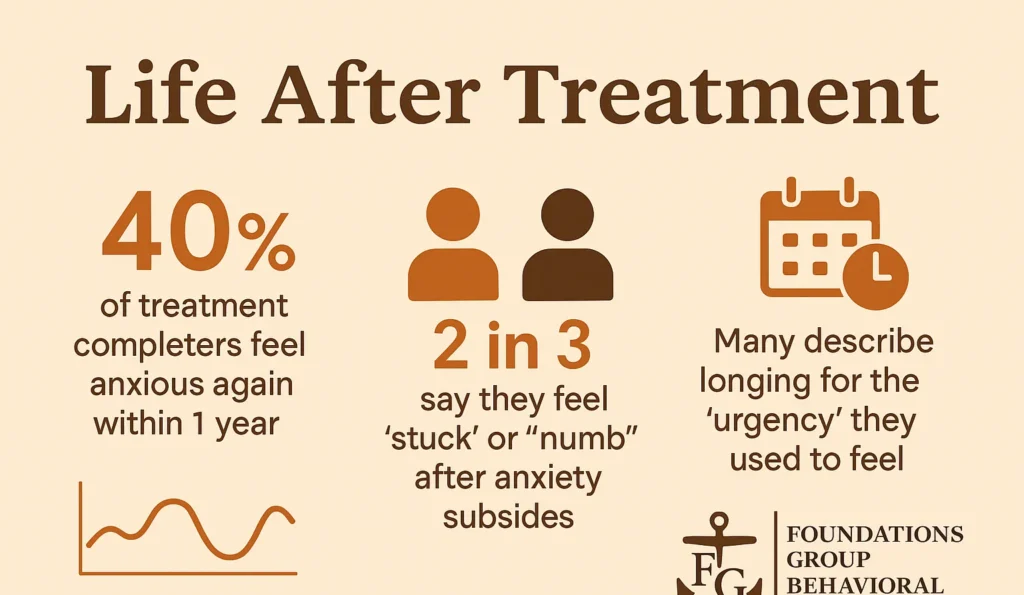
Some alumni describe it like this: “I’m doing all the right things, but I feel numb.” Others say, “I thought I’d feel proud. I mostly feel tired.”
If you’re feeling emotionally flat, stuck in neutral, or wondering why things aren’t more vibrant after treatment—please know that’s common.
This is the middle. The quiet part. The long-haul part.
It’s not failure. It’s the next step.
Peace Isn’t Always Exciting
Let’s talk about something that surprises a lot of high-functioning alumni: peace can feel kind of boring.
When you’ve lived for years in a cycle of anxious urgency—fueled by performance, panic, or people-pleasing—the absence of that adrenaline can feel like something’s missing. It’s not that you want to go back. But now that things are calmer, you might feel… unanchored.
We hear it all the time: “I know I’m better, but I feel empty.”
Or: “I miss the urgency, even though it wrecked me.”
Here’s the reframe: Peace doesn’t always feel like joy right away. Sometimes, it feels like silence. Sometimes like a blank page.
And that silence? It can be healing. It gives you space to feel things beyond fear. But it takes time to trust that stillness doesn’t mean stagnation.
This Is When Many People Ghost Their Progress
You may have noticed this part of the journey doesn’t get talked about much. That’s not an accident.
The middle isn’t flashy. It’s not crisis or breakthrough—it’s maintenance. It’s waking up and doing the things without always feeling the results. And because there’s less external feedback or urgency, it’s easy to disconnect.
This is when many people ghost their recovery routines.
Stop journaling. Cancel therapy. Avoid group. Tell themselves they’re fine—even when a small part of them knows they’re drifting.
And it makes sense. You’re tired. You want to believe you’re done with all of it. But this phase? This is when staying connected really matters.
You don’t have to be “back at square one” to benefit from a check-in. You don’t need a breakdown to justify asking for more support.
How We Support Alumni in the Hard Middle
At Foundations Group Behavioral Health, we don’t expect you to stay in touch just because your insurance covered 12 weeks of programming.
We support alumni because healing doesn’t end when the calendar does. Here’s what that looks like:
- Alumni check-ins: You can come back. Period. Whether it’s for a session, a group, or a full re-engagement—we welcome you without judgment or paperwork shame.
- Clinical booster sessions: Short-term, targeted refreshers to get back in touch with the tools and insight that helped you the first time.
- Peer-based support spaces: Because talking with people who get what you’re feeling makes all the difference.
- Family and relational support: For the conversations you’re still trying to navigate post-treatment.
Whether you’re near Barnstable County or part of our alumni network in Falmouth, MA, you’re always welcome back. Not as a new client. As the same person—just further along.
Recovery Isn’t About Constant Growth—It’s About Staying Real
If you’ve ever thought, I should be further along by now, we want to offer a different lens:
This part of the journey? It’s not a stall. It’s a settling.
Think about healing like soil. At first, everything looks dramatic—digging, tilling, planting. But eventually, it’s about roots forming underground. Quiet growth. You might not see it, but it’s happening.
You’re still recovering. You’re still worthy of support. Even when it’s quiet. Even when it’s boring. Even when you’re “fine.”
What We Wish Every Alumni Knew
You’re allowed to return. To need support. To be confused. To not be sure what you’re feeling.
You’re allowed to reach out and say:
- “I’m not in crisis, but I’m not thriving.”
- “I don’t know if I need help. I just feel… off.”
- “I thought I’d feel proud. I mostly feel numb.”
We’re not keeping score. You don’t need to be falling apart to be cared for.
In fact, the moment you feel yourself drifting? That’s the moment to re-anchor.
And if you’re here reading this? You’ve already started.
FAQs: Life After an Anxiety Treatment Program
Is it normal to feel disconnected after treatment?
Yes. Many people experience emotional flatness or confusion once anxiety subsides. Your system is adjusting to a new normal, and that can take time.
Can I reach out to Foundations even if I finished treatment a while ago?
Absolutely. We welcome alumni at every stage—whether it’s been three weeks or three years. The door is always open.
What if I’m not sure I need “treatment” again?
That’s okay. Many alumni benefit from short-term support, refreshers, or just a safe space to talk. You don’t have to label it anything big. You can just show up.
Are there specific alumni services in Cape Cod?
Yes. We serve alumni across Cape Cod, including in Falmouth and Barnstable County, with flexible, post-treatment support options tailored to your needs now—not just your past diagnosis.
What’s one small step I can take today?
Start with honesty. Name where you are. If something feels off, call or message us—even if you don’t know what to ask for. You don’t have to figure it out alone.
You’re not broken. You’re not behind. You’re just in the middle.
Call 888-685-9730 or visit Foundations Group Behavioral Health’s anxiety treatment program page to reconnect with support that meets you where you are—here in Cape Cod, or wherever you are now in your journey.