
I remember thinking, Well… that chapter’s closed.
Ninety days in, I felt steadier. I was sleeping through the night more often than not. I could go to the grocery store without mapping every exit. I wasn’t constantly scanning for danger that wasn’t there.
I truly didn’t think I would ever need an anxiety treatment program again.
And then, quietly at first, anxiety came back.
If you’re here, maybe it crept back in for you too. Not dramatic. Not catastrophic. Just subtle enough to make you question yourself. And then strong enough to knock the wind out of you.
I had bookmarked Foundations’ page on their anxiety treatment program months earlier. I told myself it was “just in case.”
I didn’t think I’d be the one clicking it again.
I Thought 90 Days Meant I Was Stable
There’s something symbolic about 90 days.
It feels like proof. Like evidence that you’ve figured it out.
By that point, I had routines. I had coping skills. I could name my triggers. I knew what grounding exercises worked for me. I even started giving advice to other people struggling with anxiety.
That’s the part that stings.
Because when anxiety came back, I didn’t just feel overwhelmed. I felt exposed.
Like I had built a house on sand and was shocked when the tide shifted.
But anxiety doesn’t care about your milestone markers. It cares about stress load, nervous system strain, sleep deprivation, grief, work pressure, life changes. It responds to accumulation.
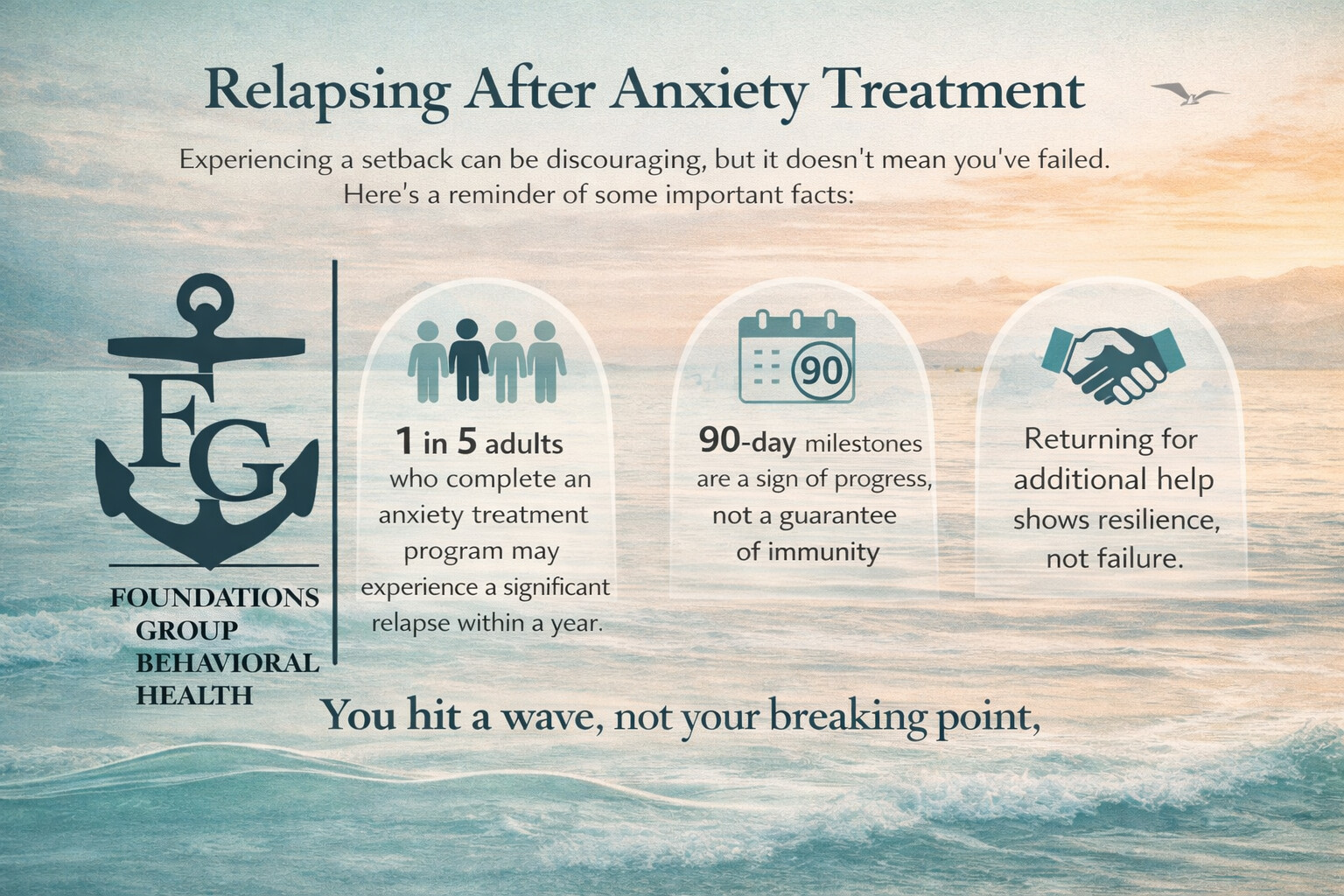
And sometimes 90 days is stability — not immunity.
The Relapse Didn’t Look Dramatic. It Looked Familiar.
For me, it started with small things:
- Avoiding a social event because I “just didn’t feel like it”
- Checking my phone repeatedly for no reason
- Lying awake with my mind rehearsing conversations that hadn’t happened
- Snapping at someone I love over something small
It wasn’t a breakdown. It was erosion.
Anxiety doesn’t always explode. Sometimes it slowly tightens around you like a drawstring bag.
And because I had “done well,” I told myself it couldn’t really be happening again.
That denial phase? It’s exhausting.
The Shame Was Worse Than the Anxiety
Here’s the part I wish more alumni talked about.
The anxiety coming back was hard.
But the shame was heavier.
I knew the tools. I knew the language. I knew what to do. So when I didn’t immediately “fix it,” I felt like a fraud.
My internal monologue sounded like this:
- You should be stronger than this.
- Other people don’t need to go back.
- You already had your chance.
That’s the cruel trick anxiety plays — it turns your recovery into a measuring stick you beat yourself with.
Going back to an anxiety treatment program didn’t feel like support.
It felt like proof I had failed.
Except… I hadn’t.
Why Going Back to an Anxiety Treatment Program Isn’t Starting Over
Here’s what I had to learn the hard way:
Returning to treatment is not resetting to zero.
It’s building on what you already know.
When I re-engaged in an anxiety treatment program, I didn’t feel like a beginner. I felt like someone who understood their patterns better. Someone who could articulate what wasn’t working. Someone who recognized the early warning signs sooner than before.
That’s growth.
Anxiety management isn’t about “curing” yourself once and for all.
It’s about learning how to respond when your nervous system flares up again.
At Foundations Group Behavioral Health, the approach to anxiety treatment acknowledges that healing isn’t linear. You don’t get shamed for coming back. You get supported for recognizing you need reinforcement.
There’s a difference.
Anxiety Is a Nervous System Pattern — Not a Character Flaw
One thing that shifted everything for me was understanding this:
Anxiety is not proof that you’re weak.
It’s a pattern in your nervous system.
And patterns can re-emerge under stress.
Maybe your workload increased. Maybe a relationship changed. Maybe something subtle triggered old fears. Sometimes there isn’t even a clear reason.
The point is this: your body responded the way it learned to respond.
An anxiety treatment program helps you interrupt that loop.
Not by telling you to “calm down,” but by helping you:
- Recognize early escalation
- Regulate your body, not just your thoughts
- Challenge distorted thinking patterns
- Build sustainable routines
- Strengthen resilience during stress spikes
It’s skill refinement, not remediation.
What Coming Back Gave Me (That White-Knuckling Didn’t)
I tried powering through on my own first.
I journaled more. Meditated longer. Avoided more triggers.
And still, I was exhausted.
When I returned to structured anxiety treatment, I got something I couldn’t give myself alone:
Accountability.
Community.
Perspective.
There’s something grounding about sitting in a room (or joining a group) where other people say, “Yeah. Me too.”
It takes anxiety out of isolation.
And isolation is where anxiety thrives.
If You’re an Alumni Afraid to Reach Out Again
Let me say this as someone who hesitated:
You are not an inconvenience.
You are not a disappointment.
You are not “the one who didn’t get it.”
Relapse after 90 days doesn’t erase the progress you made. It reveals where you need more support.
And needing support twice doesn’t mean you’re broken. It means you’re human.
The Foundations team understands that anxiety can ebb and flow. The goal isn’t perfection. It’s resilience.
FAQ: Returning to an Anxiety Treatment Program
Is it normal for anxiety to come back after 90 days?
Yes. Anxiety is influenced by stress, life changes, sleep, health, and environment. Even if you’ve made progress, new stressors can reactivate old patterns. This doesn’t mean treatment “didn’t work.” It means anxiety management is ongoing.
Does going back to an anxiety treatment program mean I failed?
No. It means you’re responding early instead of waiting for things to get worse. Returning to treatment is proactive, not regressive.
Think of it like physical therapy. If pain flares up, you go back for reinforcement. You don’t assume you’re hopeless.
What if I’m embarrassed to call?
That’s incredibly common.
Shame is part of the relapse cycle. But treatment providers are not surprised by alumni returning. It happens. Often.
You won’t shock anyone. You won’t disappoint anyone. You’ll be met with professionalism and compassion.
Will treatment look the same as last time?
Not necessarily.
Your needs may be different now. You may require a different level of care, new coping strategies, or deeper work around stress, trauma, or thought patterns.
Anxiety treatment programs are designed to adapt — not copy-paste.
How do I know if I need to go back?
You might benefit from returning if:
- Your anxiety is interfering with work, relationships, or sleep
- You’re avoiding more and more situations
- Panic symptoms are increasing
- You’re isolating
- Coping skills aren’t enough anymore
- You feel overwhelmed most days
You don’t have to hit a breaking point to deserve help.
What makes a structured anxiety treatment program helpful?
Structure reduces uncertainty.
Programs typically include:
- Individual therapy
- Group therapy
- Skills training (like CBT-based tools)
- Emotional regulation strategies
- Supportive accountability
Instead of guessing what to do next, you have a plan.
And when anxiety clouds your thinking, having a plan matters.
You Didn’t Ruin Everything
If your anxiety is back and you’re quietly panicking about what that means, pause.
Take a breath.
Relapse doesn’t invalidate progress. It highlights where reinforcement is needed.
You didn’t ruin everything.
You hit a wave.
And waves pass faster when you’re not swimming alone.
If anxiety has crept back in and you’re tired of pretending it hasn’t, you don’t have to handle it by yourself. Foundations Group Behavioral Health offers structured, compassionate care designed to meet you where you are — even if that place feels frustratingly familiar. Personalized mental health & addiction care in Barnstable County, Falmouth, MA.
Call 888-685-9730 or visit to learn more about our Anxiety treatment program services in Cape Cod, MA.