

I’ve sat across from people who run companies, raise families, and answer emails at 11:30 p.m. like everything is under control.
And then, quietly, they admit something that doesn’t match the life they’re presenting.
“I’m holding everything together… but I’m not okay.”
Many of the people who eventually find us through our support when mental health and substance use collide look exactly like the kind of people society assumes are fine.
But there’s a pattern we see again and again.
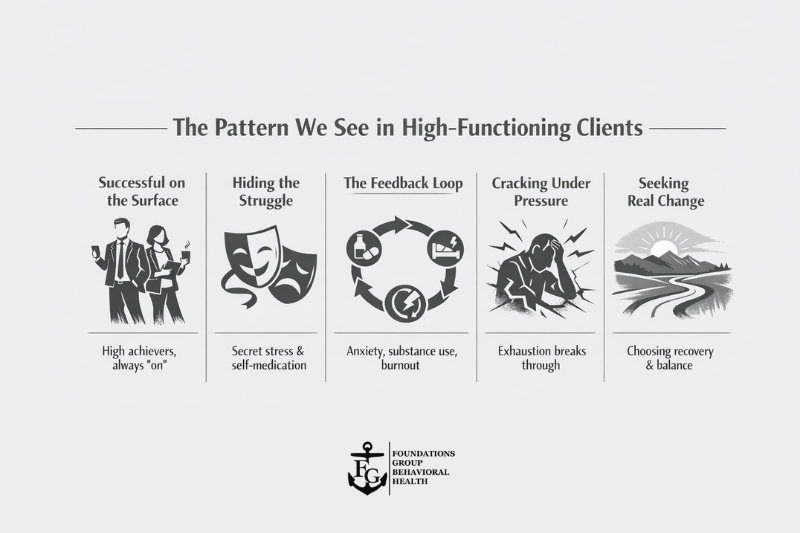
Success Becomes the Perfect Disguise
High-functioning clients rarely look like the stereotype of addiction or mental health collapse.
They show up to work.
They meet deadlines.
They keep the house running.
From the outside, it’s stability.
From the inside, it’s survival.
Alcohol becomes the off-switch after an anxious day. Pills smooth the edges of panic. Stimulants help them keep up with the pace they’ve built their identity around.
What people see as discipline is often just controlled chaos.
They’ve Been White-Knuckling Life for Years
When someone finally sits down in a clinician’s office, the story usually doesn’t start with a recent crisis.
It starts years earlier.
Maybe anxiety that never fully quieted.
Depression that came in waves.
Trauma that was never spoken about.
Instead of slowing down, high-functioning people often do the opposite.
They push harder.
More work.
More responsibility.
More pressure.
Achievement becomes armor. But armor is heavy.
The Quiet Fear of Being Found Out
High-functioning clients often live with a private, exhausting fear:
If people really knew what was happening behind the scenes.
They worry about colleagues discovering how much they drink at night.
They hide panic attacks during meetings.
They rehearse conversations so no one hears the strain in their voice.
It creates a strange double life.
Competent on the outside.
Barely holding together on the inside.
And the longer that split exists, the heavier it becomes.
When Mental Health and Substance Use Start Feeding Each Other
One of the most common patterns we see is the feedback loop.
Anxiety leads to drinking.
Drinking worsens sleep and mood.
Exhaustion increases anxiety the next day.
Soon the coping strategy becomes part of the problem.
People tell themselves it’s temporary. That they’ll scale it back after the next big project, the next quarter, the next promotion.
But the body keeps score.
And eventually the system they built to manage life starts breaking down.
The Moment Something Finally Cracks
For high-functioning people, the turning point rarely looks dramatic.
It’s often quiet.
A panic attack in a parking lot before work.
Forgetting a conversation they should remember.
Realizing the day revolves around when they can drink again.
Or the moment they notice something scarier:
They’re exhausted in a way sleep doesn’t fix.
One client described it perfectly:
“It’s like I’m running my entire life on fumes and caffeine.”
That’s usually when people begin searching for real help.
What High-Functioning Clients Often Discover in Treatment
The biggest surprise for many people is this:
They don’t have to burn their entire life down to get better.
Recovery for high-functioning professionals often focuses on stabilizing both sides of the struggle at the same time — the mental health side and the substance use side.
Not judgment.
Not shame.
Just honest work and structured support.
Many people who enter behavioral health treatment programs Massachusetts settings discover something they didn’t expect:
Relief.
Relief from constantly performing.
Relief from managing two lives.
Relief from pretending they’re fine.
And from there, things begin to rebuild in a healthier way.
You Don’t Have to Wait for a Collapse
One of the myths about addiction and mental health treatment is that people only go when everything falls apart.
That’s simply not true.
Some of the most motivated clients we work with are the ones who recognized the pattern early.
They saw the direction things were heading.
And they decided exhaustion didn’t have to be the price of success.
If you’re quietly wondering whether your life has started to revolve around coping instead of living, it might be time to talk to someone who understands the full picture — both mental health and substance use together.
Call 888-685-9730 or visit our co occurring disorder treatment program Massachusetts page to learn more about our behavioral health treatment programs Massachusetts, co occurring disorder treatment program Massachusetts services.