

The hardest part wasn’t the anxiety.
It was admitting it was back.
Not all at once. Not in some dramatic collapse. It came back quietly—like a familiar song playing in another room. You hear it, but you pretend you don’t recognize it.
At first, I told myself I was just stressed. Busy. Tired.
But when I started waking up with that tight feeling in my chest again, the one I knew too well, the truth became harder to ignore.
And that’s when the real fear showed up.
Not the anxiety.
The shame.
Because I had already done the work once. I had already learned the language. I had already been through treatment. Going back felt like admitting something had gone wrong.
But eventually I chose to reach out again—to revisit the support I first found through an anxiety treatment program.
Not because I failed.
Because disappearing would have been worse.
The Quiet Way Anxiety Returns
Most people imagine relapse as something obvious.
A big moment. A breakdown. A crisis.
But anxiety rarely announces itself that clearly.
It usually starts with small shifts.
You notice sleep getting lighter.
Your thoughts start running faster than usual.
You reread the same message five times before replying.
Then comes the overthinking.
Conversations replaying in your head at night.
Small decisions feeling strangely heavy.
A constant hum of tension that never fully turns off.
When you’ve lived with anxiety before, there’s a moment where your body recognizes it before your mind does.
Like hearing footsteps behind you that sound familiar.
And part of you hopes you’re wrong.
The Lie Alumni Carry After Treatment
There’s an unspoken pressure many alumni carry after finishing treatment.
The belief that once you’ve done the work, you’re supposed to have it handled forever.
You hear a voice that says:
You should know better now.
That voice can be brutal.
It tells you that reaching out again means everything you learned didn’t stick. That going back somehow erases the progress you made.
So instead of asking for support, many people do something else.
They go quiet.
They stop checking in.
They avoid the people who helped them before.
They pretend they’re still okay.
I almost did the same thing.
The Moment I Almost Disappeared
There was a night when my mind wouldn’t slow down.
Every worry I’d managed for years came rushing back like it had been waiting for the door to open.
I remember sitting there thinking:
I can’t go back. That would mean I failed.
But then another thought appeared.
What if pretending I’m fine is the real mistake?
That moment changed something.
Because anxiety doesn’t get smaller when you isolate yourself from help.
It grows.
And I realized something simple but important:
Going back for support wasn’t the embarrassing choice.
Disappearing was.
Walking Back Through the Door
I expected that first step to feel humiliating.
Like showing up somewhere you weren’t supposed to need anymore.
Instead, it felt… normal.
No one looked disappointed.
No one asked why I hadn’t handled it alone.
The people there understood something I had forgotten.
Mental health doesn’t move in straight lines.
You don’t graduate from needing support forever.
Sometimes life shifts in ways that require you to recalibrate.
And that’s not failure.
That’s maintenance.
What Returning Actually Felt Like
One of the biggest surprises about coming back was realizing how much I already knew.
The tools that once felt complicated came back quickly.
I could identify when my thoughts were spiraling.
I could recognize the patterns earlier.
I could speak more honestly about what I was experiencing.
The difference was that I wasn’t learning these things for the first time.
I was reinforcing them.
Think of it like returning to the gym after a long break.
Your muscles remember more than you expect.
Your mind does too.
Why Anxiety Sometimes Comes Back
Here’s something I wish someone had told me earlier.
Recovery doesn’t mean your brain never struggles again.
Life keeps changing.
New stress appears.
Relationships evolve.
Responsibilities grow.
Even positive changes—like career moves or family transitions—can trigger anxiety patterns that were quiet for years.
The tools you learned in treatment still matter.
But sometimes those tools need to be refreshed in an environment where mental health is the focus again.
That’s what structured support can provide.
Not a restart.
A reset.
The Unexpected Relief of Not Pretending
Something interesting happens when you return to a space where people openly talk about anxiety.
The pressure to perform stability disappears.
You don’t have to pretend everything is fine.
You don’t have to hide the fact that your thoughts feel loud some days.
You’re simply around people who understand what it’s like to live inside a busy mind.
That kind of honesty can feel incredibly freeing.
Because anxiety thrives in secrecy.
But it weakens when it’s spoken out loud.
The Courage It Takes to Come Back
People often talk about the courage it takes to ask for help the first time.
But in many ways, the second time is harder.
The first time, you’re overwhelmed.
The second time, you’re aware.
You know the process. You know what it means to admit you need support again.
And your pride can get involved.
But choosing to come back anyway is a powerful act of self-respect.
It means you’re paying attention to your mental health instead of ignoring it.
And that awareness can protect everything you’ve worked to build.
What I Wish Someone Told Me Sooner
If I could go back and tell my earlier self one thing, it would be this:
Progress doesn’t disappear when you ask for help again.
Everything you learned still exists.
The self-awareness.
The coping tools.
The strength it took to face your anxiety the first time.
Returning to support doesn’t erase those things.
It strengthens them.
Because mental health isn’t about never struggling again.
It’s about knowing where to turn when you do.
FAQ: Questions Alumni Often Ask Before Coming Back
Does returning for support mean treatment didn’t work?
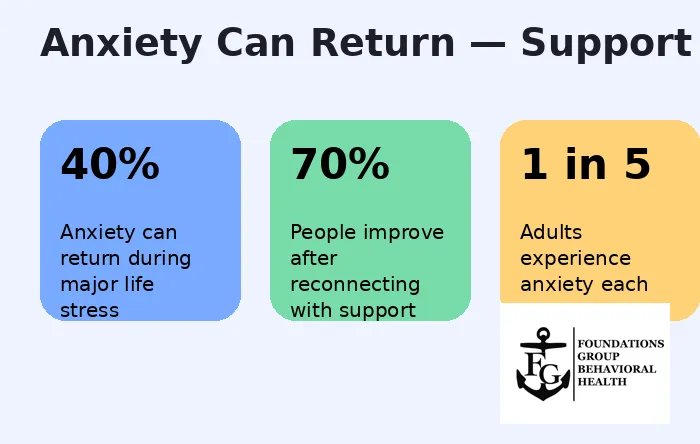
No. Mental health is ongoing, and many people revisit care during different seasons of life. Returning often strengthens the progress you’ve already made.
Is it common for anxiety to return after improvement?
Yes. Anxiety can fluctuate based on stress, environment, and life changes. Many people experience periods where additional support helps them stabilize again.
Will the staff or team be disappointed in me?
Treatment professionals understand that progress isn’t linear. Alumni returning for support are usually met with encouragement and respect, not judgment.
What if I feel embarrassed reaching out again?
That feeling is extremely common. Many alumni worry about this before reconnecting. Most find the experience relieving once they take the first step.
Will I have to start from the beginning again?
Not usually. Returning clients often build on what they previously learned rather than starting from scratch.
How do I know if it’s time to reconnect with support?
If anxiety is interfering with sleep, focus, relationships, or daily life—and your usual coping strategies aren’t helping—it may be a good time to talk with someone again.
What if I’m afraid of being stuck in anxiety forever?
Many people feel this way during difficult periods. Anxiety can make the future feel smaller than it actually is. Support helps widen that perspective again.
If You’re Thinking About Disappearing, Pause for a Moment
When anxiety returns, hiding can feel easier than asking for help.
You might think disappearing will protect your pride.
But hiding rarely quiets anxiety.
It just makes you carry it alone.
If you’re reading this and wondering whether to reach out again, the fact that you’re asking that question already means something important.
You’re paying attention to yourself.
And that awareness is the same strength that helped you the first time. Personalized mental health & addiction care in Barnstable County, Falmouth, MA.
Call 888-685-9730 or visit our page on anxiety care options to learn more about our Anxiety treatment program services.