

I didn’t want to go back.
That’s the part I need to say first, because if you’re here, you probably feel that same resistance.
I had time under my belt. I had progress. People trusted me again. I even started to trust myself—at least a little.
And then something shifted. Not all at once. Just enough to feel it.
If you’re standing in that space right now—half aware, half in denial—I want you to hear this clearly: going back didn’t erase anything I built. It showed me what I was still missing.
If you’re considering that step, you can explore support through this anxiety treatment program in Massachusetts—not as a reset, but as a continuation of something that still matters.
The Part No One Prepares You For After You Leave
There’s this quiet assumption that once you’ve done the work, things should stabilize.
Not perfect. But manageable.
And for a while, they were.
I had routines. I had structure. I had enough distance from the worst of it to feel like I was moving forward.
But anxiety didn’t disappear. It just changed its shape.
It became quieter. Less obvious. Easier to justify.
It sounded like:
- You’re just tired
- This isn’t a big deal
- You’ve handled worse before
And because it didn’t look like a crisis, I let it stay.
I Didn’t Crash — I Drifted
There wasn’t a moment where everything fell apart.
No dramatic turning point.
Just small shifts:
- Skipping things that used to help
- Avoiding conversations that felt too real
- Letting routines loosen just enough to feel it
I told myself I was fine.
But “fine” started to feel like something I had to maintain instead of something I actually was.
That’s how anxiety works sometimes.
It doesn’t break you. It slowly disconnects you from yourself.
The Thought That Kept Me Stuck Longer Than Anything Else
The hardest part wasn’t what I was feeling.
It was what I believed about it.
I shouldn’t be here again.
I already did this.
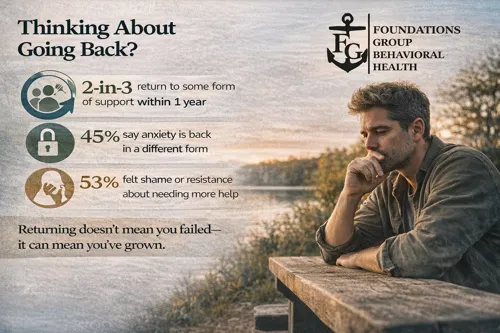
If I go back, it means none of it worked.
That belief kept me in place longer than the anxiety itself.
Because I wasn’t just dealing with what I felt—I was fighting what it meant.
And shame is heavy. Heavier than most people realize.
The Moment That Changed Everything (Even Though It Was Quiet)
It wasn’t dramatic.
No breakthrough. No big conversation.
Just a thought I couldn’t ignore anymore:
What if going back isn’t failure… what if it’s honesty?
That question didn’t fix anything overnight.
But it cracked something open.
Because if it was honesty, then:
- I didn’t have to pretend anymore
- I didn’t have to wait until things got worse
- I could respond instead of react
And that was new for me.
Going Back Didn’t Feel Like Strength — Until It Did
At first, it felt like defeat.
Walking back into support with the same fears, the same patterns—it was uncomfortable in a way I didn’t expect.
But something shifted quickly.
I wasn’t there to prove anything this time.
I wasn’t trying to be the “good client.”
I wasn’t trying to move quickly or show progress.
I was just… honest.
And that honesty created space I didn’t have before.
In places like Falmouth, Massachusetts, it’s easy to keep things looking stable on the outside.
But inside, I was tired of holding everything together.
Going back gave me permission to stop performing—and start actually paying attention.
The Second Time Was Deeper — Not Harder
I thought it would feel like repeating the same steps.
It didn’t.
It felt like understanding them for the first time.
The first time, I learned tools.
The second time, I learned patterns.
I started to notice:
- How early anxiety actually shows up in my body
- The moments I disconnect before I even realize it
- The subtle ways I avoid—not situations, but feelings
There was less pressure to “fix” things.
More space to understand them.
And that made the work feel different.
More real. Less rushed.
I Stopped Trying to Be “Done”
This was a big one.
The first time, I wanted an ending.
A point where I could say: I’m good now.
The second time, I let that go.
Because the truth is, anxiety doesn’t always disappear.
But your relationship with it can change.
And that change doesn’t come from rushing through it.
It comes from staying with it—long enough to understand it.
What I Wish Someone Had Told Me Sooner
I wish someone had said this without softening it:
You don’t outgrow needing support.
You grow into needing different kinds of it.
And that’s not a step backward.
It’s what happens when you stop settling for surface-level change.
In communities like Barnstable County, Massachusetts, I’ve learned that a lot of people return to support quietly.
Not because they failed.
Because they’re paying attention earlier than they did before.
The Shame Was Loud — But It Wasn’t Telling the Truth
That voice in your head?
The one saying:
- You should’ve handled this
- You’re back at square one
- This means something is wrong with you
It feels real.
But it’s not accurate.
Because if you were truly back at the beginning, you wouldn’t be aware of it.
You wouldn’t be questioning it.
You wouldn’t be here.
Awareness is not failure.
It’s the opposite.
If You’re Thinking About Going Back, Read This Slowly
You’re not weak for needing more support.
You’re not behind.
You didn’t undo your progress.
You reached the edge of what was working—and instead of ignoring it, you’re noticing it.
That’s not something to be ashamed of.
That’s something to respect.
FAQ: The Questions I Didn’t Want to Say Out Loud
Does going back mean I failed?
No. It usually means you’ve reached a point where you need deeper support—not that what you did before didn’t matter.
Why does it feel worse this time?
Because you’re more aware. You see what’s happening earlier, which can feel heavier—but it also means you can address it sooner.
What if I don’t want to start over again?
You’re not starting over. You’re building on what you already know, just with more honesty.
Is it normal to feel embarrassed about going back?
Yes. But that feeling often comes from expectations, not reality. Many people return more than once.
How do I know if it’s time?
If you’re asking yourself the question, it’s worth exploring. You don’t have to wait until things fall apart.
This Wasn’t Me Losing Everything — It Was Me Choosing Something Real
Looking back, I didn’t lose progress.
I stopped pretending I didn’t need more.
And that’s what changed everything.
Because the second time wasn’t about doing it perfectly.
It was about doing it honestly.
Ready to Talk?
You don’t have to figure this out alone.
Call 888-685-9730 or visit our behavioral health treatment programs massachusetts to learn more.
If you’re standing at that edge right now—unsure, uncomfortable, questioning everything—just know this:
Going back doesn’t mean you gave up.
It means you’re still willing to show up.
And that matters more than anything you think you lost.