

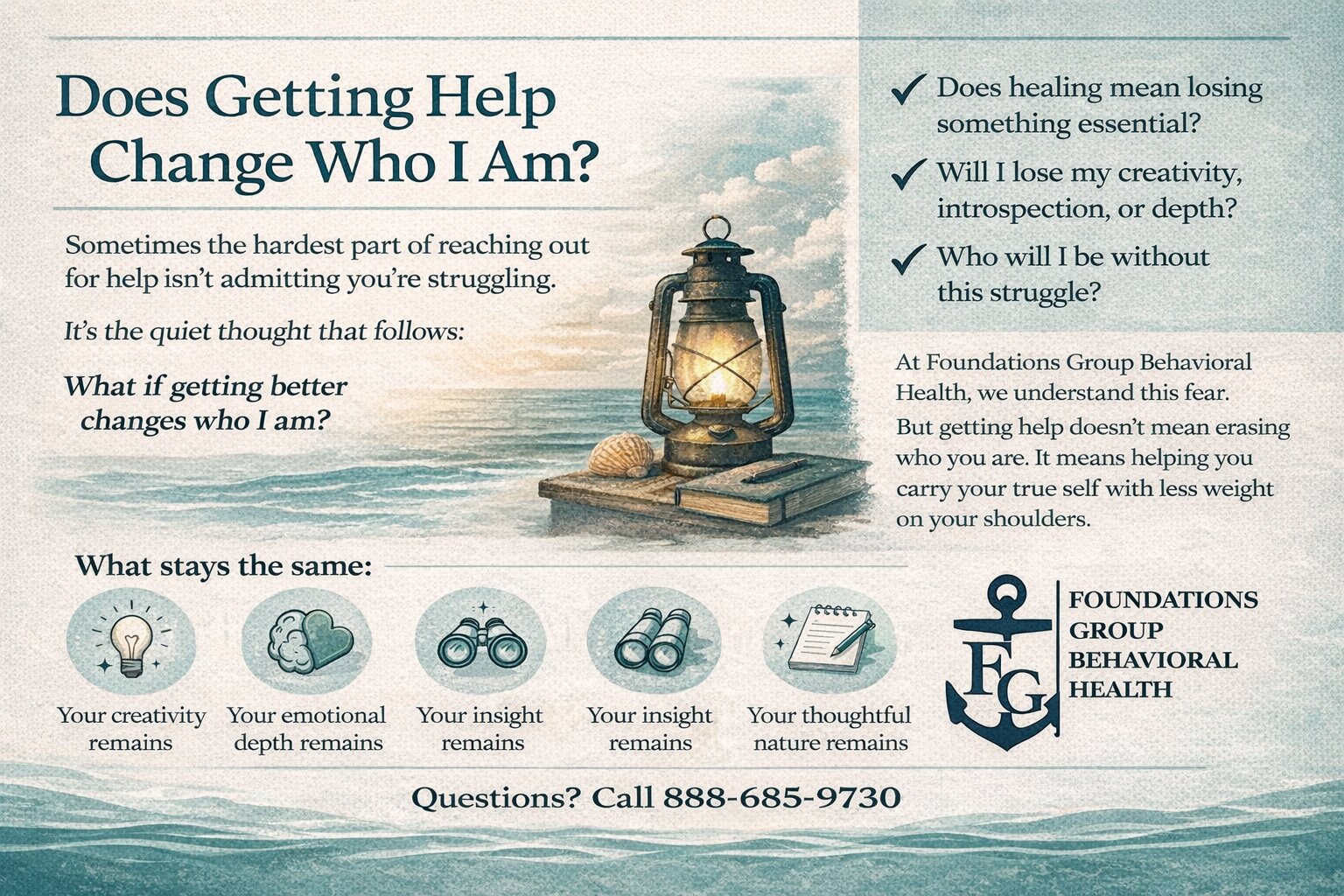
Sometimes the hardest part of reaching out for help isn’t admitting you’re struggling.
It’s the quiet thought that follows.
What if getting better changes who I am?
For many thoughtful, creative, or emotionally sensitive people, depression can feel strangely intertwined with identity. The depth of your feelings, the way you observe the world, the way you process life—those things can feel connected to the struggle itself.
So when someone suggests treatment, a natural fear can appear:
Will I lose something important about myself?
At Foundations Group Behavioral Health, we hear this concern often from people exploring a depression treatment program. And it deserves a thoughtful, honest response.
Because the goal of care is not to erase who you are.
It’s to help you carry your life without the constant weight depression places on it.
When Depression Becomes Part of Your Identity
Depression rarely appears overnight.
For many people, it builds gradually through years of stress, emotional strain, or life transitions. Over time, it can begin to influence how you see yourself and the world around you.
You may notice things like:
- Thinking deeply about life’s meaning or purpose
- Feeling emotions intensely compared to others
- Reflecting constantly on your experiences
- Being highly aware of subtle shifts in mood or relationships
These traits can sometimes feel like strengths—but when depression deepens, they can also become exhausting.
Some people begin to wonder whether their creativity, empathy, or introspection is tied to their sadness. If the sadness lifts, they worry the rest might disappear too.
This fear is understandable. But it often misunderstands what depression is actually doing behind the scenes.
What Usually Stays the Same
One of the most reassuring discoveries people make during treatment is that their core personality remains intact.
The thoughtful parts of you don’t disappear.
Your creativity doesn’t vanish.
Your emotional awareness doesn’t flatten.
In fact, many people discover those qualities become easier to access once depression is no longer consuming so much mental energy.
Think of depression like static on a radio signal.
The music was always there. The signal just needed clearing.
When that static fades—even slightly—people often reconnect with the parts of themselves they were afraid of losing.
Sometimes they realize those qualities were never tied to their suffering in the first place.
What Often Begins to Change
While your identity stays intact, certain experiences do begin to shift.
One of the biggest changes people notice is the quieting of constant self-criticism.
Depression often creates a relentless internal narrator that sounds something like this:
You’re falling behind.
You should be doing more.
Other people are handling life better than you.
This voice can become so familiar that people start to assume it’s simply part of their personality.
But it isn’t.
As people begin receiving support—through therapy, reflection, and structured care—that voice gradually softens. It may not disappear immediately, but it loses its authority.
And when it quiets, something remarkable happens.
People begin to think more freely.
They begin to imagine again.
Why Structure Can Actually Protect Creativity
When people hear the word “treatment,” they sometimes imagine rigid schedules or clinical environments that suppress individuality.
But the reality is often very different.
Depression tends to disrupt daily rhythm. Sleep becomes irregular. Focus disappears. Motivation fades.
Creative thinking becomes difficult when the mind is overwhelmed by exhaustion.
Structured daytime care provides a steady rhythm during the week—time for reflection, conversation, and emotional processing.
Instead of suppressing creativity, this kind of environment often protects it by reducing the chaos that depression creates.
Many people find their thoughts become clearer once their days have a little more stability.
The Quiet Power of Being Around People Who Understand
Depression can be deeply isolating.
Even people with supportive families or close friends often feel like no one truly understands what they’re experiencing.
This isolation can create the illusion that you’re alone in your thoughts.
But when people begin sharing their experiences with others navigating similar struggles, something shifts.
They hear someone describe the exact feeling they thought only they had.
The exhaustion.
The quiet hopelessness.
The sense of being disconnected from life.
Those moments of recognition can be powerful.
Not because they fix everything—but because they remind people that their experience is human, not shameful.
And connection often becomes one of the first steps toward healing.
Healing Often Happens in Small, Quiet Ways
Many people imagine recovery as a dramatic breakthrough.
A single moment where everything suddenly feels different.
In reality, healing often unfolds in much quieter ways.
You might notice that getting out of bed feels slightly easier.
You might laugh at something unexpectedly.
You might find yourself curious about something again after months of emotional numbness.
These shifts can feel small, but they’re meaningful signals.
They show that your mind is beginning to re-engage with the world around you.
And that reconnection often grows over time.
The Truth Many People Discover Along the Way
When people first enter care, they sometimes worry they’ll come out a completely different person.
But the reality most people describe is something else entirely.
They don’t feel like someone new.
They feel like someone who has more breathing room.
More emotional space.
More mental clarity.
More ability to move through life without carrying constant heaviness.
In many ways, treatment doesn’t change who you are.
It helps remove the weight that has been hiding parts of you for a long time.
FAQ: Common Questions About Getting Help Without Losing Yourself
Will treatment change my personality?
No. The goal of care is not to change who you are but to help relieve the symptoms that make daily life harder. Most people find their authentic personality becomes clearer once depression begins to lift.
What if my creativity feels connected to my emotions?
Many creative individuals worry about this. In reality, many people find that when depression becomes less overwhelming, they actually gain more energy and clarity to express their ideas and emotions creatively.
Do I have to take medication to get help?
Not always. Many people begin with therapy, structured care, and emotional support. Medication may be discussed as an option, but it is often part of a larger conversation about what feels right for you.
What if I’m not sure I’m ready for treatment?
That hesitation is normal. Many people spend time learning about their options and talking with professionals before deciding what steps to take. Simply gathering information can be a meaningful first step.
Will I still feel like myself if I start feeling better?
Most people describe feeling more like themselves—not less. When depression eases, people often reconnect with interests, creativity, and relationships that once felt distant.
How long does it take to start feeling better?
Everyone’s timeline is different. Some people begin noticing small shifts within weeks, while others experience gradual improvement over several months. Progress often happens through many small steps.
You Don’t Have to Choose Between Your Identity and Getting Help
If you’ve been hesitating to seek support because you’re afraid of losing something essential about yourself, that fear deserves compassion.
Your identity matters.
Your creativity matters.
Your emotional depth matters.
Getting help isn’t about flattening those parts of you.
It’s about helping you carry them without the constant weight of depression pressing down on everything.
And when that weight begins to lift, many people discover something surprising.
They didn’t lose themselves.
They found themselves again. Personalized mental health & addiction care in Barnstable County, Falmouth, MA.
If you’re curious about what support could look like for you, our team is here to talk. Call 888-685-9730 or visit our page on depression care options to learn more about our Depression treatment program services.