
I remember sitting in group, pretending to listen while secretly scanning the room.
Who looked lighter.
Who cried.
Who sounded insightful.
I wasn’t there to heal. I was there to measure.
And every day, I came up short.
If you’ve ever walked out of a Depression treatment program thinking, “It worked for them. It just didn’t work for me,” I need you to know something:
Comparison can quietly sabotage your progress long before depression does.
Let’s talk about it.
I Turned Healing Into a Scoreboard
No one told me to compare myself.
But depression already had me believing I was behind in life — behind in success, relationships, emotional maturity. So when I entered treatment, that mindset came with me.
In group, I watched:
- The woman who cried every session.
- The guy who used perfect therapy language.
- The person who said, “I finally feel hopeful.”
Meanwhile, I felt flat. Or irritated. Or numb.
So I created a mental scoreboard:
- Emotional openness = A+
- Breakthrough moment = A
- Visible vulnerability = Passing
- Quiet and unsure = F
Guess where I put myself?
Depression isn’t just sadness. It’s distorted thinking. And one of its favorite distortions is comparison.
It whispers:
- “They’re trying harder than you.”
- “You’re not doing this right.”
- “If it was going to work, you’d feel it by now.”
That voice feels logical. It feels observant. It feels smart.
But it’s the illness talking.
I Mistook Numbness for Failure
Here’s something that doesn’t get said enough:
Not everyone in treatment feels dramatic emotional shifts.
Some of us feel nothing.
And that nothing is terrifying.
When other people cried, I felt jealous. Not because I wanted to suffer more — but because their emotion felt like proof of movement.
My numbness felt like a dead end.
What I didn’t understand yet was that numbness is a protective response. For some of us, depression shuts down feeling because it’s overloaded. You can’t force emotion back online by sheer will.
And just because your healing doesn’t look loud doesn’t mean it isn’t happening underneath.
Sometimes the first sign of change is this:
You keep showing up.
Even when you’re skeptical.
Even when you’re annoyed.
Even when you think it’s pointless.
That counts.
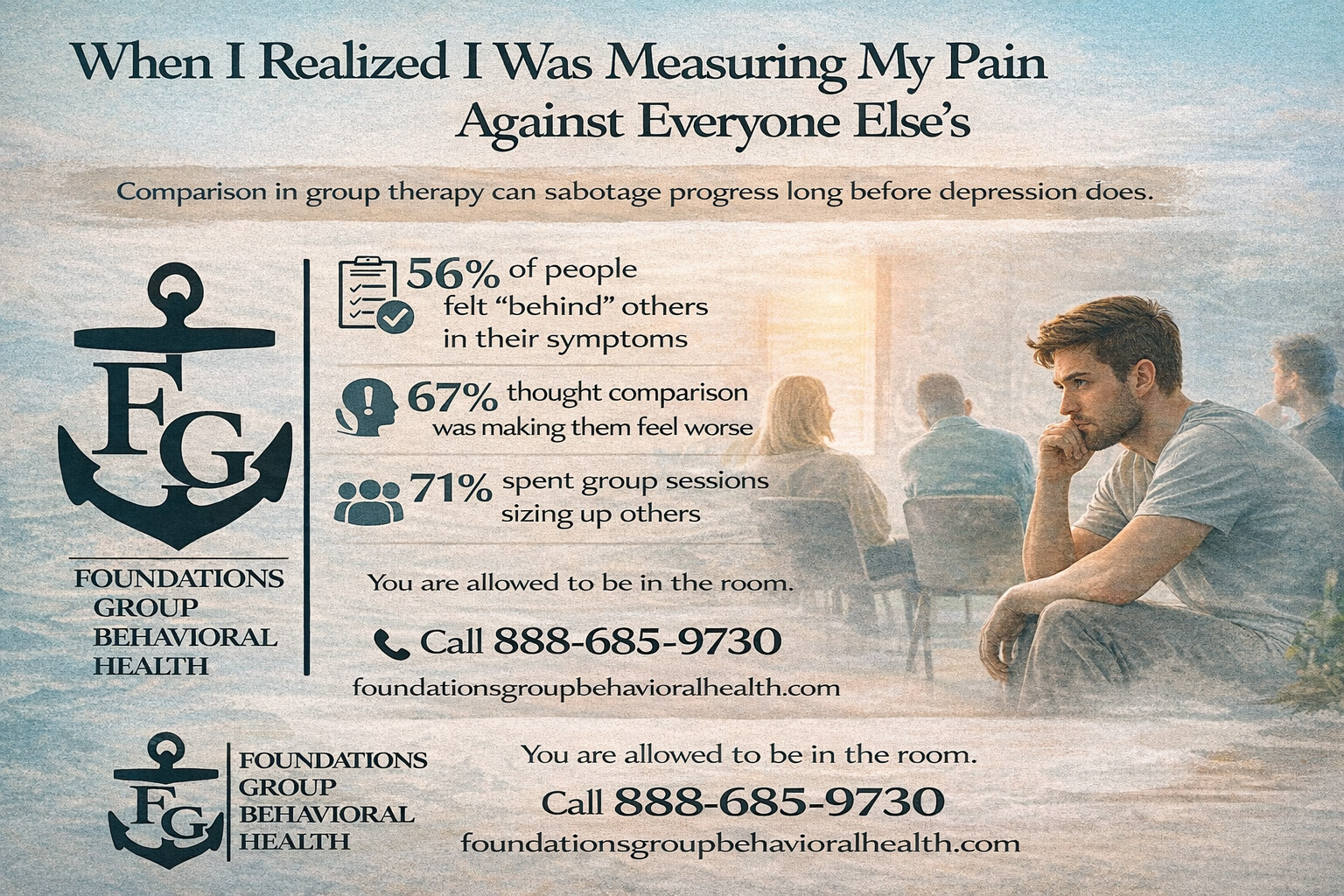
I Compared Timelines That Weren’t Comparable
Here’s another thing I didn’t consider at the time:
Everyone in that room had a different history.
Different trauma.
Different family systems.
Different biology.
Different coping strategies.
I was comparing my Week 2 to someone else’s Year 10 of trying to feel better.
I was comparing my emotional style to someone else’s personality.
I was comparing my internal experience to their external expression.
That’s not a fair match.
Healing isn’t linear. It’s not synchronized. And it’s definitely not competitive.
If anything, depression isolates us into believing we’re uniquely broken — so when we see someone else express progress, we assume they’re normal and we’re defective.
That belief feels true.
It’s also deeply inaccurate.
I Wanted Proof It Was “Working”
I came into treatment wanting proof.
A clear shift.
A big realization.
A moment where everything clicked.
When that didn’t happen immediately, I labeled the whole thing ineffective.
But depression recovery often works differently.
It’s subtle.
You might not notice:
- You slept 30 minutes longer.
- You texted someone back instead of isolating.
- You argued with your negative self-talk instead of automatically believing it.
- You showed up even when your brain said not to.
Those are small behavioral shifts.
But they’re neurological shifts too.
The brain rewires through repetition, not fireworks.
The absence of drama doesn’t mean the absence of change.
When You Start Thinking “Maybe I’m Just Untreatable”
This is the dangerous part.
After comparing yourself enough times, a new belief can take root:
“Maybe I’m the exception.”
You tried.
You attended.
You participated (even if it felt forced).
And you still feel heavy.
So the conclusion seems obvious: It didn’t work.
But what if the first round wasn’t about curing depression?
What if it was about:
- Learning your patterns
- Identifying what doesn’t help
- Building tolerance for discomfort
- Proving you can survive structured support
That’s not glamorous. But it’s foundational.
Some people need a different level of care.
Some need longer.
Some need medication adjustments.
Some need to revisit therapy with a new lens.
Treatment not feeling magical doesn’t mean it failed.
It means you’re still in process.
The Hidden Damage of Comparison in Treatment
Comparison doesn’t just make you feel bad. It changes how you engage.
You might:
- Share less because you feel inferior.
- Perform vulnerability instead of feeling it.
- Shut down when someone seems “ahead.”
- Disengage emotionally while still attending physically.
I did all of that.
On the outside, I looked compliant. On the inside, I was withdrawing.
Depression thrives in isolation — even inside a room full of people.
If you’re comparing constantly, it’s worth saying that out loud in group. I know that sounds uncomfortable. But naming it can break its power.
You’re almost never the only one thinking it.
What Actually Helped Me Shift
Not a dramatic breakthrough.
Not a motivational speech.
Just this realization:
Everyone in that room was carrying something I couldn’t see.
The loud sharer? Went home to panic attacks.
The quiet one? Had been in treatment before.
The hopeful one? Still struggled at night.
We only see edited versions of each other.
Once I stopped treating healing like a performance, I started focusing on my own work:
- What thoughts do I default to?
- What triggers my shutdown?
- What small behaviors can I change this week?
Progress became personal instead of comparative.
And that’s when it started to feel real.
If You’re Still Unsure Whether It Helped
Let’s slow this down.
Ask yourself:
- Did you learn language for what you’re feeling?
- Did you understand your patterns more clearly?
- Did you experience even one moment of connection?
- Did you survive showing up?
If yes, something shifted — even if it’s small.
If no, that’s not a personal failure. It might mean the structure wasn’t the right fit yet.
Exploring support through Foundations Group Behavioral Health’s depression treatment program services can look different depending on what you need now — not what you needed before.
Skepticism is allowed.
You don’t have to pretend it was perfect.
You just don’t have to decide you’re beyond help either.
Frequently Asked Questions
Is it normal to compare yourself to others in treatment?
Yes. It’s incredibly common.
Depression often distorts self-perception. When you’re already feeling inadequate, it’s natural to scan for evidence that you’re “behind.” The key is recognizing comparison as a symptom — not a fact.
What if I didn’t feel better after finishing treatment?
Improvement isn’t always immediate.
Some people feel relief quickly. Others notice subtle changes over weeks or months. And some need adjustments — different therapy styles, medication support, or a longer duration of care.
Not feeling instantly better doesn’t mean you’re untreatable.
How do I know if treatment truly didn’t work for me?
Instead of asking “Did it work?” try asking:
- What specifically didn’t feel helpful?
- Did I engage fully, or was I guarded?
- Do I need a different format or intensity?
Sometimes the first experience teaches you what kind of support fits better next time.
Is numbness a sign that treatment is failing?
No. Numbness is often part of depression itself. It can take time for emotional responsiveness to return. Structured support may begin by stabilizing behavior before feelings shift.
Emotional change isn’t always the first change.
What if I’m afraid to try again?
That fear makes sense.
Trying again means risking disappointment. But it also means not letting depression make the final decision about your future.
You don’t have to commit to forever. You just have to stay open to the possibility that your story isn’t finished.
If you’re still wondering whether a different pace, structure, or level of support might help, you don’t have to figure it out alone.
Call 888-685-9730 or visit our depression treatment program services in to learn more about our Depression treatment program services in Falmouth, MA.