

He was convinced he was dying.
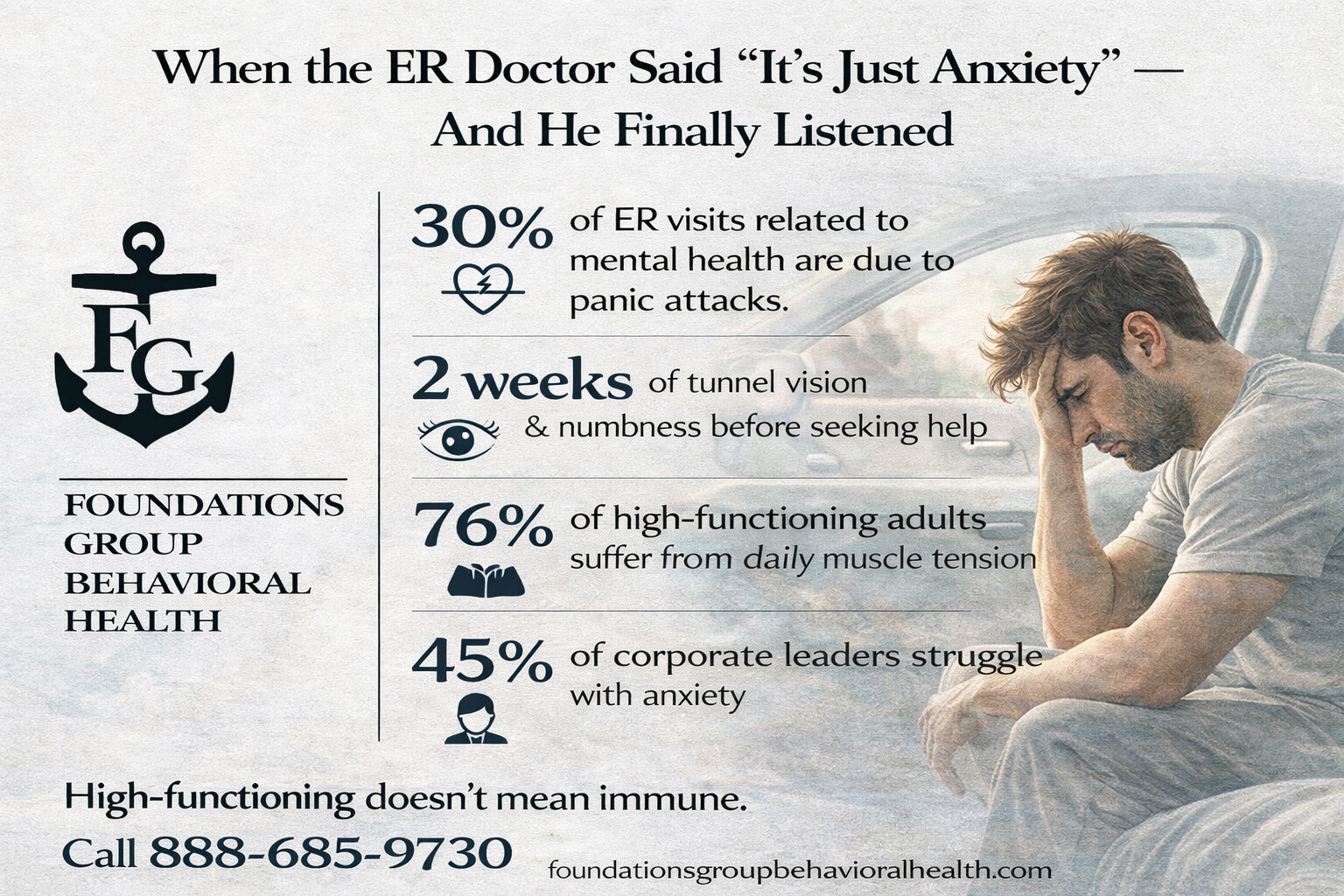
His chest locked up first. Then his hands went numb. His vision tunneled until the room felt far away. He tried to slow his breathing, but every inhale felt shallow and wrong.
By the time he pulled into the emergency room parking lot, he was rehearsing what his wife would do without him.
The tests came back clean.
The doctor said, calmly, “Your heart looks good. This was a panic attack.”
He nodded. Thanked her. Drove home.
And didn’t tell anyone.
Within a few weeks, though, he was quietly researching options for support. He found our page on anxiety treatment program services and stared at it longer than he’d like to admit.
He didn’t see himself as someone who “needed treatment.”
But something in him knew he couldn’t keep living like this.
The High-Functioning Mask
From the outside, he was solid.
Executive-level role. Reliable. Measured. The guy who fixed problems other people couldn’t solve.
He worked out three mornings a week. Never missed a mortgage payment. Volunteered at school events.
Anxiety doesn’t always look like chaos.
Sometimes it looks like control.
When he finally sat in my office, he said, “I’m not falling apart. I’m just… always on.”
That phrase stuck.
Always on.
His nervous system didn’t know how to power down. Even on vacation, he felt braced. Even at dinner, he scanned for what might go wrong.
High-functioning anxiety is often fueled by competence. You become the person who anticipates disaster before it happens. You stay five steps ahead.
But living like that is like holding your breath for years.
The Symptoms He Explained Away
The panic attack was dramatic. But it wasn’t new.
He’d been waking up at 2:57 a.m. for months.
Jaw clenched. Heart racing. Brain sprinting through worst-case scenarios.
He called it “stress.”
He told himself everyone at his level felt this way.
But there were cracks:
- Snapping at his kids over small things
- Avoiding social plans because he was “too tired”
- Drinking just enough at night to take the edge off
- Constant muscle tension
- A sense of dread that had no clear cause
When I asked how long he’d felt this undercurrent of fear, he paused.
“Honestly? Years.”
He just kept outperforming it.
Why High Achievers Wait Too Long
Here’s what I see often in high-functioning adults:
They measure whether they “deserve” help by external damage.
If they’re still employed, still married, still paying bills, they assume they’re fine.
They compare themselves to people who’ve hit visible rock bottom.
“I’m not that bad.”
But anxiety isn’t measured by how well you hide it.
It’s measured by how much it’s costing you internally.
Sleep. Presence. Joy. Patience. Health.
When your body feels like a live wire all day, that’s not resilience. That’s a nervous system stuck in fight-or-flight.
And over time, it takes a toll.
The Moment It Became Personal
He didn’t come in because of the ER visit.
He came in because of his daughter.
One night, after he barked at her for spilling juice, she looked at him and said, “Why are you always mad?”
He wasn’t mad.
He was overwhelmed. Hypervigilant. Tired of holding it together.
But that’s not what she felt.
That question pierced through the productivity armor.
He realized anxiety wasn’t just happening inside him anymore. It was shaping how he showed up.
And that mattered more than pride.
What Structured Support Actually Looked Like
He was afraid treatment would mean stepping away from his job or being labeled unstable.
It didn’t.
There are levels of care designed specifically for people who are still functioning but struggling internally. Options like structured daytime support or multi-day weekly treatment allow you to receive focused help while maintaining your responsibilities.
In his case, an anxiety treatment program meant:
- Meeting consistently with licensed clinicians
- Learning practical tools to regulate his nervous system
- Identifying the beliefs driving his catastrophic thinking
- Addressing perfectionism and control patterns
- Creating boundaries at work without guilt
This wasn’t about dismantling his identity.
It was about giving his mind and body space to recalibrate.
For the first time, he experienced what it felt like not to brace for disaster.
He described it simply:
“It’s quieter.”
Not empty. Not numb.
Just not under siege.
The Truth About “Strong” People
Strength isn’t ignoring panic.
It’s being honest about it.
High-functioning adults often equate seeking help with weakness. But the reality is this: unmanaged anxiety will eventually make the decision for you.
It shows up in your body.
In your relationships.
In your work.
Sometimes it shows up in an ER parking lot.
The earlier you intervene, the less collateral damage you create.
You don’t need a second crisis to qualify for support.
If your success is powered by fear, if your body is constantly bracing, if you’re exhausted from performing calm—you deserve more than survival.
You deserve relief.
You can explore how care is structured by visiting our anxiety treatment program page, where we walk through what support looks like for high-functioning adults who are ready for something different.
FAQ: High-Functioning Anxiety and Getting Help
Is it really anxiety if I’m still successful?
Yes. Anxiety isn’t defined by failure. It’s defined by persistent fear, tension, catastrophic thinking, physical symptoms, and a nervous system that won’t power down.
Many high-achieving professionals live with clinically significant anxiety while maintaining careers and families.
Success doesn’t cancel suffering.
How do I know it’s more than “normal stress”?
Stress tends to be situational and temporary.
Anxiety feels constant—even when nothing specific is wrong.
If you’re experiencing:
- Frequent panic symptoms
- Chronic sleep disruption
- Ongoing irritability
- Persistent worst-case-scenario thinking
- Physical tension that won’t release
It’s worth having a professional evaluation.
Will getting help affect my career?
Seeking treatment is confidential. Many professionals continue working while receiving structured care. In fact, addressing anxiety often improves performance, decision-making, and leadership because you’re no longer operating from chronic threat mode.
Getting help is not a career-ending move. It’s often a career-sustaining one.
Do I have to take medication?
Not necessarily. Medication can be helpful for some individuals, but it’s not the only option. Treatment plans are personalized. Many people benefit from therapy, skills-based interventions, and structured support without medication—or with minimal medication.
The decision is collaborative, not forced.
What if I’ve been like this for years?
That’s common. Long-standing anxiety can feel like part of your personality. But patterns can change. The brain is adaptable. With the right support, you can retrain your stress response and build healthier coping systems.
You are not “just wired this way” forever.
What if I’m embarrassed to ask for help?
Most high-functioning adults are.
You’ve built an identity around capability. Admitting you’re struggling feels like cracking the foundation.
But here’s the truth: seeking support is a private act of responsibility, not a public declaration of failure.
The people who love you don’t need you perfect. They need you present.
If you’ve been white-knuckling your way through life and calling it strength, it may be time to reconsider.
Call 888-685-9730 or visit our Anxiety treatment program services to learn more about our Anxiety treatment program services in Barnstable County.