

There’s a moment that surprises almost everyone.
It’s not dramatic. It’s not a breakthrough speech or a sudden cure.
It’s a breath.
A full one.
At Foundations Group Behavioral Health, we often hear the same sentence within the first few weeks of care:
“I didn’t know how tense I was until I wasn’t.”
If you’re considering an anxiety treatment program, you’re probably not looking for hype. You’re looking for relief. And maybe you’re wondering:
What actually changes once I start?
Let’s talk about that. Not in theory. In real, human terms.
The Anticipation Is Often the Hardest Part
Before starting care, your mind runs scenarios on repeat.
- What if this doesn’t work?
- What if I’m too far gone?
- What if they think my anxiety isn’t “bad enough”?
- What if I start and then fail?
Anxiety is excellent at predicting worst-case outcomes. So of course it turns treatment into another threat.
But once you begin, something shifts almost immediately: uncertainty gets replaced with structure.
You know when you’re meeting.
You know who you’re meeting with.
You know what the next step is.
Anxiety thrives in the unknown. Structure quietly disarms it.
Many people describe the first week not as “life-changing,” but as stabilizing. And stabilization is underrated. It’s the ground beneath your feet.
You Stop Pretending You’re Fine
High-functioning anxiety is exhausting.
You smile in meetings.
You answer texts.
You show up for your responsibilities.
Meanwhile, your chest feels tight. Your thoughts race. You replay conversations for hours. You wake up at 3 a.m. with a sense of dread you can’t explain.
Starting care means you don’t have to perform anymore.
You can say, “I’m not okay,” and someone doesn’t panic. They lean in.
That alone can feel like relief.
Because pretending is heavy. And when you put that weight down—even briefly—your body notices.
Your Nervous System Gets a Break
Anxiety isn’t just mental. It’s physical.
It’s cortisol.
It’s shallow breathing.
It’s muscles that never fully relax.
When you enter structured daytime care or multi-day weekly treatment, you’re not just talking about feelings. You’re creating predictable rhythms for your nervous system.
Regular sessions.
Consistent support.
Practical tools practiced in real time.
Over days and weeks, many people notice subtle but powerful shifts:
- They fall asleep faster.
- They don’t wake up bracing for something bad.
- Their heart isn’t constantly pounding.
- They can sit still without scanning the room.
It’s not magic. It’s regulation.
And once your body experiences safety—even briefly—it remembers how to return there.
You Learn That Anxiety Has a Logic (Even If It’s Unhelpful)
One of the most relieving realizations is this:
You’re not “crazy.” Your brain is trying to protect you.
Anxiety is often an overactive alarm system. It learned somewhere along the way that hypervigilance equals safety.
When you begin care, you start understanding your patterns:
- Why certain situations spike panic.
- Why your thoughts spiral in specific directions.
- Why control feels so urgent.
- Why rest feels unsafe.
Understanding doesn’t erase anxiety overnight. But it removes the mystery.
And when something is less mysterious, it’s less terrifying.
The Shame Begins to Loosen
A lot of people walk in feeling embarrassed.
They think they “should” be able to handle life better. They compare themselves to friends who seem calm, productive, and steady.
Inside, though, they’re exhausted.
When you begin treatment, you meet professionals who don’t see weakness. They see stress responses. They see patterns that can be untangled.
You start replacing self-criticism with curiosity.
Instead of:
“What’s wrong with me?”
It becomes:
“What happened that made my system this alert?”
That shift—from blame to understanding—creates room to breathe.
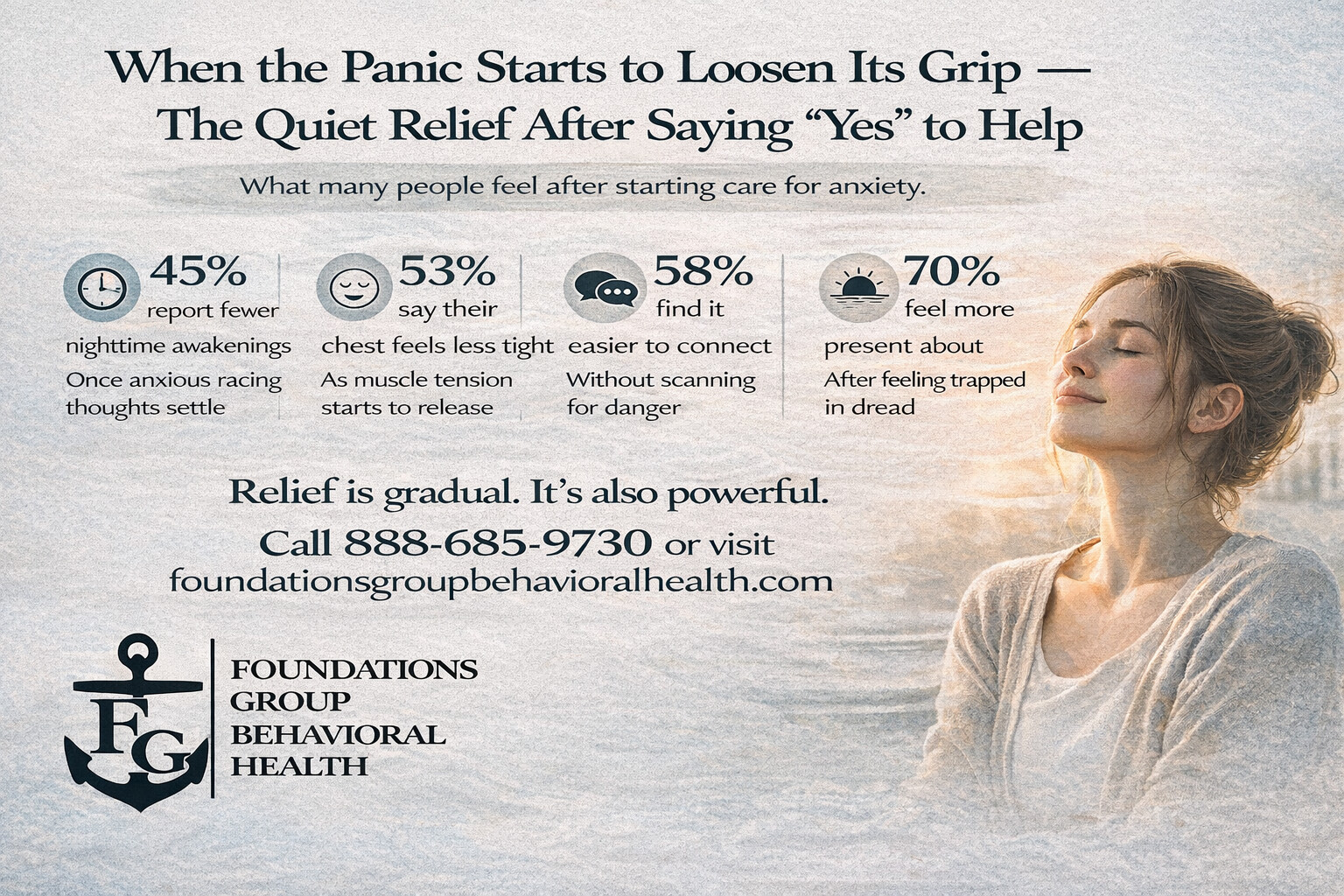
Relief Isn’t Loud. It’s Subtle and Steady.
People expect transformation to feel dramatic.
In reality, relief often shows up like this:
- You drive home without replaying every sentence you said.
- You go to the grocery store without rehearsing worst-case scenarios.
- You send the email without rereading it 14 times.
- You have one quiet evening without scanning for danger.
Tiny wins. Quiet shifts.
But stacked together? They change a life.
We’ve seen individuals who came in barely able to leave their homes gradually reclaim work, relationships, creativity, and sleep. Not because anxiety vanished—but because it stopped running the entire show.
You’re Allowed to Be Imperfect Here
First-time treatment seekers often worry they’ll “do it wrong.”
They’re afraid they won’t open up enough.
They’re afraid they’ll open up too much.
They’re afraid they’ll disappoint someone.
Let us be clear: you don’t have to perform healing.
You’re allowed to:
- Be skeptical.
- Be scared.
- Cry.
- Sit quietly.
- Ask questions.
- Change your mind.
- Start slowly.
Treatment isn’t about impressing anyone. It’s about building capacity at a pace your system can handle.
And when you realize you’re not being graded? That’s relief.
Hope Feels Possible Again
Hope doesn’t usually crash in like a wave.
It shows up as a quiet thought:
“Maybe I don’t have to live like this forever.”
That thought matters.
Because anxiety can shrink your future. It makes your world smaller—less travel, fewer risks, smaller dreams.
When care begins working, even slightly, your world starts expanding again.
You imagine:
- Taking that trip.
- Saying yes to the opportunity.
- Going to the event.
- Sleeping through the night.
And those imagined possibilities begin turning into action.
What If You’re Still Scared?
That’s okay.
Starting an anxiety treatment program doesn’t require you to be fearless. It requires you to be willing.
Willing to show up once.
Willing to have one conversation.
Willing to try something different.
Fear doesn’t disqualify you. It’s often the very reason you need support.
And most people tell us this afterward:
“I was more afraid of starting than I was of being there.”
Frequently Asked Questions
How long does it take to feel relief after starting care?
Relief looks different for everyone. Some people feel lighter after the first session simply because they’ve stopped carrying everything alone. For others, it takes a few weeks of consistency before their nervous system begins to settle. What matters most is momentum—not speed.
What if my anxiety isn’t “bad enough” for treatment?
If anxiety is interfering with your sleep, work, relationships, or sense of peace, it’s valid. You don’t need to hit a breaking point to deserve support. Early care often prevents deeper distress later.
Will I have to share everything right away?
No. You move at your own pace. Building trust takes time, and that’s respected. You are never required to disclose more than you’re ready to discuss.
What if I’ve tried therapy before and it didn’t help?
That doesn’t mean you failed—and it doesn’t mean nothing will work. Different levels of support, different approaches, and different therapeutic relationships can lead to very different outcomes. It’s okay to try again with more clarity about what you need.
Can anxiety really improve, or will I always struggle?
Anxiety may always be part of your wiring—but it doesn’t have to dominate your life. Many people learn to manage symptoms so effectively that anxiety becomes background noise instead of the main character.
What if I’m afraid I’ll become dependent on treatment?
The goal of care is not dependence. It’s skill-building, insight, and nervous system regulation so that you can function more independently over time. Support is a bridge, not a crutch.
How do I know it’s time to start?
If you’re reading this and recognizing yourself, that might already be your answer.
When the cost of staying the same feels heavier than the fear of change, it’s usually time.
Relief doesn’t mean you’ll never feel anxious again.
It means you finally have tools.
It means you have structure.
It means you have people who understand what your mind and body are doing.
It means you don’t have to fight this alone anymore.
If you’re ready to explore what that relief could feel like, Call 888-685-9730 or visit our anxiety treatment program services to learn more about our Anxiety treatment program services in Barnstable County.