
Something’s not working.
Your child has been in therapy. You’ve encouraged them, given them space, checked in, maybe even sat in the waiting room during sessions. You’ve done what a loving parent does: hope it’s enough.
But deep down, you’re starting to feel it—this might be bigger than what therapy alone can hold.
If that quiet fear has started to whisper, “What if we need more?”—you’re not wrong to ask it. And you’re not alone in this.
Therapy Was a Beginning—Not a Failure
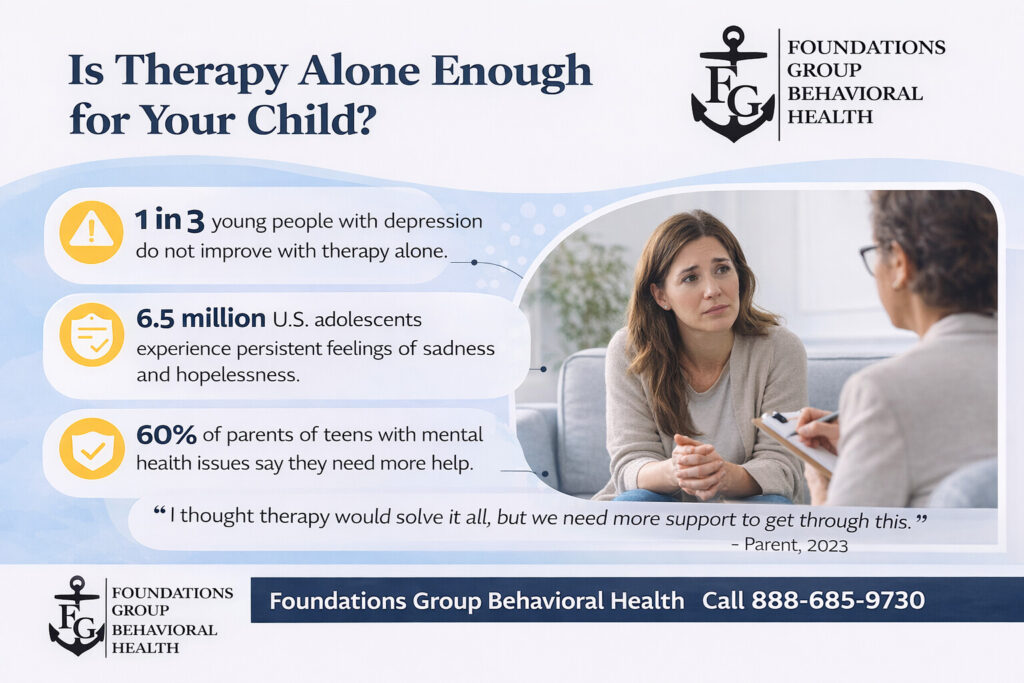
If your child is still struggling despite regular therapy, it doesn’t mean therapy didn’t work. It means therapy did what it was meant to: help assess, support, and guide. But depression, especially moderate to severe depression, often requires more than weekly insight. It needs structure. It needs consistency. It needs clinical scaffolding that traditional outpatient therapy simply isn’t built to provide.
In other words: This isn’t failure. It’s the natural next step.
What Is a Depression Treatment Program?
A depression treatment program is a structured level of care designed for people who need more than talk therapy—but not 24/7 inpatient hospitalization. These programs, often called Partial Hospitalization Programs (PHP) or Intensive Outpatient Programs (IOP), provide multiple hours of care per day, several days per week.
At Foundations Group Behavioral Health, our depression programs combine:
- Psychiatric care and medication management
- Evidence-based therapies (like CBT, DBT, ACT)
- Group therapy and peer support
- Individual therapy
- Family support sessions
- Life and coping skills training
Programs are individualized. That means your child doesn’t get a cookie-cutter schedule—they get what they need, when they need it, from people who care.
Signs It Might Be Time for a Depression Treatment Program
You don’t need to wait for things to fall apart.
Here are some signals that more support may be needed:
- Your child has withdrawn from school, work, or social life
- They’ve stopped showering, eating regularly, or keeping up with basic routines
- They’re expressing consistent hopelessness or emotional numbness
- You’re seeing signs of self-harm or hearing suicidal thoughts
- Therapy feels like a revolving door—lots of talking, but no traction
- You’re living in fear of the next phone call or emotional collapse
And maybe hardest of all—you don’t recognize your child anymore. Their spark is gone. Their eyes look distant. Their words carry weight no young person should have to bear.
If that feels familiar, you’re not imagining things. You’re noticing signs that something deeper is going on. And noticing is the first courageous step toward getting help.
What Treatment Really Looks Like—Not What You Fear
Many parents hesitate because the word “treatment” feels scary. It sounds like “locked up.” Like giving up. Like crossing a line you can’t come back from.
But that’s not what a depression treatment program is.
It’s not a punishment. It’s not forever. It’s not a label.
It’s structure. It’s relief. It’s a place where your child can get real support from people trained to help them stabilize—not just survive.
Treatment might look like:
- Morning check-ins and therapy groups
- Lunch with peers who get it
- Learning how to name emotions and build coping tools
- Working with a psychiatrist who actually listens
- Practicing life skills in real time
- Coming home each night a little less heavy
It’s not about fixing them. It’s about helping them find footing again.
You’re Not Overreacting. You’re Responding.
We know what you’re asking yourself.
“Is this too much?”
“What if they hate me for this?”
“Am I failing as a parent if I need outside help?”
Let us answer gently but clearly: No.
You are not overreacting. You are responding. Responding to the ache of watching someone you love suffer. Responding to the truth that love alone isn’t always enough—but love and support can be.
And your child? They might resist at first. That’s normal. But more often than not, what we hear weeks into care is this:
“I didn’t think I needed this. Now I don’t know how I ever got by without it.”
You’re allowed to make hard choices in the name of healing.
And if your child can’t see that yet, that’s okay. You can hold the hope for both of you.
How a Depression Treatment Program Helps Break the Cycle
Depression can feel like emotional quicksand: the more your child struggles, the deeper they sink. A treatment program breaks that cycle by:
- Interrupting isolation – Group therapy connects them to peers
- Regulating rhythms – A consistent schedule restores stability
- Treating the whole person – Not just symptoms, but skills and mindset
- Reducing crisis risk – Safety planning, support, and accountability lower danger
- Equipping you too – Family therapy helps you understand how to support without burning out
It’s not magic. But it is movement. And sometimes that’s all you need to start seeing your child again.
You Deserve Support, Too
Crisis parenting is exhausting. You’re holding fear, hope, guilt, love—all at once. You wake up braced. You go to sleep drained. You don’t know what version of your child you’ll meet each day.
You need a team too.
At Foundations Group Behavioral Health, we walk with families through this fragile stage. We don’t just treat your child—we support you with clarity, resources, and care.
📍We invite you to learn more about our depression treatment program services in your area. Personalized mental health care in Barnstable County, Falmouth, MA.
FAQ: Depression Treatment Programs for Young Adults
What’s the difference between therapy and a treatment program?
Traditional therapy is usually once a week and focuses on talk-based support. A depression treatment program offers multiple hours of therapy and activities each week in a structured, supportive environment—ideal when symptoms are intense or unmanageable alone.
Does my child have to stay overnight?
Not always. Many depression treatment programs are day programs (like IOP or PHP), which means your child can return home in the evening. This allows for high-level support without full hospitalization.
Will my child fall behind in school or work?
Programs often offer academic or vocational coordination to support your child’s transition. The goal isn’t to pause life—it’s to help them re-enter it with more stability and tools.
What if my child refuses to go?
Resistance is common, especially at first. But once enrolled, many young adults begin to feel relief. Our team can also help you navigate these conversations and offer guidance on next steps.
How long does treatment last?
It varies. Some stay for a few weeks; others need longer support. Your child’s care team will assess progress regularly and involve you in planning for discharge and follow-up care.
You’re Not Alone—And You’re Not Too Late
Even if things feel messy.
Even if you’re scared of making the wrong move.
Even if your child says they’re “fine” and you know they’re not.
There is a next step. There are people who can help.
And there is real hope—even if it doesn’t look like you imagined.
📞 Call 888-685-9730 or visit to learn more about our depression treatment program services in Cape Cod, MA.
Let us help you bring your child back to themselves—and help you find steadiness along the way.