

You answer texts.
You meet deadlines.
You show up to dinner and laugh at the right moments.
From the outside, nothing looks wrong.
But inside? Your mind rarely stops scanning. Your body feels braced, like something bad might happen—even when it doesn’t. You replay conversations. You overthink decisions. You wake up tired because your nervous system never fully powers down.
And maybe you’ve started asking a quiet question:
What if I don’t have to live like this?
If you’re sober curious, reflective, or simply tired of performing “fine,” structured support can be a turning point. Many people begin by exploring our anxiety treatment program not because they’re in crisis—but because they’re ready for something steadier.
Here’s how that kind of support actually helps.
1. You Stop Managing the Image and Start Telling the Truth
High-functioning anxiety can be isolating.
You might be the reliable one. The calm one. The responsible one. The one people lean on.
Admitting you’re struggling can feel like cracking the foundation of your identity.
In a structured therapeutic environment, you don’t have to protect anyone from your reality. You don’t have to water it down so it sounds acceptable.
You can say:
- “I feel tense all the time.”
- “I can’t shut my brain off.”
- “I’m scared that if I slow down, everything will unravel.”
And instead of being dismissed, you’re met with curiosity and skill.
There’s something powerful about not being the strongest person in the room for once.
2. You Understand the Pattern — Not Just the Symptoms
Anxiety isn’t random.
It often follows predictable loops:
- Thought → physical tension → catastrophic interpretation → more tension
- Social interaction → self-criticism → replaying → avoidance
- High expectations → overworking → burnout → guilt
When you’re stuck inside it, it just feels like who you are.
Structured care helps you zoom out. With professional guidance, you begin to see the architecture of your anxiety—how it forms, what fuels it, and what reinforces it.
And when you see the pattern, you gain leverage.
You stop fighting yourself.
You start interrupting the cycle.
3. You Learn to Regulate Your Nervous System (Not Just “Calm Down”)
Being told to “just relax” has probably never helped.
Because anxiety isn’t a mindset problem. It’s often a nervous system problem.
In treatment, you practice:
- Grounding exercises that actually work in the moment
- Breath techniques designed for physiological reset
- Cognitive strategies that challenge distorted thinking
- Behavioral shifts that reduce avoidance
It’s hands-on. Repetitive. Practical.
Like physical therapy for your stress response.
At first, it can feel unfamiliar—almost too slow. But over time, your baseline changes. Your body learns that not every moment is an emergency.
That shift alone can feel life-altering.
4. You Build Tolerance for Discomfort (Without Escaping It)
If you’ve relied on distractions—scrolling, overworking, staying busy, maybe even substances—to quiet anxiety, you’re not alone.
Avoidance works… temporarily.
But what structured care offers is different: a safe place to stay with discomfort long enough to learn you can survive it.
You practice:
- Sitting with uncertainty
- Letting intrusive thoughts pass without chasing them
- Having difficult conversations without rehearsing them for hours
You build emotional endurance.
And when you realize you can handle discomfort without collapsing, your world expands.
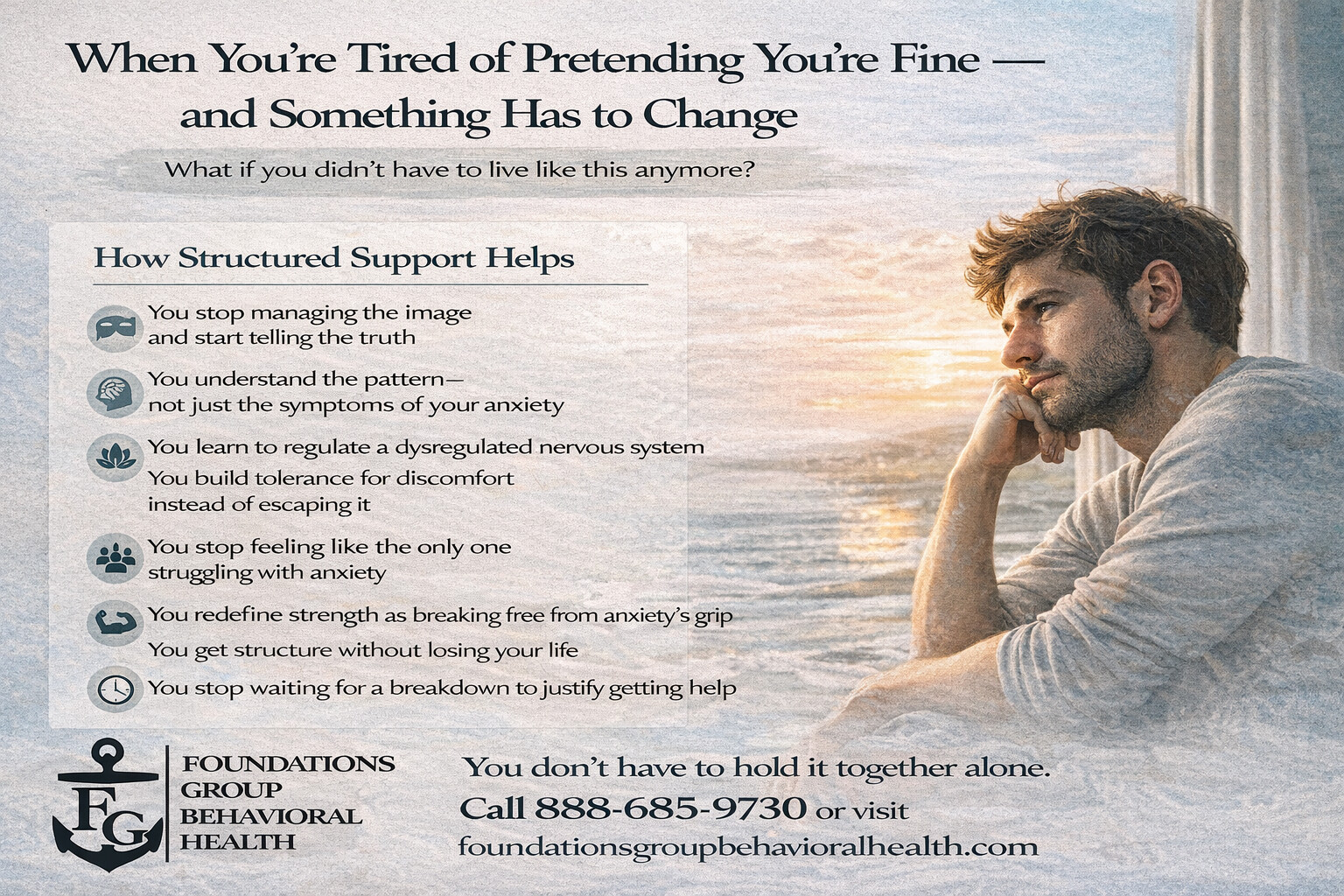
5. You Stop Feeling Like the Only One
Anxiety is incredibly common—but incredibly private.
You might assume:
- Everyone else is more confident
- Everyone else is less afraid
- Everyone else isn’t overthinking every text
In group-based components of care, something surprising happens.
Someone says out loud the exact thought you’ve never admitted:
“I replay everything I say for days.”
And the room nods.
You realize you’re not uniquely flawed.
You’re human in a high-pressure world.
Connection softens shame. And shame feeds anxiety. So when shame decreases, symptoms often follow.
6. You Redefine What Strength Means
A lot of people delay getting help because they can still function.
You might tell yourself:
- “It’s not that bad.”
- “Other people have it worse.”
- “I can handle it.”
And maybe you can.
But handling it isn’t the same as thriving.
White-knuckling your way through life isn’t strength. It’s survival mode.
True strength is saying:
I don’t want to live in constant hypervigilance anymore.
Exploring an anxiety treatment program doesn’t mean you’re weak. It means you’re proactive. It means you care enough about your future to intervene before burnout, depression, or substance use creep in.
You’re not giving something up.
You’re reclaiming your bandwidth.
7. You Get Structure Without Losing Your Life
One of the biggest fears people have is:
“Will I have to step away from everything?”
Not necessarily.
Many structured care models offer:
- Structured daytime care for those who need deeper immersion
- Multi-day weekly treatment for those balancing work or school
- Therapeutic programming that integrates into real life
The goal isn’t to remove you from your responsibilities forever.
It’s to help you return to them with more clarity and steadiness.
And you don’t have to commit blindly. Learning about options is just that—learning.
8. You Stop Waiting for a Breakdown
There’s a myth that treatment is only for people who are falling apart.
But here’s the truth: the earlier you intervene, the easier it is to shift the trajectory.
If your anxiety is:
- Affecting your sleep
- Straining relationships
- Impacting your focus
- Making you dread ordinary things
That’s enough.
You don’t need a dramatic moment to justify support.
Sometimes the bravest move is addressing anxiety before it escalates.
Frequently Asked Questions
How do I know if my anxiety is “serious enough” for structured support?
If anxiety is consistently interfering with your sleep, relationships, work, or overall quality of life, it’s worth exploring support. You don’t need to be in crisis. If you feel chronically tense, overwhelmed, or stuck in repetitive thought loops, that’s enough to start a conversation.
Will I have to stop working or going to school?
Not necessarily. Many programs offer flexible scheduling options, including multi-day weekly treatment models that allow you to maintain important responsibilities while receiving meaningful care. During an initial consultation, your team can help determine what level of support fits your life.
Is this only for people with a formal diagnosis?
No. You don’t need to walk in with a label. If you’re experiencing persistent worry, panic, racing thoughts, or physical tension, an evaluation can clarify what’s happening and what may help. The focus is relief—not paperwork.
What if I’ve tried therapy before and it didn’t help?
That’s a valid concern. Not all therapy experiences are the same. Structured care often offers more frequency, skill-building, and real-time application than once-a-week sessions. If you felt like traditional therapy wasn’t enough, a more immersive format may feel different.
I’m sober curious. Does anxiety treatment mean I have to identify as having a substance problem?
No. Exploring your mental health doesn’t require you to adopt a label you don’t identify with. If you’re simply rethinking how stress, alcohol, or coping patterns intersect with anxiety, that exploration can happen at your pace, without pressure or assumptions.
What’s the first step if I’m interested?
The first step is usually a confidential conversation. You can ask questions, describe what you’ve been experiencing, and learn what options might fit. There’s no obligation—just information.
You don’t have to keep performing calm while feeling chaotic inside.
You don’t have to wait until you’re completely burned out.
If you’re ready to explore what steadier, quieter days could look like, we’re here to talk. Call 888-685-9730 or visit our Anxiety treatment program services in to learn more.