

I remember a client looking at me and saying something I’ve heard dozens of times over the years.
“I don’t think I need treatment. If I really had a problem, I wouldn’t still be showing up to work.”
On paper, his life looked impressive.
He had a successful career.
A steady income.
A home.
People depended on him.
Most people would have described him as driven, capable, and successful.
What they didn’t see were the nights he barely slept.
The racing thoughts that never seemed to stop.
The impulsive decisions he later regretted.
The emotional crashes that left him unable to function.
The alcohol he used to slow everything down.
The constant fear that someone would eventually realize how hard he was working just to appear normal.
As a clinician, I’ve learned something important:
The people who look the most put together are often carrying burdens nobody can see.
That’s especially true for many individuals living with bipolar disorder.
If you’re researching options like a bipolar disorder treatment program in Massachusetts, there’s a good chance you aren’t looking for someone to save you.
You’re looking for a way to stop living in survival mode while keeping your life intact.
The Problem With Being the Person Who Always Functions
High-functioning people develop a unique challenge.
Everyone expects them to keep functioning.
Including themselves.
They become the person who handles everything.
The dependable employee.
The successful entrepreneur.
The responsible parent.
The friend who always shows up.
Over time, those identities become difficult to question.
When symptoms appear, many people don’t ask whether they need help.
They ask whether they can continue pushing through.
And often, they can.
For a while.
The problem is that functioning and wellness are not the same thing.
I’ve worked with people who were earning six-figure salaries while privately experiencing severe emotional instability.
I’ve worked with business owners who built successful companies while sleeping only a few hours each night.
I’ve worked with professionals whose coworkers admired their productivity while they secretly felt completely out of control.
Being able to perform does not mean you’re okay.
It simply means you’ve become skilled at performing.
When Elevated Energy Starts Looking Like Success
One reason bipolar disorder can be difficult to recognize is because some symptoms don’t initially look like problems.
They look impressive.
People become more ambitious.
More productive.
More social.
More confident.
They take on additional responsibilities.
Launch new projects.
Make major plans.
From the outside, it can seem like they’re thriving.
Friends may compliment their energy.
Coworkers may admire their drive.
Family members may feel relieved to see them motivated.
The challenge is that elevated energy often comes with hidden costs.
Sleep decreases.
Impulsivity increases.
Decision-making changes.
Emotional intensity rises.
What looks like momentum can eventually become difficult to sustain.
Many people don’t recognize the problem until the crash arrives.
And by then, significant damage may already have occurred.
The Crash Nobody Talks About
The periods of increased energy often get the most attention.
The crash is what usually brings people through the door.
Because the crash doesn’t feel productive.
It feels devastating.
The same person who recently felt unstoppable suddenly struggles to answer emails.
Returning phone calls feels exhausting.
Simple decisions become overwhelming.
Motivation disappears.
Many clients describe feeling confused by the contrast.
They don’t understand how they went from feeling invincible to feeling incapable.
The answer isn’t weakness.
It’s that emotional extremes are exhausting.
Eventually the mind and body demand a correction.
The result can feel like hitting a wall at full speed.
Why Alcohol Often Becomes Part of the Story
One pattern I’ve seen repeatedly is the relationship between bipolar symptoms and alcohol.
Many high-functioning adults don’t drink because they’re looking for trouble.
They drink because they’re looking for relief.
Relief from racing thoughts.
Relief from stress.
Relief from emotional intensity.
Relief from sleepless nights.
At first, alcohol appears helpful.
It slows things down.
It creates temporary calm.
It offers a brief escape from whatever is happening internally.
The problem is that temporary relief often becomes a long-term problem.
The brain begins relying on alcohol instead of learning healthier ways to regulate emotions.
Over time, the original struggles remain while new challenges develop alongside them.
Many people eventually realize they aren’t managing symptoms.
They’re managing the consequences of their coping strategy.
The Myth That You Have to Hit Rock Bottom
One of the most damaging beliefs in behavioral health is the idea that treatment is only for people in crisis.
It’s simply not true.
Many people postpone seeking help because they compare themselves to others.
They think:
“At least I’m not homeless.”
“At least I’m still working.”
“At least my relationships haven’t completely fallen apart.”
What they fail to recognize is how much energy they’re spending simply maintaining appearances.
Imagine driving a car while the check engine light flashes continuously.
The car still moves.
You still get where you’re going.
But eventually ignoring the warning becomes more dangerous than addressing it.
Mental health works similarly.
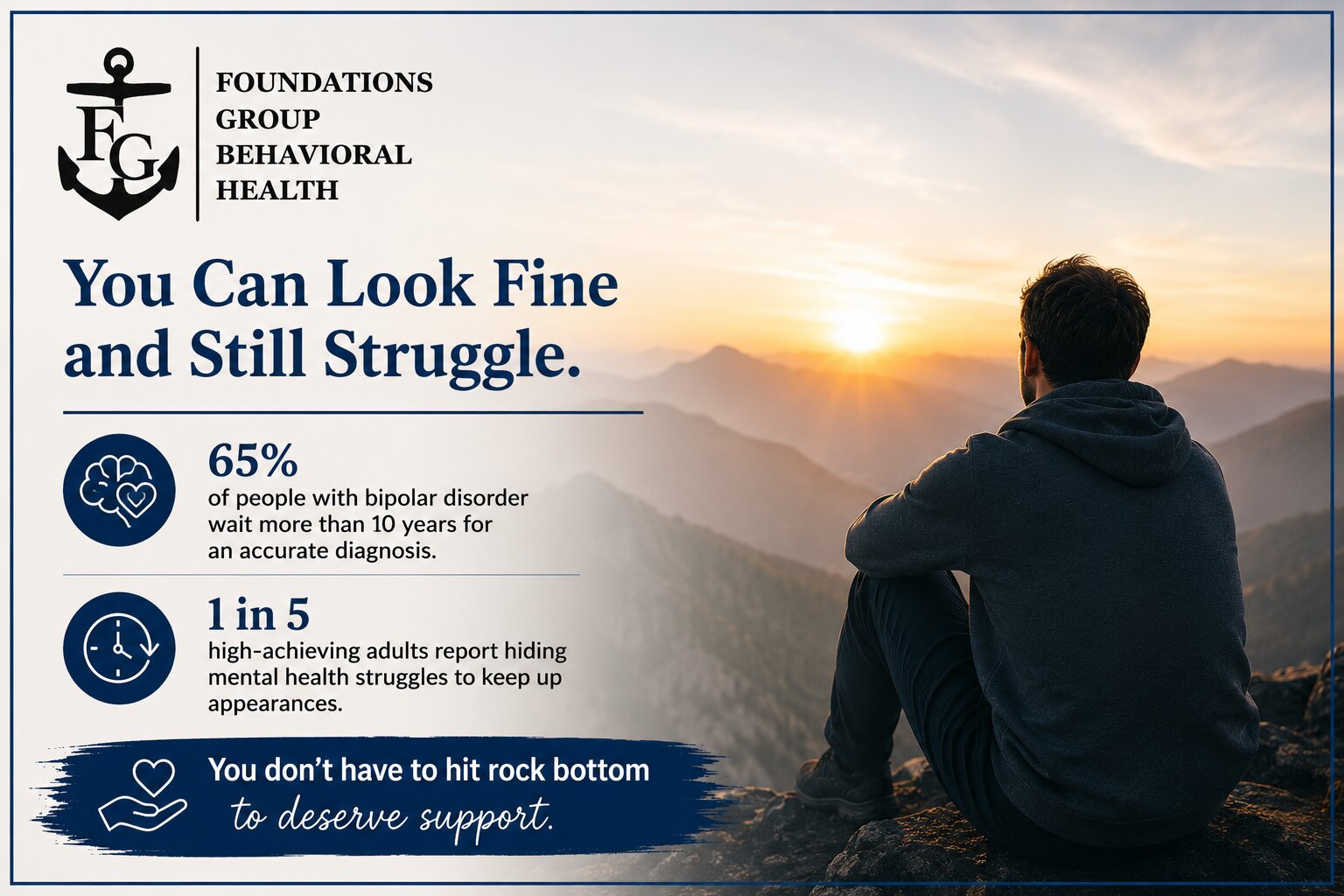
You don’t need everything to collapse before seeking support.
What Treatment Usually Looks Like Versus What People Fear
Many people researching care imagine the worst.
They picture disappearing from their lives.
Leaving work indefinitely.
Abandoning responsibilities.
Starting over completely.
Those assumptions prevent many people from exploring options that could help.
The reality is often much different.
Many individuals benefit from support that allows them to continue working, maintain family responsibilities, and remain connected to important aspects of life while receiving care.
That’s one reason so many people begin researching a bipolar intensive outpatient program.
They’re not looking for a complete separation from life.
They’re looking for a way to function more consistently within life.
For many people, the question isn’t whether they need help.
The question is whether help can fit into the life they’ve built.
The Turning Point I See Again and Again
Most people don’t arrive at treatment because someone convinced them.
They arrive because they’re tired.
Not physically tired.
Emotionally tired.
Tired of pretending.
Tired of managing symptoms alone.
Tired of wondering whether life always has to feel this difficult.
One former client explained it perfectly.
“I spent years proving I could handle everything. Eventually I realized handling everything was destroying me.”
That statement captures something important.
Many people aren’t avoiding treatment because they feel good.
They’re avoiding treatment because they fear what treatment means.
Once that fear starts shrinking, new possibilities emerge.
Recovery Looks Different Than Most People Expect
Many individuals imagine recovery as a finish line.
A day when symptoms disappear.
A day when life becomes easy.
Recovery is usually much more practical than that.
It often looks like consistency.
Better sleep.
Healthier decision-making.
Improved relationships.
Reduced impulsivity.
Greater self-awareness.
More emotional stability.
It looks like recognizing warning signs earlier.
It looks like asking for support before a crisis develops.
It looks like spending less energy managing symptoms and more energy living your life.
One former client told me:
“I thought recovery would change who I was. Instead, it helped me become who I was before everything became so difficult.”
I think about that often.
Because many people fear treatment will take something away.
What they often discover is that it gives something back.
You Don’t Have To Wait Until Everything Falls Apart
If you’re reading this, there’s a good chance you’ve already spent time trying to determine whether your situation is serious enough.
Many people do.
They search online.
Read articles.
Compare themselves to others.
Convince themselves they’re fine.
Then search again a week later.
The reality is that needing support isn’t determined by how successful you look from the outside.
It’s determined by how difficult life feels on the inside.
If maintaining your life requires enormous emotional effort, that’s worth paying attention to.
If symptoms are affecting your relationships, your sleep, your decision-making, or your quality of life, that’s worth paying attention to.
If you’re using alcohol or other coping mechanisms simply to get through the day, that’s worth paying attention to.
Many people throughout Massachusetts begin seeking support long before they reach a crisis point.
And many discover something unexpected:
Treatment didn’t take away their independence.
It strengthened it.
Because real independence isn’t carrying everything alone.
It’s having the support necessary to live well.
Frequently Asked Questions
Can someone have bipolar disorder and still be successful?
Yes. Many individuals with bipolar disorder maintain careers, relationships, and responsibilities. Success does not eliminate the possibility of significant emotional struggles.
Why do some symptoms look positive at first?
Periods of elevated mood or energy can initially appear productive, ambitious, or creative. The challenges often emerge when those periods become difficult to sustain or lead to consequences.
Is it common for people to use alcohol to cope?
Yes. Many people use alcohol in an attempt to manage stress, emotional intensity, sleep difficulties, or racing thoughts. Unfortunately, this often creates additional problems over time.
How do I know if I need more support?
If symptoms are affecting your quality of life, relationships, sleep, work performance, or emotional wellbeing, it may be helpful to explore professional support options.
Do I have to stop working to receive treatment?
Not necessarily. Many treatment options are designed to help people receive support while continuing to manage important responsibilities.
What makes structured outpatient support different?
Programs that provide multiple sessions each week often offer greater consistency, accountability, skill-building opportunities, and therapeutic support than less frequent care.
Can treatment help if I’ve been struggling for years?
Yes. Many individuals seek support after living with symptoms for extended periods. Long-term challenges do not prevent meaningful progress.
What if I don’t feel “sick enough” for treatment?
Many people who benefit from treatment never experience a dramatic crisis. Seeking help early can often prevent symptoms from becoming more disruptive.
Is recovery realistic?
Absolutely. Many individuals learn to manage symptoms effectively, build healthier routines, strengthen relationships, and improve their overall quality of life.
Call 888-685-9730 or visit our behavioral health treatment programs Massachusetts page to learn more about our behavioral health treatment programs Falmouth, MA, bipolar disorder treatment program services in Barnstable County, MA.