

A racing mind. Constant worry. Difficulty relaxing. The feeling that something is wrong—even when you can’t explain why.
If you’ve been searching OCD vs anxiety, you’re not alone. These conditions share many symptoms, and it’s common to wonder whether you’re dealing with generalized anxiety disorder, obsessive-compulsive disorder (OCD), or both.
Perhaps your thoughts feel impossible to shut off. Maybe you replay conversations for hours, seek reassurance from people you trust, or find yourself repeating certain actions because they briefly make the anxiety disappear.
These experiences can be confusing, especially because OCD is frequently misunderstood. Many people think OCD is simply about liking things neat or organized, when in reality it’s a mental health condition centered on intrusive thoughts and compulsive behaviors.
Understanding the difference matters because the most effective treatment for OCD is not exactly the same as treatment for anxiety disorders. Learning more about OCD treatment can help you understand which approaches are designed to address the unique challenges of obsessive-compulsive disorder.
If your thoughts have been frightening or difficult to talk about, know this before reading further:
Intrusive thoughts are symptoms—not reflections of your character or intentions.
OCD vs Anxiety: At a Glance
Although OCD and anxiety often overlap, there are important differences that help clinicians distinguish between them.
Feature |
Anxiety Disorders |
Obsessive-Compulsive Disorder (OCD) |
|---|---|---|
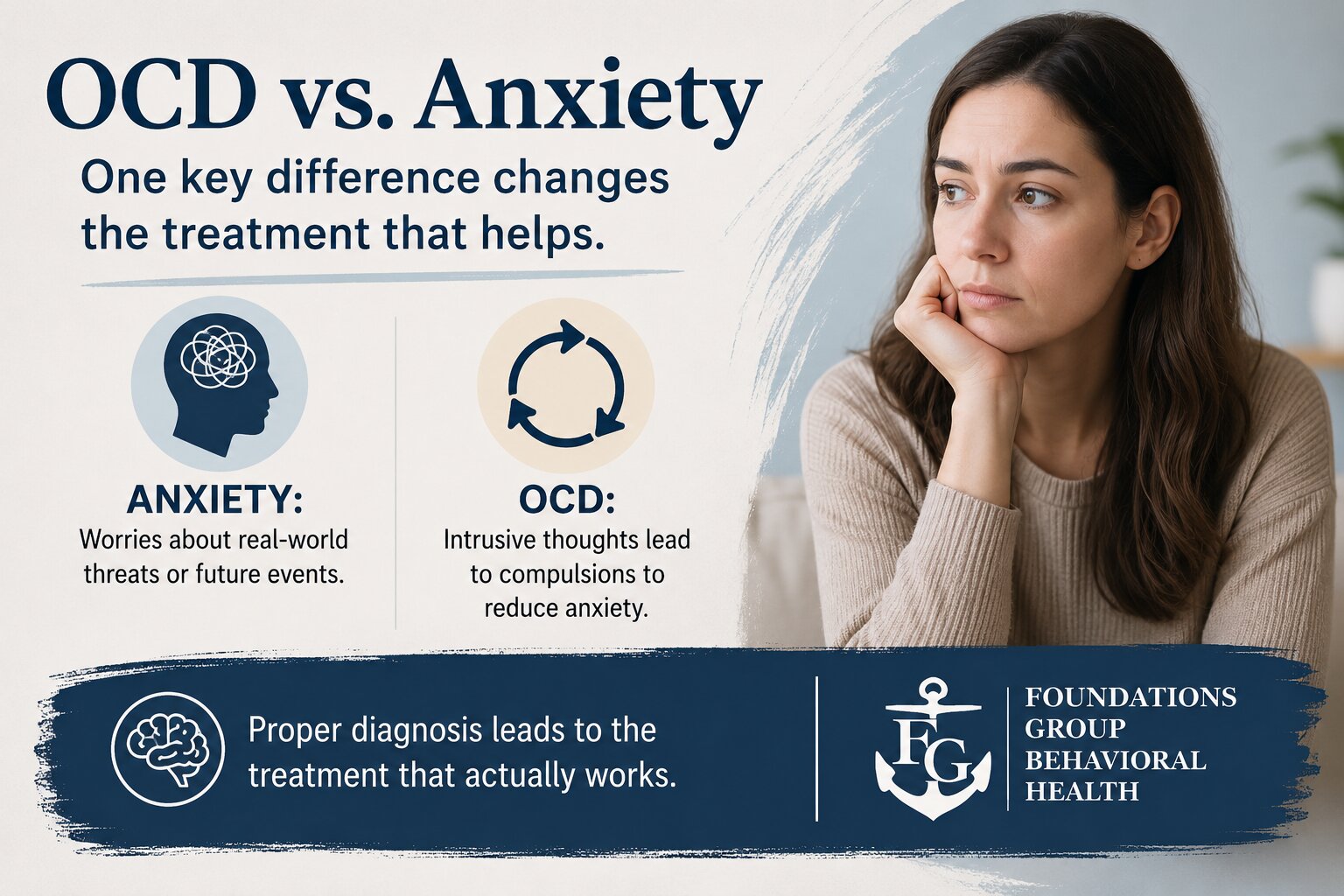
| Primary concern | Excessive worry about everyday situations or future events | Intrusive, unwanted thoughts (obsessions) that trigger compulsions |
| Nature of thoughts | Worries often relate to real-life concerns | Thoughts feel intrusive, irrational, or inconsistent with personal values (ego-dystonic) |
| Typical response | Avoidance, reassurance, or ongoing worry | Compulsions or mental rituals performed to reduce distress |
| Relief | Anxiety gradually changes as situations resolve | Relief after compulsions is temporary before the cycle repeats |
| Most effective treatment | CBT, ACT, exposure-based approaches, medication | Exposure and Response Prevention (ERP), specialized CBT, medication when appropriate |
The biggest difference isn’t simply how anxious someone feels.
It’s how they respond to the anxiety.
What Distinguishes OCD: The Obsession + Compulsion Cycle
The difference between OCD and anxiety becomes much clearer when you understand the cycle that defines OCD.
Rather than involving worry alone, OCD follows a predictable pattern:
Obsession → Anxiety → Compulsion → Temporary Relief → Obsession Returns
This cycle often repeats many times each day.
Obsessions: More Than Ordinary Worries
Obsessions are intrusive, unwanted thoughts, images, urges, or doubts that repeatedly enter someone’s mind.
They often feel disturbing because they are ego-dystonic, meaning they conflict with the person’s values, beliefs, or sense of self.
Someone with OCD does not want these thoughts.
In fact, the thoughts often feel frightening precisely because they are so unlike who the person believes themselves to be.
Examples might include:
- Fear of accidentally harming someone
- Persistent doubts about whether something was done correctly
- Fear of contamination
- Intrusive thoughts involving violence, religion, or sexuality that feel deeply upsetting
- Constant uncertainty about making a terrible mistake
People with OCD usually recognize these thoughts as unwanted.
The distress comes from feeling unable to dismiss them.
Compulsions: Attempts to Feel Certain Again
The second half of the cycle is what makes OCD different from anxiety disorders.
Compulsions are behaviors—or mental rituals—performed to reduce the anxiety created by obsessions.
Common compulsions include:
- Repeated checking
- Excessive handwashing or cleaning
- Counting
- Arranging items repeatedly
- Mentally reviewing events
- Repeating phrases silently
- Seeking reassurance from loved ones
- Searching online for certainty
- Avoiding situations that trigger intrusive thoughts
The compulsion usually provides temporary relief.
Unfortunately, that relief teaches the brain that the ritual was necessary.
The next time an intrusive thought appears, the urge to perform the compulsion becomes even stronger.
Over time, the cycle reinforces itself.
OCD Intrusive Thoughts vs Anxiety
Many people specifically wonder about OCD intrusive thoughts vs anxiety because both involve distressing mental experiences.
There are similarities—but also important differences.
Anxiety tends to involve worries connected to everyday life.
Someone might think:
- “What if I lose my job?”
- “What if I embarrass myself?”
- “What if my child gets sick?”
These worries usually involve realistic concerns, even if the anxiety greatly exaggerates their likelihood.
OCD intrusive thoughts are different.
They often feel bizarre, shocking, or deeply inconsistent with the person’s identity.
The individual typically feels horrified by having the thought at all.
Rather than asking, “Could this happen?” the mind becomes trapped asking:
- “What if this thought means something about me?”
- “What if I can’t be absolutely certain?”
- “What if I lose control?”
The person then performs compulsions to reduce uncertainty or prove that the feared outcome won’t happen.
It’s important to remember that experiencing intrusive thoughts does not mean someone wants to act on them. In OCD, these thoughts are distressing precisely because they conflict with the person’s values.
How OCD and Anxiety Overlap
Even though they are different conditions, OCD and anxiety share many features.
Both involve an overactive threat detection system.
Both can produce:
- Persistent fear
- Physical symptoms of anxiety
- Difficulty concentrating
- Restlessness
- Sleep problems
- Catastrophic thinking
- Avoidance behaviors
- Difficulty tolerating uncertainty
It’s also common for people with OCD to have an anxiety disorder at the same time.
In fact, anxiety disorders are among the most frequent conditions that occur alongside OCD.
Because of this overlap, it can sometimes take time to receive the correct diagnosis.
The goal isn’t simply choosing one label over another.
It’s identifying the pattern that best explains your experiences so treatment can address the right symptoms.
Can You Have Both OCD and Anxiety?
Yes.
Many people meet criteria for both OCD and an anxiety disorder.
For example, someone might experience generalized anxiety about work and relationships while also having OCD involving intrusive thoughts and checking compulsions.
This distinction matters because treating only the anxiety may leave the OCD cycle untouched.
If compulsions continue, intrusive thoughts usually continue as well.
That’s one reason comprehensive evaluation is so important.
Rather than asking only, “How anxious are you?” clinicians also explore:
- Are intrusive thoughts repetitive and unwanted?
- Do you perform behaviors or mental rituals to reduce distress?
- Do those rituals provide only temporary relief?
- Does uncertainty feel nearly impossible to tolerate?
Those answers help determine whether OCD is part of the picture.
Why Treatment Differs: ERP for OCD vs. Therapy for Anxiety
This is where the difference between anxiety disorder vs OCD becomes especially important.
Although both conditions can benefit from therapy, the therapeutic approach is not identical.
Anxiety Treatment
Many anxiety disorders respond well to evidence-based approaches such as:
- Cognitive Behavioral Therapy (CBT)
- Acceptance and Commitment Therapy (ACT)
- General exposure-based therapy
- Mindfulness strategies
- Medication when appropriate
These treatments often focus on changing relationships with anxious thoughts, reducing avoidance, and gradually facing feared situations.
OCD Treatment
OCD typically requires a specialized approach known as Exposure and Response Prevention (ERP).
ERP is considered the gold-standard psychological treatment for OCD.
Rather than trying to eliminate intrusive thoughts, ERP helps individuals:
- Experience intrusive thoughts without performing compulsions.
- Build tolerance for uncertainty.
- Learn that anxiety naturally rises and falls without rituals.
- Break the obsession-compulsion cycle over time.
This is a crucial difference.
Someone with OCD often feels an intense urge to perform a ritual because it temporarily reduces distress.
ERP specifically targets that urge.
Standard anxiety treatment alone may not adequately address compulsions. In some cases, repeated reassurance—which may temporarily calm general anxiety—can unintentionally reinforce OCD by strengthening the belief that certainty must be achieved before anxiety can decrease.
When OCD is accurately recognized, treatment can focus on the cycle that keeps symptoms going rather than only on the anxiety those symptoms create.
Is It OCD or Anxiety?
Many people spend years wondering:
“Is it OCD or anxiety?”
The answer isn’t always obvious from the inside.
If your worries mainly involve everyday concerns—even when they’re excessive—you may be experiencing an anxiety disorder.
If your distress revolves around unwanted intrusive thoughts followed by repetitive behaviors or mental rituals intended to neutralize those thoughts, OCD may be worth discussing with a qualified mental health professional.
Only a licensed clinician can make a diagnosis.
The encouraging news is that both OCD and anxiety are highly treatable, especially when treatment matches the condition being addressed.
You Don’t Have to Be Certain Before Asking for Help
One of the hardest parts of OCD is the constant search for certainty.
Ironically, many people wait to seek treatment because they feel they must first become completely certain about what’s happening.
You don’t have to figure it out alone.
Whether your symptoms are related to OCD, anxiety, or both, reaching out for a professional evaluation is a meaningful first step.
If you’ve been hiding intrusive thoughts because you’re afraid they’ll be misunderstood, know that mental health professionals are trained to recognize them as symptoms—not character flaws.
Treatment isn’t about changing who you are.
It’s about helping you spend less time trapped in fear, doubt, and compulsive cycles so you can return your attention to the life you want to live.
Frequently Asked Questions
What is the difference between OCD and anxiety?
The primary difference is that OCD involves both obsessions (intrusive, unwanted thoughts) and compulsions (behaviors or mental rituals performed to reduce distress). Anxiety disorders generally involve excessive worry without the same obsession-compulsion cycle.
How do you know if you have OCD or anxiety?
Only a qualified mental health professional can make a diagnosis. However, if intrusive thoughts lead you to repeatedly check, seek reassurance, perform rituals, or mentally review situations to reduce anxiety, OCD may be worth discussing during an evaluation.
Can OCD be treated with anxiety medication?
Some medications used for anxiety are also effective for OCD, but medication alone is often not enough. The most evidence-based psychological treatment for OCD is Exposure and Response Prevention (ERP), which specifically targets compulsions and the obsession-compulsion cycle.
Final Thoughts
If you’ve been questioning whether your experiences are anxiety, OCD, or both, remember that you don’t have to have all the answers before seeking support. Understanding the role of intrusive thoughts and compulsions can be an important step toward finding the treatment approach that best fits your needs.
With the right care, many people learn to manage intrusive thoughts, reduce compulsive behaviors, and regain confidence in daily life. Personalized mental health & addiction care in Barnstable County, Falmouth, MA.
Call (888) 685-9730 or learn more about OCD treatment at Foundations Group.