

You may be having an ordinary day when, without warning, an overwhelming wave of fear, shame, panic, or helplessness crashes over you.
Nothing dramatic happened. No one threatened you. Yet your body reacts as though you’re in danger. Your heart races, your thoughts spiral, and it suddenly feels impossible to think clearly. Hours later, you may still be wondering, “What just happened to me?”
If this sounds familiar, you may have experienced an emotional flashback.
For many people living with trauma, especially childhood trauma or complex post-traumatic stress, emotional flashbacks can be one of the most confusing symptoms because they don’t always look like what people expect from PTSD. Learning more about trauma treatment can help you understand why these experiences happen and how healing is possible.
The most important thing to know is this:
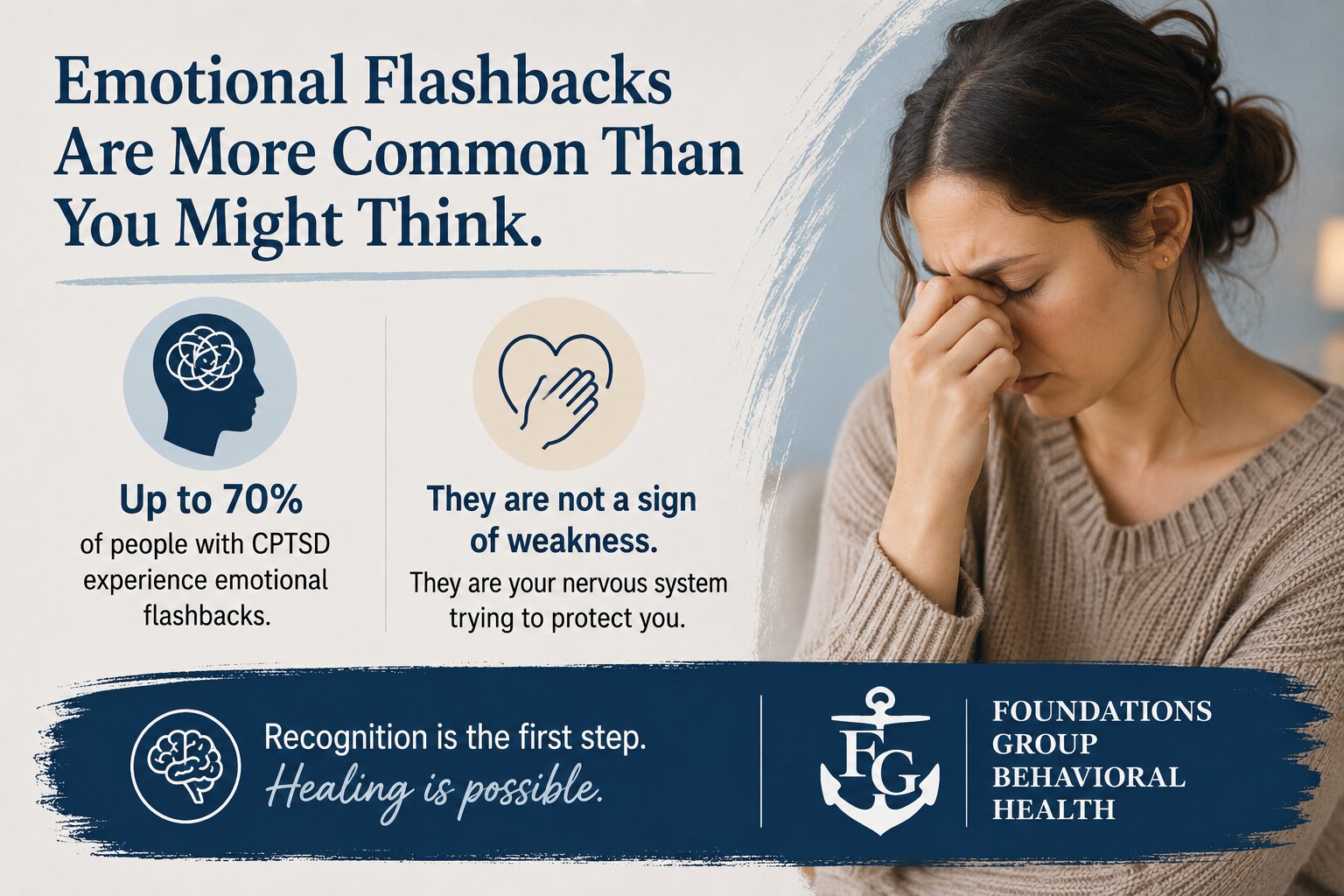
An emotional flashback is not a sign that you’re “losing control.” It is your nervous system responding to experiences that once required you to survive.
Understanding what’s happening is often the first step toward feeling safer again.
What Is an Emotional Flashback?
If you’ve been wondering what is an emotional flashback, you’re not alone.
The term was popularized by trauma therapist Pete Walker, who described emotional flashbacks in the context of Complex Post-Traumatic Stress Disorder (CPTSD). While the concept is widely recognized in trauma-informed therapy, it is not a separate diagnostic term in the DSM-5.
An emotional flashback is a sudden return to the intense emotional states connected to past trauma—without necessarily replaying the memories themselves.
Instead of seeing vivid images of a traumatic event, you may suddenly experience emotions that feel overwhelming and immediate, such as:
- Intense fear
- Deep shame
- Helplessness
- Worthlessness
- Panic
- Abandonment
- Rage
- Grief
These feelings can arrive with incredible force.
The difficult part is that you may have no idea what triggered them.
Someone might make an innocent comment, cancel plans, raise their voice slightly, or simply seem distracted. On the surface, none of these situations appear dangerous.
Yet your nervous system reacts as though an old threat has returned.
The emotional experience feels completely real because, in many ways, your brain has temporarily confused the past with the present.
Emotional Flashback vs. Regular Flashback
Many people imagine PTSD flashbacks as vivid scenes from a traumatic event.
While that certainly happens, it’s only one type of flashback.
Understanding the difference between an emotional flashback vs regular flashback can make these experiences easier to recognize.
Regular (Visual) Flashbacks
Traditional PTSD flashbacks often involve sensory re-experiencing.
A person may:
- See images from a traumatic event
- Hear sounds connected to the trauma
- Smell familiar scents
- Feel temporarily transported back to the event itself
These experiences are commonly associated with single-incident trauma, such as serious accidents, combat, natural disasters, or assaults.
Emotional Flashbacks
Emotional flashbacks work differently.
Rather than replaying visual memories, they recreate the emotional experience.
Someone experiencing an emotional flashback may suddenly feel:
- Like a frightened child
- Completely powerless
- Deeply ashamed
- Certain they’re about to be rejected
- Convinced they’ve done something terribly wrong
- Overwhelmed by fear without understanding why
There may be no pictures.
No memories.
No obvious explanation.
Only emotion.
That difference is one reason emotional flashbacks often go unrecognized for years.
People frequently assume they’re simply “too emotional” or “overreacting,” when their nervous system is actually responding to old survival patterns.
The CPTSD Connection
When people search emotional flashback CPTSD, they’re often trying to understand why these experiences seem to happen without warning.
Emotional flashbacks are considered one of the hallmark features of Complex Post-Traumatic Stress Disorder (CPTSD).
Unlike trauma that develops after one overwhelming event, CPTSD typically develops through prolonged or repeated experiences such as:
- Childhood emotional neglect
- Emotional abuse
- Physical abuse
- Chronic criticism
- Ongoing family conflict
- Persistent invalidation
- Growing up in unpredictable or frightening environments
In these situations, there may not be one single traumatic memory to replay.
Instead, the nervous system learns something much broader:
“The world isn’t safe.”
“I have to stay alert.”
“If I make a mistake, something bad will happen.”
“My needs aren’t important.”
Those beliefs become deeply wired into survival responses.
Years later, relatively ordinary situations may activate the same emotional states, even though the original danger has passed.
This doesn’t mean your brain is broken.
It means your nervous system became exceptionally good at protecting you under circumstances where protection was necessary.
The challenge is that it continues using those same protective responses long after they’re needed.
How to Recognize You’re in an Emotional Flashback
Recognition can feel surprisingly powerful.
Many people describe enormous relief the first time someone explains emotional flashbacks because it finally gives language to experiences they’ve struggled to understand.
Some common signs include:
The Emotion Feels Bigger Than the Situation
Perhaps someone offered gentle feedback at work.
Objectively, it wasn’t harsh.
Yet you suddenly feel devastated.
The emotional intensity doesn’t seem to match what actually happened.
You Feel Small Again
Many people describe suddenly feeling like a frightened child rather than the capable adult they know themselves to be.
You may feel:
- Trapped
- Helpless
- Powerless
- Invisible
- Unworthy
These emotions often echo earlier experiences rather than your current reality.
The Feeling Seems Timeless
During an emotional flashback, it can seem as though the emotion has always existed and always will.
It’s difficult to remember feeling calm.
The distress feels permanent, even though emotional flashbacks eventually pass.
Your Inner Critic Gets Loud
Old beliefs often return quickly:
- “I’m failing.”
- “Everything is my fault.”
- “Nobody wants me.”
- “I’m too much.”
- “I ruin everything.”
These thoughts often reflect trauma rather than objective truth.
Dissociation or Numbness May Follow
For some people, overwhelming emotions eventually give way to emotional numbness, detachment, or feeling disconnected from themselves.
This can also be part of the nervous system’s protective response.
How to Get Through an Emotional Flashback
If you’re reading this shortly after an emotional flashback, you may feel exhausted, embarrassed, or frightened.
Please know this:
You do not have to solve your trauma right now.
In this moment, your only job is helping your nervous system recognize that the danger has passed.
The following strategies are adapted from ideas popularized by Pete Walker and other trauma-informed clinicians. Think of them as gentle invitations rather than rules.
Begin by Naming What’s Happening
Sometimes a single sentence can interrupt the spiral.
Try quietly telling yourself:
“I’m having an emotional flashback.”
Not:
“I’m falling apart.”
Not:
“I’m broken.”
Simply recognizing the experience helps create a little distance between you and the emotion.
Remind Yourself That This Feeling Belongs to the Past
The emotions are real.
But the danger may not be.
You might gently say:
“My body feels unsafe right now, but I am in the present.”
“These feelings come from experiences I’ve survived.”
You don’t have to force yourself to believe these statements completely.
Simply introducing the possibility can help your nervous system begin shifting out of survival mode.
Gently Reconnect With the Present
Grounding doesn’t erase emotions.
Instead, it reminds your brain where you are.
Notice:
- Five things you can see.
- Four things you can touch.
- Three sounds you can hear.
- Two things you can smell.
- One thing you can taste.
Or simply feel both feet resting against the floor.
Notice the chair supporting your body.
Look around the room slowly.
These small moments help your nervous system gather evidence that the present is different from the past.
Slow Your Breathing
Trauma often speeds breathing without us noticing.
Instead of trying to breathe perfectly, simply allow your exhale to become a little longer than your inhale.
Even a few slower breaths can signal safety to the nervous system.
There’s no need to rush.
Be Gentle With Your Inner Voice
During emotional flashbacks, the inner critic often becomes extremely convincing.
You might hear harsh thoughts telling you that you’re weak, dramatic, or failing.
Instead of arguing with those thoughts, try responding with curiosity.
Ask yourself:
“Would I say this to someone I love?”
Probably not.
You deserve the same compassion.
Lower the Pressure
This may not be the right moment to solve relationship problems, make major decisions, or force yourself to be productive.
If possible, give yourself permission to postpone difficult decisions until your nervous system has settled.
Right now, safety matters more than productivity.
Healing Happens Between Flashbacks
Grounding strategies can help you move through an emotional flashback, but they don’t erase the underlying trauma.
That healing usually happens gradually through trauma-focused therapy.
Many people worry that therapy means reliving every painful memory in detail or being pushed before they’re ready.
Modern trauma therapy is not about forcing you to revisit experiences before you’ve developed tools to cope with them. Instead, it often begins with building safety, understanding how trauma affects the nervous system, and learning skills that make emotional flashbacks feel less overwhelming over time.
With support, many people notice they:
- Recognize flashbacks sooner.
- Recover more quickly.
- Feel less controlled by shame or fear.
- Develop greater confidence in managing difficult emotions.
- Experience longer periods of calm and stability.
Healing isn’t about pretending the past never happened.
It’s about helping your mind and body recognize that you no longer have to survive every moment as if you’re still there.
You Are Not Your Flashback
One of the hardest parts of emotional flashbacks is how convincing they feel.
In those moments, it may seem impossible to believe that things will improve.
But emotional flashbacks are experiences—not identities.
They are temporary nervous system responses shaped by earlier experiences, not permanent reflections of who you are.
Every time you recognize one, ground yourself, and respond with compassion instead of self-judgment, you’re teaching your nervous system something new:
That the present can be safe.
That overwhelming feelings eventually pass.
And that healing is possible.
Frequently Asked Questions
What is an emotional flashback?
An emotional flashback is a sudden return to the intense emotional states associated with past trauma without necessarily experiencing visual memories. People may feel overwhelming fear, shame, helplessness, or panic that seems disconnected from their current situation.
How is an emotional flashback different from a regular flashback?
Regular flashbacks often involve vivid sensory memories, such as seeing or hearing aspects of a traumatic event. Emotional flashbacks primarily involve re-experiencing the emotions connected to trauma without visual recollections, making them especially common in people with complex childhood trauma.
What do you do during an emotional flashback?
Start by recognizing that you’re experiencing an emotional flashback. Gently remind yourself that the feelings belong to the past, use grounding techniques to reconnect with the present, slow your breathing, practice self-compassion, and reduce unnecessary demands until your nervous system begins to settle. If flashbacks happen frequently or interfere with daily life, working with a trauma-informed mental health professional can provide additional support.
Final Thoughts
If you’ve experienced sudden waves of fear, shame, or helplessness that seem to come out of nowhere, you are not alone—and you are not “overreacting.” Emotional flashbacks can be deeply unsettling, but understanding what they are can make them feel less mysterious and more manageable.
You don’t have to wait until these experiences become overwhelming to seek support. With compassionate, trauma-informed care, many people learn to recognize emotional flashbacks earlier, respond to them with greater confidence, and gradually reduce their impact on daily life. Personalized mental health & addiction care in Barnstable County, Falmouth, MA.
Call (888) 685-9730 or learn more about trauma treatment at Foundations Group.