
Food, eating, and body image don’t exist in two separate categories of “healthy” and “unhealthy.” Instead, they exist on a spectrum.
If you’ve been searching for eating disorder vs disordered eating, you may be wondering whether your experiences are “serious enough” to matter. Perhaps you’ve noticed rigid food rules, cycles of restriction, episodes of eating that feel out of control, or constant thoughts about your body—but you don’t identify with the phrase eating disorder.
Many people find themselves in this uncertain space.
Understanding that uncertainty is important because both disordered eating and eating disorders deserve attention. Learning about eating disorder treatment can help you understand the spectrum, recognize warning signs, and know when additional support may be beneficial.
The line between disordered eating and a clinical eating disorder is real—but it isn’t a cliff edge. People often move gradually along the spectrum, and it can be difficult to recognize when those patterns have become more serious.
Eating Disorder vs Disordered Eating: The Key Distinctions
One of the biggest misconceptions is that someone either has an eating disorder or they don’t.
In reality, clinicians often look at several factors together rather than relying on a single behavior. Three of the most important are:
Frequency
How often do the behaviors occur?
Many people occasionally skip meals, emotionally eat during stressful periods, or try restrictive diets. These behaviors can still be concerning, but they may not meet the frequency required for a clinical diagnosis.
As behaviors become more frequent, persistent, and difficult to interrupt, they may begin to reflect an eating disorder rather than isolated or occasional disordered eating patterns.
Distress
How much emotional suffering do the behaviors create?
Someone experiencing disordered eating may feel guilty after eating certain foods, become anxious when routines change, or spend significant time worrying about meals.
With an eating disorder, those thoughts often become much more intrusive. Food, body image, or weight may dominate large portions of the day, making it difficult to focus on work, school, relationships, or activities they once enjoyed.
Impairment
How much do these patterns interfere with daily life?
Clinicians also consider whether eating behaviors affect:
- Physical health
- Emotional well-being
- Relationships
- Work or school performance
- Social activities
- Overall quality of life
Disordered eating can absolutely affect quality of life. Eating disorders generally involve greater levels of impairment and meet established diagnostic criteria.
The important point is that distress matters even before someone meets those criteria.
What Is Disordered Eating?
Many people ask, what is disordered eating?
Disordered eating is an umbrella term describing unhealthy relationships with food, eating, exercise, or body image that may not meet the criteria for a diagnosed eating disorder.
It is not a diagnosis itself.
Instead, it describes behaviors and thought patterns that create emotional distress or interfere with well-being, even if they don’t occur often enough—or in the specific ways—required for a clinical diagnosis.
Disordered eating can look different from one person to another.
Some common examples include:
Rigid Food Rules
Someone may divide foods into “good” and “bad,” experience intense guilt after eating certain meals, or feel anxious when they cannot follow carefully established eating rules.
The distress often comes not only from eating but from the fear of breaking those rules.
Frequent Dieting or Restriction
Repeated attempts to control food intake, eliminate entire food groups, or constantly start over after eating “imperfectly” may become an ongoing cycle.
Even without an eating disorder diagnosis, this pattern can affect mood, energy, and emotional health.
Binge Episodes That Don’t Meet Diagnostic Criteria
Some individuals experience episodes of eating that feel difficult to control but do not occur frequently enough to meet diagnostic requirements for binge eating disorder.
That doesn’t mean those experiences are unimportant.
Feeling out of control around food can still create shame, anxiety, and isolation.
Occasional Compensatory Behaviors
Some people occasionally try to “make up” for eating by restricting food afterward, exercising excessively, or using other unhealthy compensatory behaviors.
Even when these behaviors occur infrequently, they deserve attention because they can become more established over time.
Exercise as Punishment
Movement can support physical and mental health.
However, when exercise becomes something that feels required to “earn” food or punish oneself for eating, it may reflect disordered eating rather than healthy physical activity.
Emotional Eating That Feels Out of Control
Many people eat for comfort occasionally.
Disordered eating may involve using food as the primary way to cope with stress, loneliness, sadness, or anxiety while feeling unable to change the pattern.
The common thread isn’t perfection or diagnosis.
It’s that these behaviors create genuine emotional suffering and reduce quality of life.
What Crosses Into an Eating Disorder?
Understanding the difference between eating disorder and disordered eating can feel confusing because there isn’t always one obvious moment when things change.
Instead, clinicians evaluate patterns over time.
Eating disorders—including anorexia nervosa, bulimia nervosa, binge eating disorder, avoidant/restrictive food intake disorder (ARFID), and other specified feeding or eating disorders (OSFED)—meet established diagnostic criteria involving the type of behaviors, their frequency, duration, and the degree of impairment they cause.
These diagnoses are based on comprehensive clinical assessment rather than a single symptom.
The Spectrum Matters
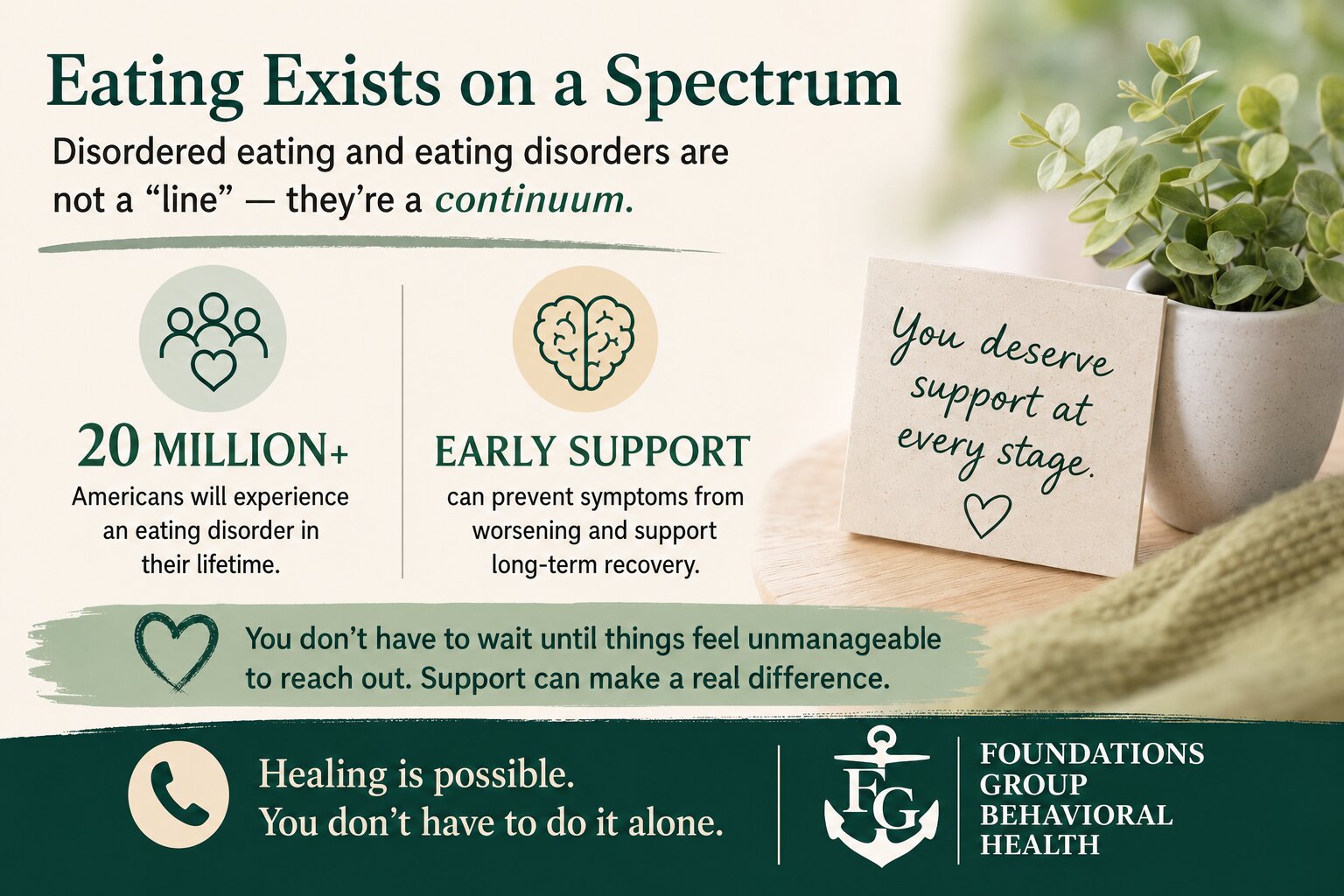
One of the most important ideas to understand is that disordered eating and eating disorders are part of the same spectrum.
People do not suddenly wake up with an eating disorder overnight.
For many individuals, the process begins gradually.
Perhaps dieting becomes increasingly restrictive.
Maybe concerns about body image slowly take over more mental space.
Food rules become harder to break.
Meals become more stressful.
Social situations involving food start to feel overwhelming.
Over time, these patterns may become more frequent, more distressing, and more disruptive.
Eventually, they may meet the criteria for a clinical eating disorder.
That gradual progression is one reason early support matters.
Why It Can Be Hard to Recognize
One of the challenges is that people living with eating disorders often minimize their experiences.
They may think:
- “I’m not sick enough.”
- “Other people struggle more than I do.”
- “I should be able to control this.”
- “It’s just a phase.”
- “I don’t look like someone with an eating disorder.”
These thoughts can delay treatment for months or even years.
Unfortunately, waiting until symptoms become severe often makes recovery more difficult.
You do not need to reach a crisis before seeking help.
Disordered Eating Signs to Watch For
Because the line isn’t always obvious, paying attention to patterns can be more helpful than focusing on labels.
Some disordered eating signs include:
- Constant preoccupation with food or eating
- Persistent body dissatisfaction
- Feeling guilty after meals
- Anxiety when routines around food change
- Avoiding social situations involving meals
- Cycles of restriction followed by overeating
- Exercising primarily to compensate for eating
- Believing self-worth depends heavily on body shape or eating habits
- Feeling that food thoughts occupy significant mental space
None of these automatically mean someone has an eating disorder.
However, they do suggest that additional support could be helpful.
When Does Disordered Eating Become an Eating Disorder?
Many people specifically wonder, when does disordered eating become an eating disorder?
The answer isn’t based on one behavior alone.
Instead, clinicians consider whether patterns become:
- More frequent
- More emotionally distressing
- More difficult to stop
- More disruptive to daily life
- Significant enough to meet diagnostic criteria
It’s also important to remember that people are often poor judges of the severity of their own symptoms.
Someone may continue functioning at work while privately struggling every day.
Someone else may believe they’re “fine” simply because they haven’t received a diagnosis.
Neither situation means help isn’t appropriate.
When to Seek Help
One of the biggest myths surrounding eating disorders is that treatment should only begin after receiving a formal diagnosis.
That simply isn’t true.
You deserve support if food, eating, or body image has begun affecting your life—even if you don’t know whether your experiences qualify as an eating disorder.
Consider reaching out if:
- Thoughts about food or your body occupy a large portion of your day.
- Eating causes ongoing anxiety, guilt, or fear.
- Your relationship with food feels increasingly difficult to manage.
- You avoid activities because food might be involved.
- Your behaviors feel harder to control than they once did.
- You’ve tried to change these patterns on your own without lasting success.
Early intervention is often associated with better outcomes.
Seeking support is not about proving you’re “sick enough.”
It’s about improving your quality of life before the problem becomes more entrenched.
Treatment is also highly individualized. For many people, one of the biggest fears is that getting help means losing control or being forced into decisions they’re not ready for. In reality, care is designed to meet people where they are. A clinician can help you understand your symptoms, discuss treatment options, and work collaboratively toward recovery at a pace that feels safe and appropriate.
You Don’t Have to Wait Until It Gets Worse
Many people delay seeking help because they believe someone else has it worse.
But suffering isn’t a competition.
Whether your experiences are best described as disordered eating or a diagnosed eating disorder, your emotional pain deserves compassion—not comparison.
Recovery isn’t reserved for people at the far end of the spectrum.
It’s available to anyone whose relationship with food, eating, or body image has begun interfering with their well-being.
Frequently Asked Questions
What is the difference between an eating disorder and disordered eating?
Disordered eating describes unhealthy eating behaviors and thought patterns that may not meet the clinical criteria for a diagnosed eating disorder. Eating disorders are recognized mental health conditions diagnosed using established clinical standards that consider symptom patterns, distress, frequency, and impairment.
Can disordered eating become an eating disorder?
Yes. Disordered eating exists on the same spectrum as eating disorders, and for some people, symptoms become more frequent, distressing, and disruptive over time. Early support may help prevent further progression.
When should I seek help for disordered eating?
You don’t need a diagnosis to benefit from support. If food, eating, body image, or exercise habits are causing ongoing distress, taking up significant mental energy, or affecting your daily life, speaking with a qualified mental health professional is a worthwhile next step.
Final Thoughts
If you’ve been wondering whether your struggles are “bad enough,” that question alone may be worth exploring with a professional. The goal isn’t to determine whether you fit a label—it’s to understand whether your relationship with food, eating, or your body is affecting your well-being.
You don’t have to wait until your symptoms become more severe before reaching out. Early support can make recovery more approachable and help you build a healthier relationship with food and yourself. Personalized mental health & addiction care in Barnstable County, Falmouth, MA.
Call (888) 685-9730 or learn more about eating disorder treatment at Foundations Group.