

I remember the exact moment I searched for help again because it made me feel ridiculous.
Not because things were spiraling.
Because they weren’t.
I was working. Paying bills. Showing up to family events. Answering texts. I had already been through treatment before, and from the outside, my life looked stable enough that even I started believing I had no right to struggle anymore.
But underneath all of that, something felt off in a way I couldn’t explain.
Not chaotic. Not dramatic. Just… empty.
And honestly, that scared me more than the obvious crises ever did.
For a long time, I thought needing support again would mean I had somehow failed. What I eventually realized was that bipolar disorder doesn’t always come back loudly. Sometimes it returns quietly through exhaustion, numbness, emotional distance, or the strange feeling that you’ve become disconnected from your own life while still managing to function inside it.
Reading about support for bipolar disorder in Massachusetts helped me realize something important: you do not need to be falling apart to deserve support again.
Nobody Talks About the Hollow Version of “Fine”
People talk about major episodes because they’re easier to recognize.
The manic stretches. The crashes. The moments everyone around you can clearly see something is wrong.
But there’s another phase people rarely discuss.
The long middle stretch where your life becomes technically stable while your inner world slowly loses color.
For me, it looked like this:
- Getting through work but feeling emotionally detached all day
- Cancelling plans because socializing felt exhausting
- Sleeping enough but still waking up drained
- Losing interest in things I used to genuinely enjoy
- Feeling emotionally flat even during good moments
- Looking functional while quietly feeling disconnected from myself
And because nothing looked “serious” from the outside, I kept minimizing it.
That’s the dangerous part of high-functioning mental health struggles. You become skilled at surviving while emotionally disappearing at the same time.
Stability and Emotional Connection Are Not the Same Thing
This took me years to understand.
After treatment, I became intensely focused on stability. Staying productive. Avoiding major symptoms. Keeping life manageable.
And yes, stability matters.
But eventually I realized I had confused “not falling apart” with actually feeling alive.
Those are not the same thing.
A person can be stable and still feel lonely inside themselves.
A person can be functioning and still feel emotionally exhausted every day.
A person can look successful while privately wondering why everything feels so flat.
I think a lot of long-term alumni quietly experience this. Especially people who have learned how to mask symptoms well.
You become the reliable one. The productive one. The “doing great now” person.
Meanwhile, internally, you feel like you’re carrying yourself through life by force.
Like pushing a stalled car uphill every single day while everyone else assumes the engine still works fine.
I Thought Going Back to Treatment Would Mean Starting Over
That belief kept me stuck longer than I want to admit.
I told myself:
- “I already know the coping skills.”
- “I should be able to manage this.”
- “Maybe this is just adulthood.”
- “Other people have it worse.”
- “I’m probably overreacting.”
But the more I ignored what was happening internally, the smaller my emotional world became.
I stopped talking honestly about how disconnected I felt. I isolated more. I became quieter emotionally, even around people I loved.
The strange thing about emotional disconnection is that it often happens slowly enough that you don’t fully notice it at first.
You just adapt.
You lower expectations for your own happiness. You normalize exhaustion. You stop asking yourself whether you actually feel okay because technically your life is still functioning.
That’s how people can go years suffering silently while convincing themselves they’re “fine enough.”
High-Functioning Bipolar Disorder Can Be Hard to Recognize
A lot of people imagine bipolar disorder as something obvious and dramatic all the time.
But long-term management can look very different.
Some people become extremely good at hiding symptoms. They maintain careers, relationships, and routines while privately struggling with:
- Emotional numbness
- Irritability
- Isolation
- Mental exhaustion
- Mood instability
- Racing thoughts
- Difficulty staying emotionally grounded
- Feeling disconnected from themselves
Because they’re still functioning outwardly, they often invalidate their own experience.
That’s part of why many people quietly search for bipolar treatment near me even after years of appearing stable to everyone around them.
Not because they’ve completely fallen apart.
Because something internally no longer feels sustainable.
The Search for Help Again Usually Starts Quietly
For me, it didn’t begin with a breakdown.
It began with late-night Googling I immediately felt embarrassed about.
I’d search support options, stare at the screen for a few minutes, then close everything quickly like I’d been caught doing something shameful.
Part of me still believed needing help again meant weakness.
But the truth was simpler than that:
I was tired of carrying everything alone.
I was tired of pretending emotional numbness was normal. Tired of measuring my mental health entirely by whether I could still function at work.
And honestly, I was tired of missing myself.
That’s the part people rarely say out loud.
Sometimes the reason people seek support again is not because their lives are collapsing. It’s because they miss feeling emotionally connected to themselves.
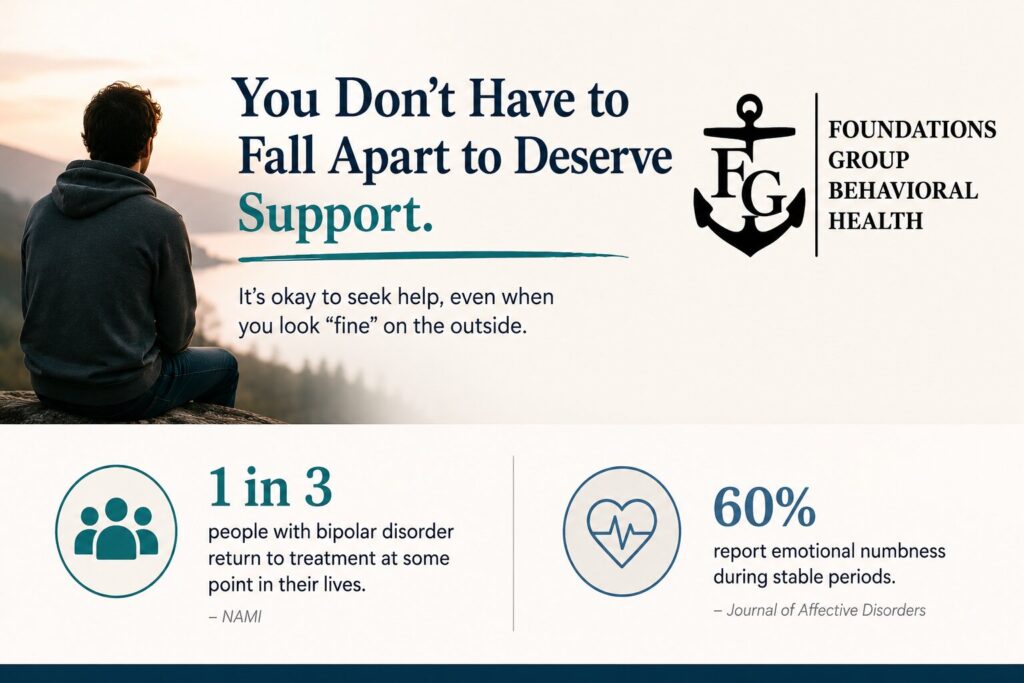
There’s a Difference Between Peace and Emotional Shutdown
This distinction matters.
At first, emotional shutdown can feel deceptively calm. You stop reacting as strongly. You disconnect from stressful emotions. You become quieter internally.
But eventually, that numbness spreads.
Good things stop reaching you too.
Music doesn’t feel the same. Conversations feel distant. Even moments that should feel meaningful land flat.
You move through life like you’re watching it through thick glass.
That’s not peace.
That’s disconnection.
And many long-term alumni become so accustomed to functioning while emotionally detached that they stop recognizing how heavy it actually feels.
Returning to Support Felt More Like Relief Than Failure
I expected shame when I reached back out.
What surprised me was the relief.
Relief that I didn’t need to keep performing okayness for everyone else.
Relief that someone understood the difference between “functioning” and actually feeling emotionally present.
Relief that I could finally admit:
“I don’t think I’m doing as well as I’ve been pretending.”
That sentence changed something for me.
Because once I stopped fighting so hard to maintain the image of stability, I finally had space to look honestly at what I needed.
Sometimes returning to structured daytime care or multi-day weekly treatment isn’t about crisis management.
Sometimes it’s about reconnecting with yourself before emotional exhaustion deepens further.
You Are Allowed to Need More Support in Different Seasons of Life
I wish more people talked openly about this.
Mental health recovery is not a straight upward line where you eventually become permanently unaffected forever.
Life changes. Stress changes. Relationships change. Your nervous system changes.
There may be periods where symptoms feel manageable and periods where you quietly start struggling again.
That does not erase your progress.
It doesn’t invalidate the work you already did.
And it definitely doesn’t mean treatment “didn’t work.”
Sometimes it simply means you’re human.
People often return to support with more insight than they had the first time. More self-awareness. More honesty about what avoidance looks like for them.
That matters deeply.
The Hardest Part Was Admitting I Didn’t Want to Keep Surviving Like This
Not dramatically.
Not in a crisis way.
I just didn’t want every day to keep feeling emotionally gray.
I didn’t want to continue moving through my life disconnected from myself while calling it “stability.”
That realization was painful. But it was also honest.
And honesty was the thing that finally moved me toward support instead of further into isolation.
A lot of long-term alumni know exactly what I mean when I say this:
You can become so focused on avoiding collapse that you forget you’re also supposed to feel alive sometimes.
You Don’t Need to Completely Fall Apart Before Reaching Back Out
This may be the most important thing here.
You do not need to wait until symptoms become unbearable.
You do not need to lose your job, damage relationships, or experience a major episode before asking for help again.
You are allowed to seek support because:
- You feel emotionally disconnected
- Life feels heavier than it should
- You’re exhausted from masking
- You miss feeling present
- You’re struggling quietly
- You don’t want things to get worse
Those reasons are enough.
More than enough.
FAQ About Returning to Bipolar Disorder Treatment
Is it normal to need support again after years of stability?
Yes. Many people living with bipolar disorder experience periods where symptoms shift or emotional exhaustion builds over time. Returning to support does not mean previous progress was lost.
Can bipolar disorder feel “quiet” instead of dramatic?
Absolutely. Some people experience emotional numbness, fatigue, isolation, irritability, or disconnection rather than obvious crisis symptoms.
Why do I feel disconnected even though my life looks stable?
High-functioning mental health struggles can create a gap between outward stability and internal emotional wellbeing. It’s possible to function externally while still feeling emotionally exhausted or detached.
Does going back to treatment mean I failed?
No. Returning to support often reflects self-awareness, not failure. Many people seek additional help during different seasons of life or stress.
What if I’m still working and managing responsibilities?
Many people with bipolar disorder continue functioning outwardly while struggling internally. Productivity does not cancel out emotional pain.
Is emotional numbness part of bipolar disorder?
For some people, yes. Emotional flatness, disconnection, or feeling detached from life can occur during periods of depression, burnout, or emotional exhaustion.
Why do people avoid reaching back out for help?
Shame, pride, fear of “starting over,” and believing they should already know how to cope can all keep people isolated longer than necessary.
What if I don’t know whether I need treatment again?
You do not need to have complete certainty before asking questions or exploring support options. Sometimes the first step is simply admitting that something no longer feels sustainable.
You are allowed to miss feeling like yourself.
You are allowed to need support again.
And you are absolutely allowed to stop calling emotional survival “fine” just because nobody else can see how hard it’s become.
Call 888-685-9730 or visit our behavioral health treatment programs Massachusetts to learn more about our behavioral health treatment programs Massachusetts, bipolar disorder treatment program Massachusetts services in Falmouth, MA.