

It often doesn’t start the way you expect.
There isn’t always a clear moment where things “become serious.” Instead, it builds quietly. Your child seems overwhelmed, maybe withdrawn. Then you notice substance use. Then you notice what happens when they try to stop—and suddenly, everything feels more intense, not less.
If you’re feeling confused, scared, or unsure what you’re looking at, you’re not alone.
Many families in Barnstable County, Massachusetts find themselves in this exact place—trying to understand how two struggles can become so tightly connected.
Early on, it can help to explore options like co-occurring disorder treatment programs that are built specifically for situations where emotional health and substance use overlap.
Why Things Don’t Always Improve When They Stop Using
One of the most unsettling experiences for parents is watching their child try to stop drinking or using—and then seem worse.
You might expect relief. Instead, you see deeper sadness. Irritability. Anxiety. Sometimes even a sense of emotional collapse.
This isn’t a failure of effort.
It’s often because substances were doing something important in the background.
They were numbing pain.
Slowing racing thoughts.
Softening emotions that felt too intense to hold.
When those substances are removed, everything they were holding back can surface all at once.
That’s where the alcohol and depression link becomes important—not as a label, but as a pattern. One that explains why stopping doesn’t immediately bring peace.
When It’s Not Just One Problem Anymore
From the outside, it’s natural to want to separate things.
“Is this depression?”
“Is this substance use?”
“Which one came first?”
But for many young adults, these experiences are intertwined.
They may drink to cope with emotional pain.
Then feel worse because of the drinking.
Then try to stop—and feel overwhelmed by what’s underneath.
Then return to using, just to get a break from that intensity.
It becomes a loop.
Not because they don’t want to get better—but because they’re trying to manage something that feels unmanageable.
Why Addressing Only One Side Often Falls Short
It can seem logical to focus on one issue at a time.
But when emotional health and substance use are connected, treating only one side can leave the other untouched.
If the emotional pain isn’t addressed, the urge to cope remains.
If substance use continues, it can keep destabilizing mood, sleep, and clarity.
This is why integrated care matters—not as a concept, but as a practical way to meet someone where they actually are.
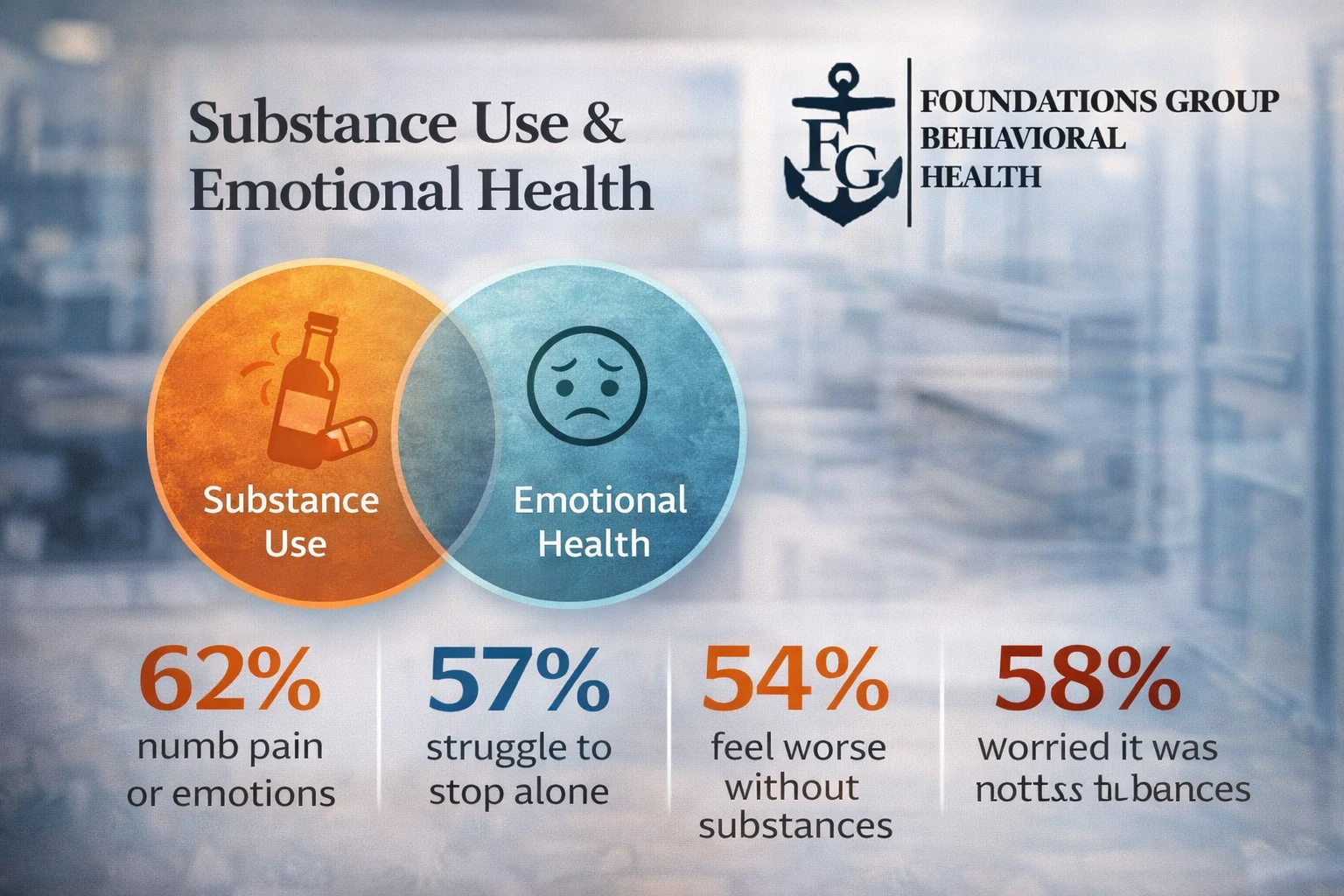
What Support Can Look Like Without Overwhelming Them
Many parents worry that treatment will feel too intense, too clinical, or too much too soon.
In reality, care is often designed to be gradual and supportive.
For some young adults, that means structured daytime care a few days a week. A place where they can begin rebuilding routine without being removed from their entire life.
For others, it may involve more consistent support for a period of time—especially if daily functioning has become difficult.
Support often includes:
- Individual therapy to process emotions safely
- Group sessions that reduce isolation
- Guidance around coping strategies that actually work
- Medication support when symptoms interfere with stability
In Falmouth, Massachusetts, families often describe this stage not as a dramatic turning point, but as a steadying one.
A place where things begin to feel a little less chaotic.
What Early Signs of Progress Really Look Like
Progress doesn’t always look the way people expect.
It’s rarely immediate. Rarely dramatic.
Instead, it shows up in small, meaningful shifts:
- Sleeping a little more regularly
- Eating more consistently
- Participating in conversations, even briefly
- Expressing emotion instead of shutting down
These moments can be easy to overlook.
But they matter.
Because they signal that something inside is beginning to stabilize.
A Story That May Feel Familiar
We’ve worked with families who came in feeling exactly where you might be now.
One parent described their child as “there, but not really there.” Withdrawn. Exhausted. Using substances to cope—but feeling worse each time they tried to stop.
At first, nothing changed dramatically.
But over a few weeks, they noticed small things.
Their child started waking up earlier. Sitting in shared spaces longer. Engaging in short conversations again.
No big breakthrough.
Just a slow return.
That’s often how healing begins—not with a moment, but with momentum.
What You Can Do When Everything Feels Unclear
This stage can feel overwhelming because there’s no obvious roadmap.
You may feel pulled in different directions—wanting to help, but unsure how.
A few things that can help:
- Focus on connection, not control
- Avoid trying to solve everything at once
- Stay curious about what your child is experiencing
- Give yourself permission to seek support too
You don’t have to carry this alone.
And you don’t have to get everything right.
You Don’t Have to Wait for a Crisis
One of the most common patterns we see is families waiting.
Waiting for certainty. Waiting for things to become more serious. Waiting for a moment that makes the decision obvious.
But help doesn’t require a breaking point.
It can begin right here—in the confusion, in the concern, in the quiet realization that something isn’t right.
Reaching out earlier often makes the path forward clearer, not harder.
FAQs: What Parents Often Ask in This Situation
Why does my child seem more depressed when they stop drinking?
Because substances often mask or suppress underlying emotions. When they stop, those emotions can return more intensely, at least temporarily.
Is this something they can grow out of?
In some cases, symptoms may shift over time—but when emotional distress and substance use are both present, structured support can make a significant difference.
How do I talk to them without pushing them away?
Focus on listening more than fixing. Keep your tone calm and open. Sometimes simply saying, “I’m here if you want to talk,” is enough to keep the door open.
What if they don’t think they need help?
That’s common. Many young adults feel uncertain or resistant at first. Keeping the conversation gentle and ongoing can help build openness over time.
How long does recovery usually take?
There’s no fixed timeline. Progress happens at different speeds for different people. What matters most is consistent support and a safe environment to stabilize.
Am I missing something important?
Probably not. If you’re paying attention, asking questions, and looking for support, you’re already doing more than you realize.
A Final Thought to Hold Onto
This situation can feel chaotic. Emotional. Hard to make sense of.
But underneath all of it, there is something steady:
These patterns are understood.
Support exists.
And change is possible—even if it starts small.
You don’t have to solve everything today.
You just have to take the next step.
If you’re trying to understand what your child is going through and what support might look like, you don’t have to do it alone. Call 888-685-9730 or visit our behavioral health treatment programs in Cape Cod, MA to learn more.