

You did everything right.
You showed up when it was hard. You learned the skills. You practiced them. You built something that, at one point, actually worked.
So why does it feel like those same tools don’t land the way they used to?
If you’ve quietly found yourself revisiting options like depression treatment services, not because you’ve forgotten what to do—but because something isn’t clicking anymore—you’re not off track.
You’re hitting a different layer.
You’re Not Back at the Beginning—You’re in a Different Phase
This part matters more than most people realize.
It can feel like you’ve slipped backwards. Like all that work somehow didn’t stick.
But what’s actually happening is more nuanced.
Early on, the goal is survival. Stabilization. Learning how to interrupt patterns that felt automatic.
Later?
It becomes about integration.
And integration is harder.
Because now you’re not just reacting—you’re facing the deeper stuff that didn’t fully surface the first time.
The Tools Didn’t Fail—Your Capacity Shifted
There’s a quiet truth here that doesn’t get said enough:
The effectiveness of a tool depends on your capacity to use it.
And depression—especially the kind that lingers or returns—directly impacts that capacity.
You might:
- Know exactly what would help
- Recognize your patterns in real time
- Understand what you “should” do next
And still feel completely unable to do it.
That’s not a lack of discipline.
That’s depletion.
The Space Between Insight and Action Can Feel Brutal
This is where a lot of long-term alumni get stuck.
You have insight. You have awareness. You even have language for what’s happening.
But there’s a gap.
A frustrating, exhausting gap between:
- “I know this would help”
and - “I can’t get myself to do it”
That gap creates a specific kind of frustration.
Because now it’s not confusion—it’s disconnection.
And disconnection can feel heavier than not knowing at all.
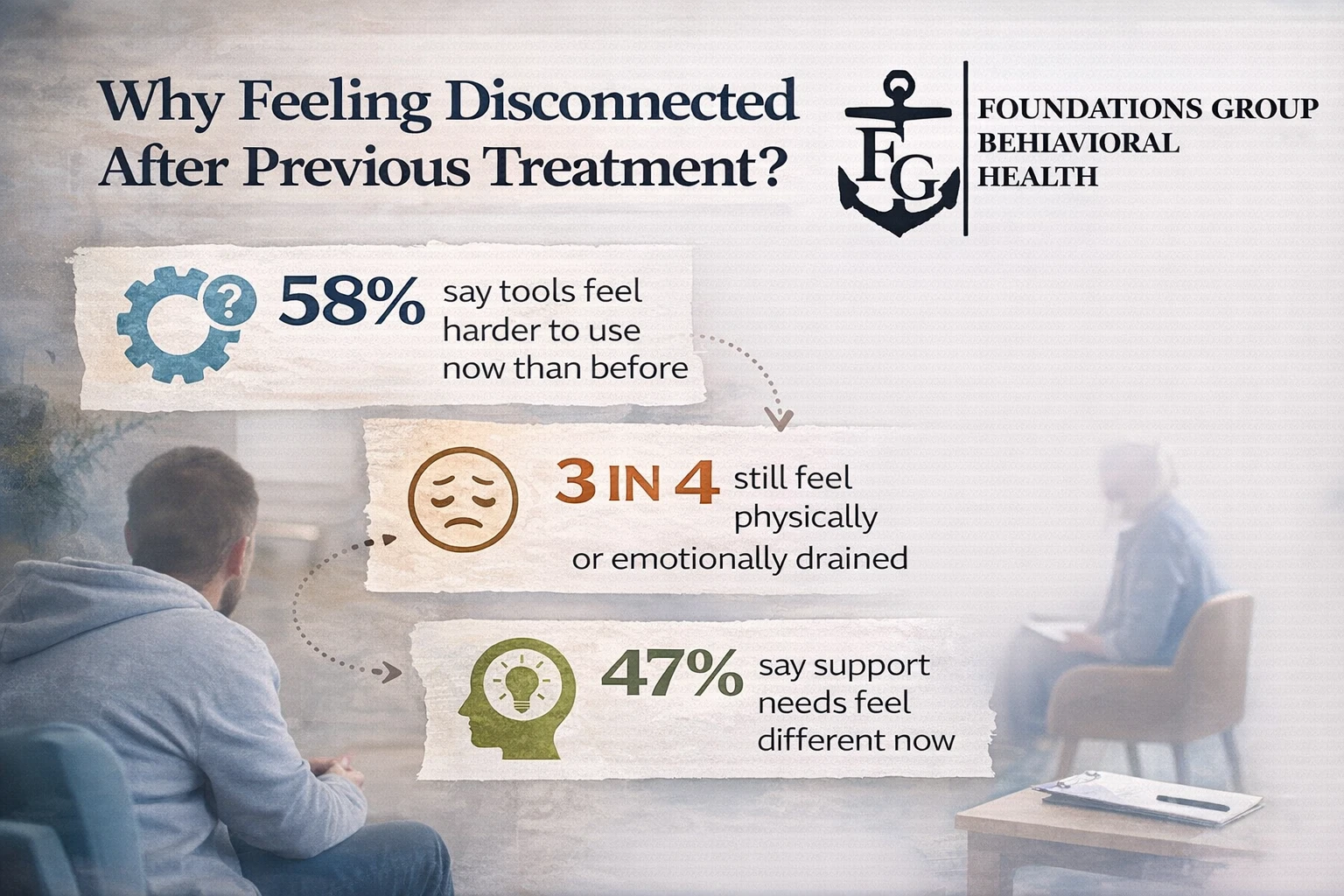
Why It Feels Harder Now Than It Did Before
This part can feel unfair.
You’ve already done the work. You’ve already built the foundation.
So why does it feel harder now?
Because you’re no longer dealing with surface-level patterns.
You’re dealing with:
- Subtle avoidance
- Emotional fatigue that doesn’t announce itself
- Long-standing beliefs that didn’t fully shift
It’s like you cleared the obvious obstacles—only to realize there’s deeper terrain underneath.
That’s not regression.
That’s depth.
The Quiet Pressure to “Be Fine By Now”
No one may be saying it out loud.
But you might feel it anyway.
That internal pressure:
- “I should be past this.”
- “I know better than this.”
- “Why can’t I just use what I learned?”
That pressure doesn’t motivate.
It isolates.
Because now, instead of reaching out, you’re measuring yourself against a version of you that felt stronger.
And that comparison can keep you stuck longer than the symptoms themselves.
When Support Needs to Look Different Than Before
Here’s the shift that often changes things:
You don’t need the same kind of help you had before.
You need help that matches where you are now.
For many people, that means returning to structured support—not as a restart, but as a recalibration.
In Falmouth, Massachusetts, we often see long-term alumni come back into multi-day weekly care not because they’ve lost progress, but because they’ve outgrown the level of support they were relying on.
They need something more consistent. More grounded. More responsive to what’s actually happening now.
Revisiting the Therapy and Medication Conversation
At this stage, a lot of people circle back to a question they thought they had already answered:
Is what I’m doing still working?
That includes the ongoing conversation around therapy vs medication depression.
Not in a theoretical way—but in a practical one.
Because what worked before might need adjusting now.
Sometimes:
- Therapy needs to shift from coping to deeper processing
- Medication may need to be revisited, adjusted, or reconsidered
- Or both need to be aligned more intentionally
This isn’t about choosing sides.
It’s about staying responsive to your current reality.
A Story That Mirrors What You Might Be Feeling
We’ve seen this pattern many times.
Someone who completed treatment. Stayed steady for a while. Built a life that looked, from the outside, stable.
But internally?
Something felt off.
Not dramatic. Not urgent. Just… disconnected.
One person described it like this:
“I wasn’t falling apart. I just wasn’t connected to anything I was doing.”
They came back—not because things were “bad enough,” but because they didn’t want to keep living in that middle space.
And slowly, things shifted.
Not overnight.
But enough to feel real again.
Why Coming Back Isn’t What You Think It Is
There’s a misconception that returning to support means starting over.
It doesn’t.
It means continuing—with more awareness.
You bring:
- Everything you learned before
- A clearer understanding of your patterns
- A deeper willingness to engage honestly
That changes the entire experience.
You’re not relearning.
You’re refining.
What “Stuck” Actually Means in This Stage
Feeling stuck doesn’t mean you’ve hit a wall.
It often means:
- Your current tools aren’t matching your current needs
- Your energy is lower than your expectations
- Your support system isn’t as active as it needs to be
It’s not about effort.
It’s about alignment.
A Truth That Might Land Differently Right Now
You don’t need more willpower.
You need the right conditions.
Because even the best tools don’t work in isolation.
They work when there’s:
- Structure
- Support
- Space to process what’s underneath the surface
Without that, even the most effective strategies can feel out of reach.
You’re Allowed to Re-Engage Without Explaining Yourself
You don’t need a crisis to come back.
You don’t need to justify it.
You don’t need to prove that things are “bad enough.”
If something in you is saying, “This isn’t working anymore,” that’s enough.
In places like Barnstable County, Massachusetts, we see people make this decision quietly all the time.
Not out of failure.
Out of awareness.
FAQs: For Long-Term Alumni Feeling Disconnected
Why do the tools feel harder to use now than before?
Because depression can impact your energy, motivation, and emotional access. The tools are still there—but your ability to engage with them may need additional support.
Does this mean treatment didn’t work?
No. It means your needs have evolved. Treatment often gives you a foundation, but ongoing support may be needed as new layers surface.
Should I go back even if things aren’t “that bad”?
Yes. Waiting for things to get worse often makes the process harder. Early re-engagement can help you stabilize faster.
What if I feel embarrassed about needing help again?
That’s common—but it’s also a signal that you care about your progress. Returning to support is a continuation, not a failure.
Will it be different the second time?
It usually is. You’re coming in with more awareness, which often leads to deeper and more effective work.
How do I know what kind of support I need now?
You don’t have to figure that out alone. Talking to a professional can help you understand what level of care fits your current situation.
If you’re ready to reconnect with what actually works—and have the support to use it—call 888-685-9730 to learn more about our Depression treatment services in Cape Cod, MA.