

You’ve already done a lot.
Therapy.
Reading.
Conversations that weren’t easy to have.
Maybe you spent months—or years—learning how to manage your anxiety and depression. You developed language for things you once couldn’t even name.
And for a while, it worked.
But lately something feels different.
You’re not in crisis. You’re functioning. From the outside, life probably looks stable.
But internally?
You feel flat. Disconnected. A little tired of carrying your mind around.
And then the question shows up:
What if I need support again… but I don’t want antidepressants?
That question comes up more often than people think—especially for those revisiting care options like an anxiety treatment program.
Because when you’ve already done a lot of personal work, the next step can feel complicated.
The Quiet Middle Space No One Talks About
There’s a strange phase in long-term mental health recovery that rarely gets discussed.
It’s the space between struggling and thriving.
You’re not spiraling anymore.
You’re not constantly overwhelmed.
But you’re also not feeling deeply connected to your life.
This middle space can look like:
- Going through routines without much emotional engagement
- Feeling mentally tired even when life seems manageable
- Losing excitement about things that used to matter to you
- Feeling like your inner world is dimmer than it used to be
It’s subtle.
But over time, that subtle disconnection can start to feel heavy.
Why It’s Harder to Ask for Help the Second Time
The first time someone seeks support, the reason is often obvious.
They’re overwhelmed. Burned out. Struggling in ways they can’t ignore anymore.
The second time can feel different.
This time the struggle is quieter.
You might think:
I should be able to handle this.
Or:
Didn’t I already deal with this before?
When people have done years of self-reflection, they sometimes expect themselves to have permanent solutions.
But mental health doesn’t work that way.
Life changes. Stress evolves. Responsibilities grow.
And sometimes the support that helped you years ago simply needs updating.
The Antidepressant Question That Sits in the Background
For many people returning to care, there’s one concern that makes the decision harder.
Medication.
Maybe you tried antidepressants before and didn’t love how they made you feel.
Maybe you watched someone else struggle with side effects.
Maybe you simply value feeling emotionally clear and don’t want to risk dulling that.
So the question becomes:
Can I get help without automatically going back to medication?
The honest answer is that good mental health care should leave space for that conversation.
You’re allowed to have preferences about your own mind.
You’re allowed to ask questions.
And you’re allowed to explore support options that align with what feels right for you.
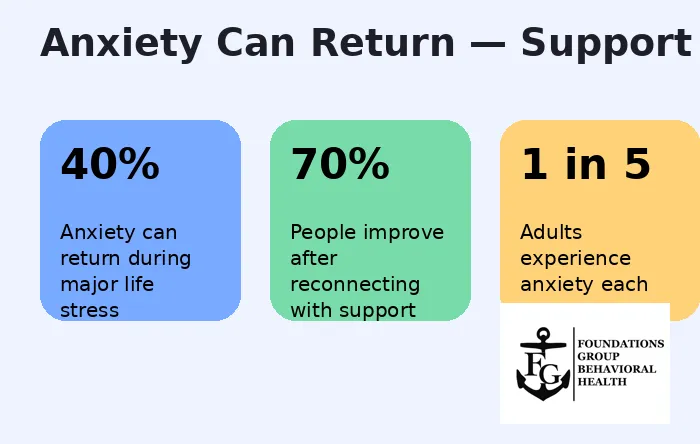
When Thinking About Your Mental Health Isn’t Enough
One thing many long-term alumni discover is that insight alone doesn’t always move things forward.
You might understand your triggers.
You might know the coping tools.
But when you’ve been feeling stuck for months—or even years—thinking harder about it often just creates more mental loops.
What often helps instead is changing the environment around your mind.
That’s where structured daytime care can be helpful.
Not because you’ve failed.
But because sometimes the brain needs a new context to shift patterns that have quietly settled in.
The Surprising Relief of Being in a Space Where Mental Health Is Normal
When people re-enter structured support after managing things on their own for years, one reaction comes up again and again.
Relief.
Not because everything is suddenly easy.
But because they no longer have to pretend they’re fine all the time.
They can talk about the mental exhaustion that shows up in quiet moments.
They can admit that their thoughts sometimes spiral late at night.
They can stop performing stability for everyone around them.
Being around others who understand mental health struggles creates a rare kind of honesty.
And honesty often becomes the starting point for real change.
Why Returning to Support Isn’t the Same as Starting Over
A lot of people hesitate to return to care because they think it means they’re back at square one.
But that’s rarely true.
You’re not the same person you were the first time you sought help.
Now you have:
- More awareness of how your mind works
- More language for describing your experiences
- More clarity about what does and doesn’t help
That makes the process different.
You’re not learning everything from scratch.
You’re refining the tools you already have.
Think of it less like restarting and more like adjusting the course after a long stretch of travel.
What People Often Rediscover When They Come Back
When someone reconnects with support after years of managing things on their own, something interesting happens.
They remember parts of themselves they had quietly lost.
Curiosity returns.
Energy begins to shift.
Conversations feel more meaningful again.
Not instantly.
But gradually.
Sometimes the biggest shift isn’t a dramatic breakthrough.
It’s simply realizing:
I don’t have to carry all of this alone.
The Truth About Growth That No One Mentions
Growth is rarely a straight line.
It’s not a one-time victory where everything stays solved forever.
It’s more like learning how to navigate your mind across different seasons of life.
Sometimes you’re strong and steady.
Sometimes you need support again.
Neither version cancels the other.
In fact, many of the most self-aware people are the ones willing to revisit help when they notice themselves drifting.
Not because they’re failing.
But because they’re paying attention.
FAQ: Questions Long-Term Alumni Often Ask
Is it normal to need support again after years of progress?
Yes. Mental health shifts over time, especially as life circumstances change. Revisiting support is common and often reflects self-awareness rather than regression.
What if I don’t want antidepressants?
That’s a valid preference to discuss with a care team. Many people explore therapy, structured care, and lifestyle adjustments before considering medication again.
Why do I feel disconnected even though life is stable?
Anxiety and depression can create emotional numbness or chronic mental fatigue even when external life appears stable. Addressing these patterns often requires more than surface-level coping strategies.
Does returning to care mean I failed?
No. Returning to support is often a sign that you’re listening to yourself. Many people revisit therapy or structured care multiple times throughout their lives.
How do I know when it’s time to reach out again?
If you’ve been feeling persistently flat, mentally drained, or disconnected—and your usual coping tools aren’t helping—it may be a good time to explore additional support.
What if I’m worried about starting the whole process again?
You won’t be starting from zero. Everything you’ve learned about yourself still applies. In many ways, returning to support becomes easier because you already understand your mind better.
If You’re Feeling Stuck, That’s Not the End of Your Story
A lot of people assume that once they’ve done the work, they’re supposed to stay fixed forever.
But mental health isn’t a destination.
It’s a relationship with your own mind that evolves over time.
Sometimes that relationship needs attention again.
And that’s okay.
If you’re feeling stuck or disconnected, support is still available—and it can meet you where you are now, not where you used to be. Personalized mental health care in Barnstable County, Falmouth, MA.
Call 888-685-9730 or visit our page on anxiety support and care to learn more about our Anxiety treatment program services.